
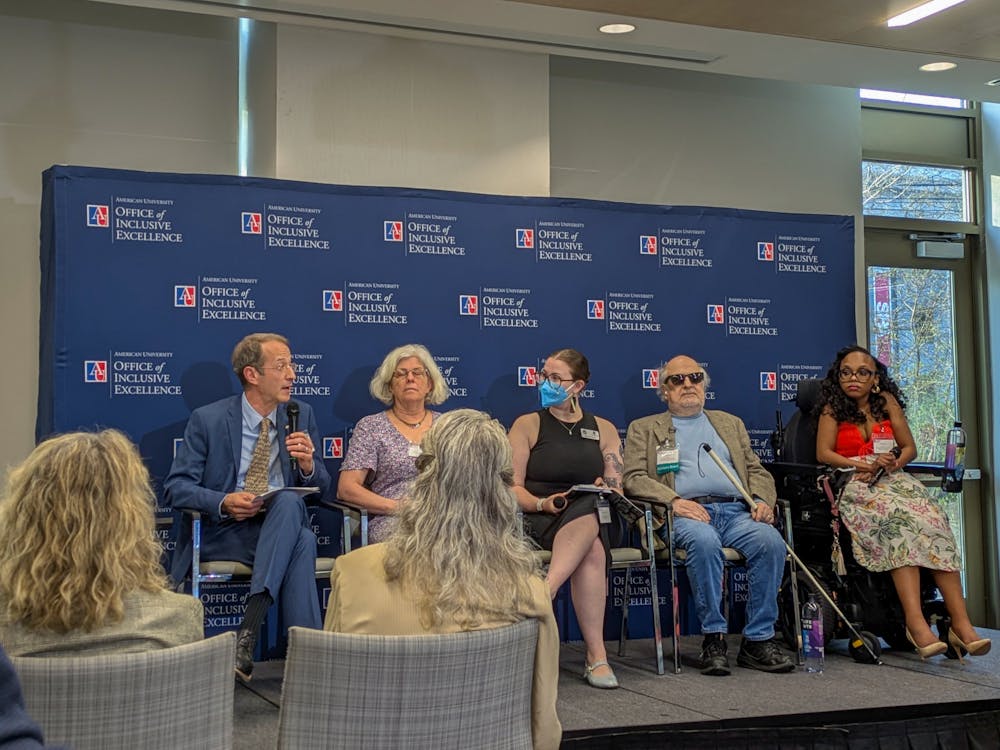
In partnership with the FDR Memorial Legacy Committee, American University hosted a Disability Representation in America panel on March 31 to honor the 25th anniversary of the Franklin Delano Roosevelt Wheelchair Statue.
The wheelchair statue in the Tidal Basin was added in 2001 after a group of disabled activists, including panelist Jim Dickson, called on Congress to honor FDR’s legacy within the disability community. The disability community raised $1.65 million for the statue’s construction and installation.
The movement took six years, but one of its first meetings happened on American University’s campus in 1996. Mary E. Dolan, the co-founder and executive director of the FDR committee, said it is important for people to visit this memorial to recognize the impact the disability community’s advocacy continues to have.
“I am definitely right now looking to make sure that the story about the fight for the wheelchair statue moves on to another generation,” Dolan said.
The panel of five speakers included: Max Friedman, a University history professor; Mary Ellen Curtin, a University American Studies professor; Katherine Greenstein, a University alumna; Jim Dickson, a leader of the movement and Nila Morton, a disability activist. The event also featured a screening of the documentary “FDR Great Abilities” about the advocacy for the statue.
Kate Radt, president of the Disabled Student Union, said she was excited to have the panel be a part of the 250th anniversary series.
“That [is] sort of elevating disabilit[ies] as a generative topic and as something with historical and political significance, which it is, but it's not always recognized as such,” she said.
Panelists Dickson and Morton said the statue and the voices leading the disability community continue to be important.


Dickson said when he found out he would lose his sight, his mother told him that President Roosevelt used a wheelchair and that Dickson could be anything he wanted so long as he worked for it.
Panelists also touched on the intersectionality of the disability movement.
“Whenever we talk about disabilities and disability rights and things like that, oftentimes Black disabled people are not in mind,” Morton said.
Morton believes that changing this discourse is possible if people learn to sit in their discomfort.
Speakers also addressed a recent comment made by President Donald Trump about California Gov. Gavin Newsom’s dyslexia, calling him dumb and that presidents shouldn’t have learning disabilities.
“If the President [is] saying these things, it’s not a joke, it sends a message, it sends a green light, and it makes it seemingly acceptable,” Curtin said. “So I think this also calls on all of us to step up to denounce these kinds of statements.”
Dickson added that this standard should apply to everyone and that, in conversation, people shouldn’t critique the President’s physical traits.
“You can oppose his policies, but [that] is ableist, and I think it’s very important that we have that word,” Dickson said.
To see that change in dialogue surrounding disabilities, Greenstein said she believes students will be the leading forces.
“When you want progress, students are the people you need to talk to,” Greenstein said.
The FDR Memorial Legacy Committee is hosting two additional commencement events for the FDR wheelchair statue on May 12 and 13.
This article was edited by Natalie Hausmann, Payton Anderson and Walker Whalen. Copy editing done by Avery Grossman, Mattie Lupo and Ava Stuzin. Fact-checking done by Andrew Kummeth.
