
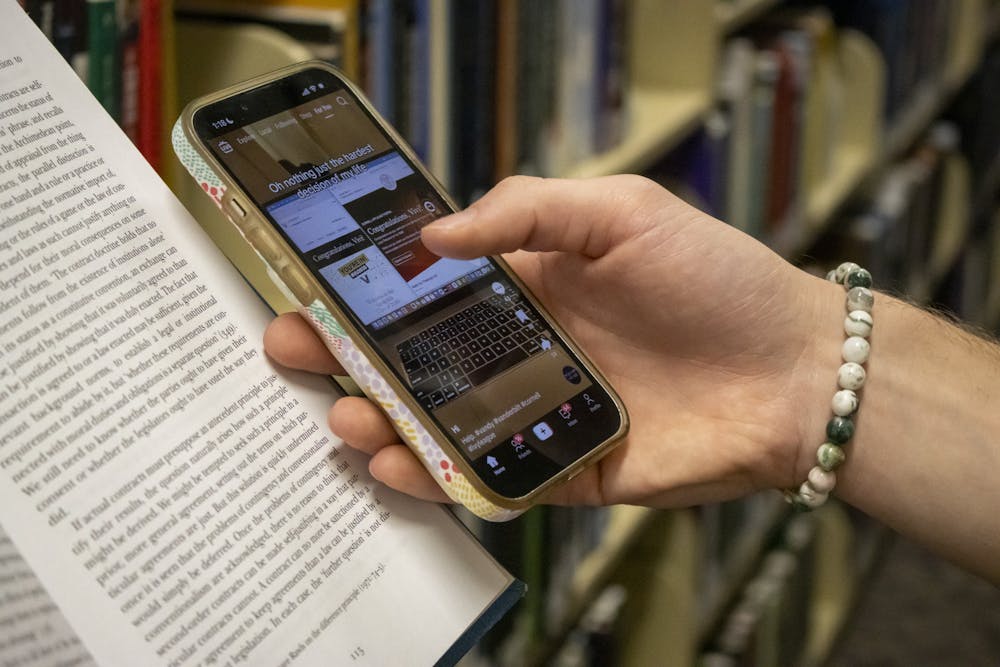
It’s no secret that reading is a crucial component of a student’s academic career, whether it be reading the news, reading for fun or most commonly, reading assignments.
While academic reading remains integral to the college experience, according to a USC report, the way students approach it has changed in a shifting digital world, be it cutting corners or finding online tools to assist the heavy workload.
Teddy Skye Garcia, a sophomore in the College of Arts and Sciences, said he receives around six-to-eight hours of reading every week.

With a heavy workload, Garcia said it is important that he figures out what each professor expects the reading to contribute to the learning experience.
According to Garcia, he utilizes the syllabus as a tool when deciding how to read most effectively. He often is able to find which sections will be discussed in class and read over them.
When it comes to deciding which reading takes precedence, Garcia said he gravitates toward assignments that spark his interests or shift away from traditional academic journals.
Freshman School of Public Affairs student, Amirah Owonikoko, explained her unique process.


Owonikoko explained that she has trouble skimming reading assignments and oftentimes has to take notes to comprehend the material, which she said is extremely time consuming.
According to Owonikoko, sometimes, with a heavy workload she has to make cuts. To do this, she analyzes the teaching style of her professors.
“There’s classes where I know specifically that the reading doesn’t matter,” she said. “So if it’s optional to me, I’m going to sacrifice it.”
Gracia also said he grows frustrated when his classmates don’t complete the required reading or, at the very least, some of it.
“A lot of literature classes are very discussion-based, so it’s really hard when people haven’t even started,” Gracia said.
Amaarah DeCuir, a professor in the School of Education, said it is important for her and her colleagues to adapt to students’ needs. DeCuir teaches first-year students through the University’s Complex Problems Seminar and education courses. Her course design differs based on the students in each class.
For her Complex Problems course, she said she aims to appeal to a diverse range of students across the University, as the program is required for every major. Her goal for the assignments is to connect with and interest students from a variety of educational backgrounds.
In her education courses, she has the chance to connect to learning outside her class.
“I will do my part of giving them material to facilitate their learning,” DeCuir said. “But in turn, they have to also meet me halfway and do the reading, which is a key driver in student learning and student achievement.”
DeCuir said it is important to create a space where students feel comfortable being honest with her. She understands her class is one of a busy course load and is open to feedback.
DeCuir says she is open to working with students who aren’t able to get the work done due to physical or mental health challenges. “None of those statements should ever be followed by ‘then don’t come to class,’ or ‘you failed as a student this week,’” she said.
In doing so, she said she prioritizes meeting students where they are.
“It’s responding with a sense of compassion that someone wasn’t able to do one part, but we’re going to use the class session to continue with the learning, and then they’ll be able to pick up the reading later,” DeCuir said.
Additionally, Artificial Intelligence creates a unique challenge in higher education. According to the College Board, 74 percent of higher education faculty report their students using AI to write papers or complete assignments. Additionally, 72 percent of faculty members face challenges managing AI usage in the classroom with little confidence in guiding students on how to use said programs.
In his classes, Garcia said he was shocked to find how many of his peers rely on AI programs. He explained that in creative fields AI takes away from the process whether it be analyzing literature or studying art.
“It sucks to feel like I hate reading because I don’t. I have a major that tells me I don’t,” Garcia said. “But it’s like you get stuck in a rut in academia where you’re just doing something for a product and I feel like AI is so indicative of that, where it’s not about the process. It’s all just about the product.”
DeCuir said it is crucial to understand the changing landscape of education and use new tools as a way to help students.
“As faculty members, we need to be open to teaching how we want the reading to be done. In some cases, reading through AI summaries is absolutely reasonable,” DeCuir said. “In other cases, it’s not.”
In an academic landscape that is changing, faculty and students adapt. DeCuir highlighted the COVID-19 pandemic as an example. She said that she had to readjust and reconfigure her course plan to adapt to the change and to make space for students’ struggles.
“I refuse to suggest that it is a personal failure on their part,” DeCuir said. “I believe that we have created an environment that is not sustainable to get all of this work done and to be in a state of wellness and to have a full and healthy social life and a life of community engagement.”
This article was edited by Olive Redd, Payton Anderson and Walker Whalen. Copy editing done by Avery Grossman, Paige Caron, Mattie Lupo and Ava Stuzin.
features@theeagleonline.com.
