
The following piece is an opinion and does not reflect the views of The Eagle and its staff. All opinions are edited for grammar, style and argument structure and fact-checked, but the opinions are the writer’s own.
The Declaration of Independence celebrates its 250th birthday this July 4. Festivities began as early as June of last year with the United States Army 250th Anniversary Parade, which President Donald J. Trump presided over. Slightly under 10 years ago, President Barack Obama presided over the United States Semiquincentennial Commission. At the time, we were anticipating a President Hillary Clinton.
Presidents past, present and perhaps permanent are not the only ones excited for the occasion. Our American University joined a legion of elite institutions in rolling out 250th anniversary programming, including extensive speaker events and luncheons. Notably, however, our banners read 250+.
But what are we celebrating? Beyond a great year for banner salesmen, what does America’s 250th birthday mean?
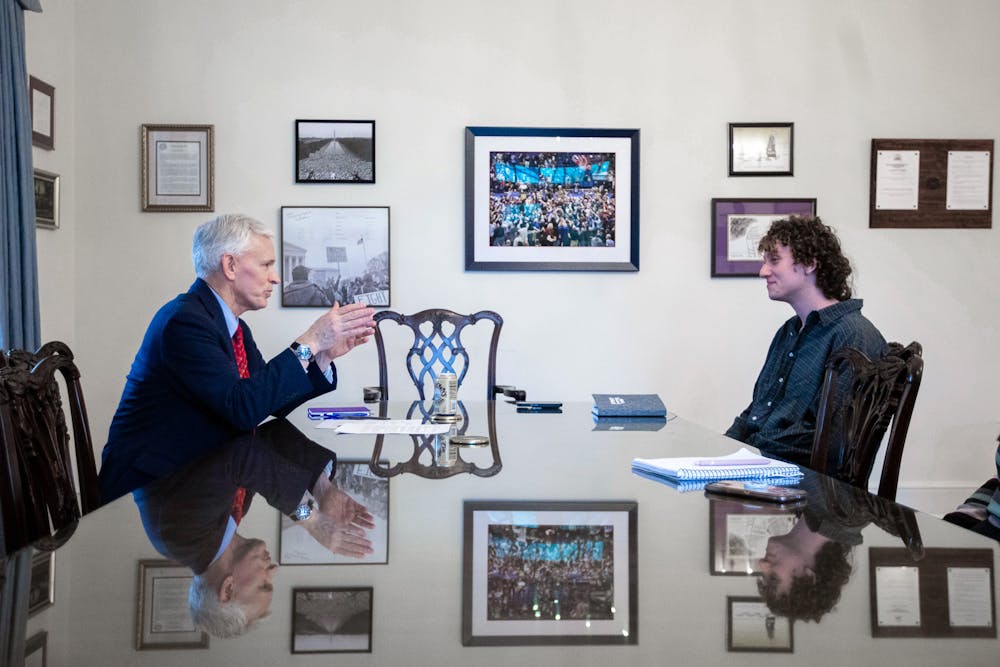
These thoughts and others weighed on me as I sat down with yet another President excited about America at 250: American University President Jonathan Alger.
Alger opened with America’s history in his rearview.
“As you know, it’s 250 plus at American, right?” he said. “And the plus is really important because we want to talk about what comes next.”
His framing compellingly emphasized that our vision for our nation is in our interest. But I wanted to press him on the past. I mentioned the 14th Amendment, and how it is an excellent example of progress, but also evidence that foundational ideals may not apply to an evolving nation.


“The founders were imperfect” and “creatures of their time,” he said. “So, what do we do with that? … I think what [250+] tells us is, no, we need to be looking at ourselves.”
Our country and its issues, stemming from inception up till now, are up to us to fix, Alger said. He highlighted the importance of students in the effort to imagine a better future.
I then asked him about our founders’ desire for respect in governance and if our responsibility to one another as citizens increases when leaders sow division. President Alger noted the lack of respectful discourse today. In his perspective, the University’s unique environment can address this issue, letting us model a better way of debate, disagreement and compromise. Developing this better way on campus, through programming like 250+, would conceivably build on this vision.
I then asked more directly about expression on campus, probing at American University’s role — as President Alger put it — in improving the tensions in our greater political community. My question specifically asked about institutional faith to the First Amendment.
“We’re grounded in an educational mission … that’s got to be our North Star,” he said.
Moreover, he added that Americans have been really good at talking about rights, but less so about collective responsibilities. Alger argued that community requires balancing your rights with other members of the community, and that the ultimate goal on campus is to foster the best learning environment.
My last question got at the heart of the issue: whether there is any value in our nation’s 250th beyond gesturing toward unity.
President Alger distinguished respect from reverence.
“I’ve always said we should respect … the founding and the people who did this great work, but not treat them as gods,” he said.
The 250th gives us at American and beyond an opportunity to reset, ask what we are and what we have taken for granted, Alger said. Considering these questions enables us to chart a better way forward — with an ear for learning — as we build on civic engagement skills.
“I’m really determined for American University to be [a more inclusive] exemplar of the ideals on which our country was founded,” Alger said.
Readers and community members should come to their own conclusions about President Alger’s responses. But I appreciated much of his perspective. I left our conversation feeling more personally capable of the project for “a more perfect union,” distinguishing it from abstractly upholding dead men’s designs.
This said, I find myself overall more pessimistic than I would like to be.
In the face of our moment, our founders would tell us to affirm popular sovereignty and the inalienable rights of men. American University’s 250+ initiative tells us to evolve these ideals to the present and work toward a better future. I agree, but we should accept neither of these answers passively.
By intent or lack of regard, our United States Supreme Court found corporations equivalent to individuals for First Amendment purposes in 2010, thereby protecting corporate dollar signs as speech and enabling the existence of today’s Super PACs that confer massive political influence to the ultrawealthy.
As a result, those who govern have become insulated from everyday interests, causing just 17 percent of Americans as of September 2025 to believe in Washington’s ability to do the right thing almost always/most of the time, per Pew Research.
Our founding does carry a meaning that is applicable now. But in our practical evolving of founding ideals to the present, we have demonstrably watered them down.
The founders’ vision for liberty against the backdrop of an insular monarch remains resonant. As the semiquincentennial approaches, we would do well to accompany reflection with a vigorous evaluation of what America still means to us.
The founders gave us an argument about liberty and self-government through the Declaration, not a self-fulfilling, everlasting premise for a nation. We can only sustain that argument — and therefore our nation — if we earnestly insist on renewing it.
American University students have a unique opportunity this July. Whether you desire a role in politics, law or any occupation that affords systemic might, it is imperative you consider what makes up the system you work under.
Consider whether you still believe in the ideals that made our nation and revolution possible. Consider also what acting on these ideals means in the present.
Harry Walton is a sophomore in the School of Public Affairs and the assistant opinion editor for The Eagle.
This article was edited by Addie DiPaolo and Walker Whalen. Copy editing done by Avery Grossman, Arin Burrell, Paige Caron and Nicole Kariuki. Fact-checking done by Andrew Kummeth.
opinion@theeagleonline.com
