
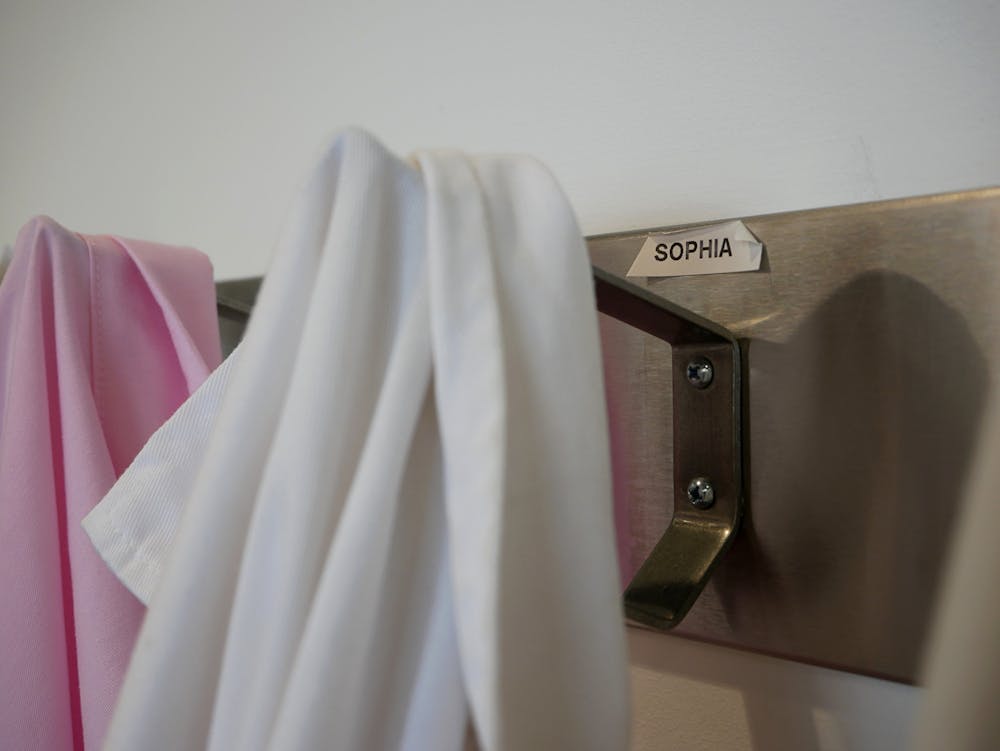
After almost 18 months of work, Sophia Gagliardi uncovered a potential biological link between long COVID symptoms and gender, a discovery that could lead to a treatment for the disease.
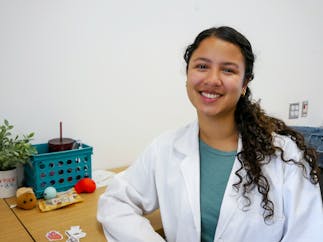
Gagliardi, a student in the joint BA, MS program in the College of Arts and Sciences, works out of Professor Taisuke Izumi’s virology lab, where she uncovered a biological and molecular explanation for long COVID symptoms. Long COVID, according to the World Health Organization, produces symptoms like fatigue, brain fog and muscle pain, and can affect people up to 12 months after initial infection.
In March 2025, Gagliardi produced a method for safe infection experimentation, enabling the Izumi Lab to study the relationship between angiotensins and long COVID.
“Angiotensins are hormones found in everybody, but are influenced by your other hormones and sex,” Gagliardi said.
In February, Gagliardi said she discovered males have more angiotensins in their lungs and females have more in their brains. Gagliardi said these patterns line up with how long COVID symptoms impact the two genders, with men being hospitalized more often due to respiratory problems, while women are more commonly hospitalized due to neurological symptoms.
“Once we saw that, it was able to make it really clear that angiotensins are definitely a contributing factor to long COVID,” Gagliardi said.
Izumi is a biology professor and virologist who focuses mainly on HIV research at American University. He said Gagliardi began working in his lab in the summer of 2024 as soon as he had room for additional student researchers. Izumi initially gave Gagliardi an independent project related to COVID research.
The two used a methodology from another researcher to base their experiments on, but Izumi said this did not mean everything was smooth sailing.


Izumi said Gagliardi’s friends noticed she was struggling to see the results despite following the explicit methodology. He said learning this showed him how committed Gagliardi was to the research and her perseverance inspired Izumi to stay motivated through the hard project.
“My view is quite different from the actual status of the student, because I am not always in the laboratory,” Izumi said. “So this one was a very good experience for me. I have to see the hidden message from the student.”
Gagliardi said she chose AU for its research opportunities and the ability for students to publish papers. As an EMT during the COVID pandemic, Gagliardi said she’s seen what the disease looks like firsthand, prompting her interest in the scientific explanations behind the disease.
“It definitely really drove me to continue with this project, especially when we hit road bumps,” Gagliardi said.
Izumi received a degree from the University of Kyoto in Japan before moving to the United States and completing his postdoctoral at the National Cancer Institute at Frederick, in Frederick, Ma. Izumi said he chose to come to American University because of its interdisciplinary focus and his own desire to bring science to wider audiences.
“I believe AU is one of the best places to translate our laboratory observations to the community,” Izumi said.
Following Gagliardi’s graduation, she plans to continue research but is unsure if she will be able to continue directly with her project. However, she is hopeful that other labs with more resources will build on her findings and contribute to treatments for long COVID.
“It’d be really cool for another place to be like, ‘Hey, we like your studies we’re gonna try a mouse model,’ and then somebody saying ‘We like the mouse model, we’re gonna try a human model,’” Gagliardi said. “Seeing it all come together and be an actually completed study would be really, really cool.”
When she toured AU, Gagliardi said her tour guide mentioned a student who published papers. Once wanting to be that student, Gagliardi said she is grateful Izumi and the University have allowed her to become one.
“I love my research. I love that I get to do this,” Gagliardi said. “It’s definitely been challenging at times, but I think the fact that I am so passionate about it is what allows me to keep doing it.”
This article was edited by Olive Redd, Payton Anderson and Walker Whalen. Copy editing done by Avery Grossman, Mattie Lupo and Ava Stuzin. Fact-checking done by Andrew Kummeth.
features@theeagleonline.com.
