
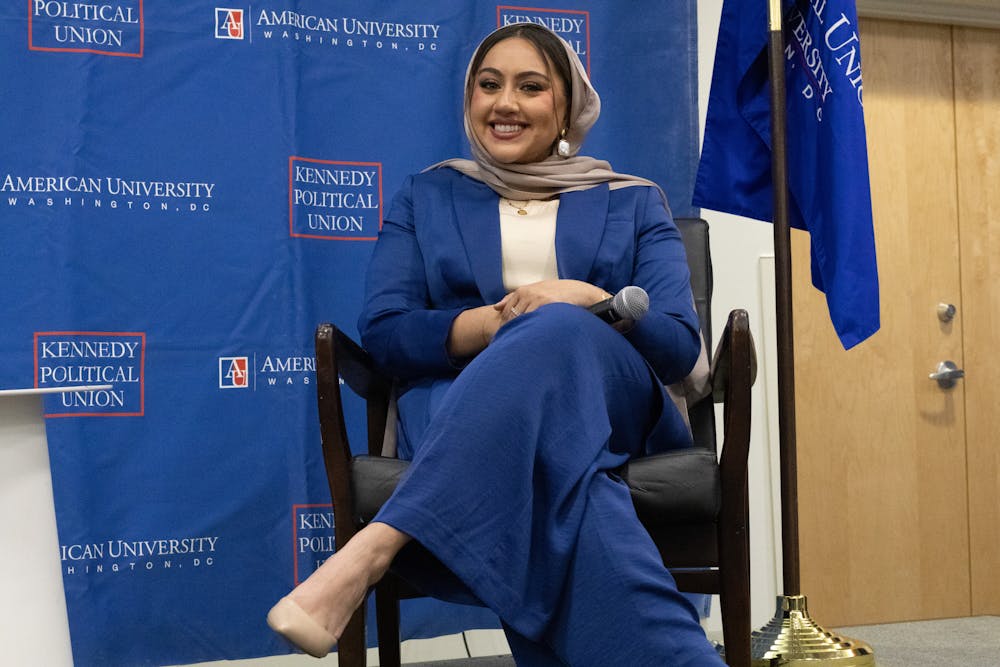
The first Gen Z elected official, Bushra Amiwala, spoke at American University on March 19 about her journey as a young politician. Amiwala just completed her recent campaign for Congress in Illinois’ ninth district, learning she lost just two days before coming to speak at the University.
The event took place during Women’s History Month and was hosted by the Kennedy Political Union, the School of Education’s Undergraduate Council and Black Girls Vote , highlighting how Amiwala’s identity and values have shaped her political career.
As a college student, Amiwala turned down nights with friends to work five jobs to support her family. Years later, she left her stable job at Google and a school board position to run a congressional campaign. Driven by a passion to make an impact, Amiwala said she wants to guide her generation to do the same.
Despite losing the race for Congress, Amiwala had over 6,200 voters, according to a statement on her Instagram.
“While I did not come out victorious, I am really proud of the lessons I learned and happy to share those with you all today,” Amiwala said.
She is no stranger to the political scene. At the age of 19, Amiwala announced her candidacy for the Cook County Board of Commissioners, with the goal to amplify underrepresented voices.
“She’s an awesome speaker,” Grace Gilligan, a senior in the School of Public Affairs and director of operations and finance for KPU, said. “She’s done so many cool things, and I think that people would really resonate with that.”
As a part of Gen Z herself, Gilligan said it’s inspiring to hear from young speakers who are so accomplished.


Amiwala was still in high school during President Donald Trump’s first term, and said that she had many peers who supported him. This confused Amiwala, as she could not understand how her classmates, or anyone, could be so moved by a candidate spreading hate about a key part of her identity to her face.
“I know people have a lot of misconceptions for Muslim people and immigrants and people that just look like me,” Amiwala said.
While in high school, Amiwala said she took up a position working for a Republican senate candidate Mark Kirk in Skokie, IL.
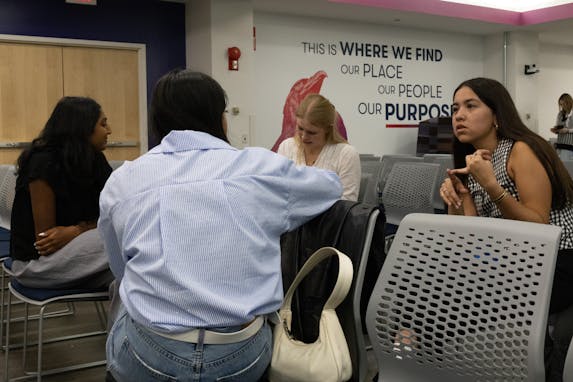
Amiwala said she went door-to-door asking registered Republicans questions like, “On a scale of 1-10, how fearful are you of an Islamic terror attack on US soil?”
“People would look at me, and they would say ‘10: very fearful,’ and me standing on their front porch wasn’t helping,” Amiwala said.
In addition to her early interest in politics, Amiwala said she strived to make a difference in her community in any way she could.
“I was an avid volunteer,” Amiwala said. “I volunteered at five different nonprofits the five days of the week, from poverty, hunger, homelessness, food insecurity, education, inequality.”
Even after Kirk lost his campaign, the office’s field director told her she received the most survey results, increasing the registered voter turnout. That field director then encouraged 18-year-old Amiwala to run for public office.
Amiwala launched her first campaign in March of 2017 against candidate Larry Suffredin, who had held the seat for 16 years. She ran on a platform for a progressive taxation model. At the beginning of her campaign, she was offered $56,500 from the corporate Political Action Committee.
“Which I declined,” Amiwala said. “Not because it was trendy to do so back then, but it was just the right thing to do.”
After losing her first election, Amiwala said she told a reporter that she would not run again. But that all changed the next day after she received a phone call from her victorious opponent.
He explained that her campaign led to a historic voter turnout of around 5,400 new voters and thousands of new registered voters.
“You have to run again, but this time, I’ll support you. Just don’t run against me,” Amiwala recalled Suffredin telling her.
Amiwala ran again in 2019 to be on the Skokie school board — and she won, becoming the first person in Gen Z to become an elected official in the United States.
However, being the first came with a lot of pressure.
“Anything feels special, feels cool, but when you are the first, and then the only, you do not have a playbook you can follow,” Amiwala said.
During Amiwala’s first campaign, she said a reporter asked out of all her various identities: Muslim, Pakistani, young and a female politician, which was working against her the most.
Amiwala answered being a woman.
“Sexism is the intersection of my identity as a woman that made every other -ism and phobia worse, or amplified,” Amiwala said. “It’s not just that you are a young person, you are a young woman. It’s not just that you are a person of color; you are a woman of color. It’s not just that you’re Muslim, you’re a Muslim woman, and visibly one at that.”
Now, Amiwala said she avoids questions regarding how her identity shapes her, because there is no hiding who she is, but her identity is not the sole factor that guides her as a politician.
“You can call it humility, you can call it shame. You could call it the lack of ability to effectively communicate the nuance that my background has without being misconstrued or misunderstood or misrepresented, has almost led me to just not talk about it,” Amiwala said.
The daughter of immigrants and the first in her family born in the United States, Amiwala explained that she has been the primary breadwinner of her family since age 18.
“My story, it really doesn’t make sense without my parents’ story first,” Amiwala said.
Interpersonal relationships played a large role in Amiwala’s campaign. She said she responds to every direct message on social media and believes that is what makes being a Gen Z candidate so special.
“It takes nothing to reply to a text,” she said.
During her campaign, Amiwala said she and her team went on a meet-and-greet tour of over 360 living rooms, backyards and garages belonging to voters in the ninth district.
Amiwala said it was these moments that made her campaign stand out.
“One conversation makes a huge difference,” Amiwala said.
This article was edited by Natalie Hausmann, Payton Anderson and Walker Whalen. Copy editing done by Avery Grossman, Mattie Lupo and Ava Stuzin. Fact-checking done by Andrew Kummeth and Luca Palma Poth.
