
I’ve noticed a trend of labeling any movies over two-and-a-half hours as “too long,” which puts a filmmaker like Lav Diaz in an awkward position. A pioneer of slow cinema, Diaz’s films typically clock in at somewhere between four and eight hours long — although his most notorious, “Evolution of a Filipino Family” (2004), runs for 10 hours and 25 minutes. His work has never broken into the mainstream and probably never will. And although that’s not entirely due to their length, it certainly hasn’t helped.
Cut down for the Cannes Film Festival and a wider international release, “Magellan” is a little under three hours long — though there is a rumored nine-hour cut, told from the perspective of Beatriz Barbosa de Magallanes (Ângela Azevedo), Magellan’s widow. As Diaz told Screen International, he chose to shorten it to reach a larger audience — and, crucially, to make it all the way to the AFI Silver Theatre and Cultural Center, so I could review it.
“Magellan” begins in 1511 with the Portuguese conquest of Malacca, traverses the globe back to Portugal, features a brief stint in Spain (where Magellan’s proposal to circumnavigate the Earth is finally accepted) and finally returns to Southeast Asia to the island of Cebu in 1521 — the place and time of Magellan’s death.
By far the biggest name in this film is Gael García Bernal in the titular role of Ferdinand Magellan. Any glee or exuberance viewers might know Bernal for in “Y Tu Mama Tambien” (2001) is long gone, as a greying Bernal delivers an understated but powerful performance.
Most of the film is spent at sea, where Magellan’s expedition crumbles at the hands of mutiny and harsh conditions. Timestamps that read “1519, Atlantic Ocean” and “1520, Pacific Ocean” hammer home the true scale of this journey, while “Magellan’s” lack of music — instead scored by the creaking of wooden ships — isolates the crew and removes any sense of extravagance.
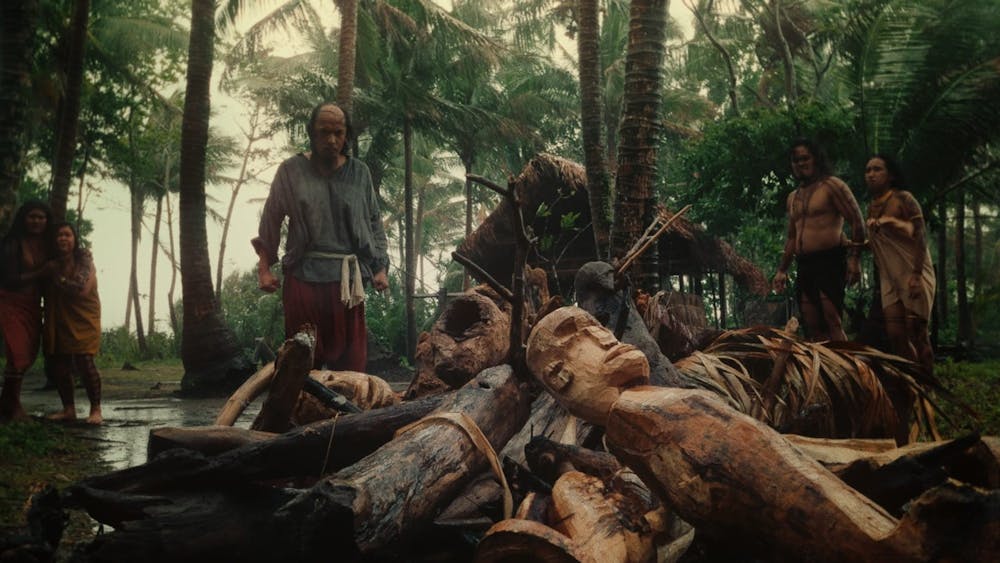
Unlike most historical epics and biopics, “Magellan” never glorifies its protagonist. Any sense of the “epic” or grandiose is inspired by the historical recreation and the photography that captures it, rather than Magellan’s voyage or conquests. The film spends its runtime demystifying the figure and his famed expedition across the globe.
Magellan is not a hero or adventurer, nor even a true captain or leader. Instead, he is a greedy pawn of the even greedier institutions of Christianity and Portugal. In place of any perverse attraction to a false hero, “Magellan” instead displays great empathy for the victims of Magellan’s expedition: the colonized and the enslaved.
A slave Magellan purchases in Malacca, whom he names Enrique (portrayed by Amado Arjay Babon), becomes a part of the expedition and outlives the adventurer himself. Enrique’s personal journey in the film is perhaps the only storyline an audience can truly enjoy.



That is not to say “Magellan” is not a worthwhile watch. This story of power-hungry colonists should not be enjoyable. It’s this refreshing maturity that makes it such a compelling watch; paired with Diaz’s dedication to historical recreation and image-making, that results in a mesmerizing masterpiece.
Detailed sets, props and costumes are captured vividly; shots are harmonized with perfect patience and rhythm. And (believe it or not) all of this splendor was shot on a Panasonic LUMIX GH7, a camera available at your local Best Buy.
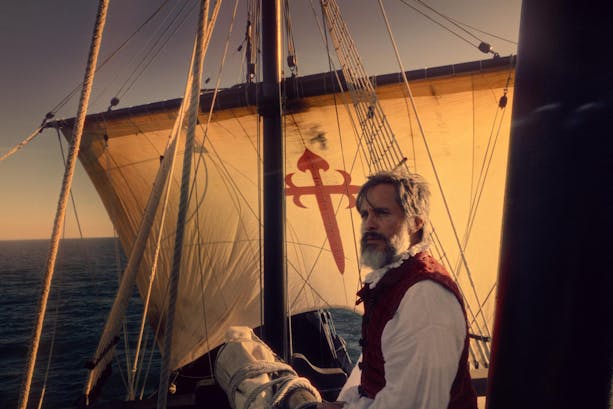
“Magellan” is undoubtedly a special film. It is a breath of fresh air with its minimalist approach, budget and narrative-wise, yet remains confoundingly grand for its visuals and scale. Movies like this don’t come around often, let alone to theaters near you.
Don’t let the length scare you off. You might find yourself itching for that nine-hour cut — I know I am.
“Magellan” is in select theaters now.
This article was edited by Mina O’Dell, Jessica Ackerman and Walker Whalen. Copy editing done by Avery Grossman, Arin Burrell and Nicole Kariuki.
