
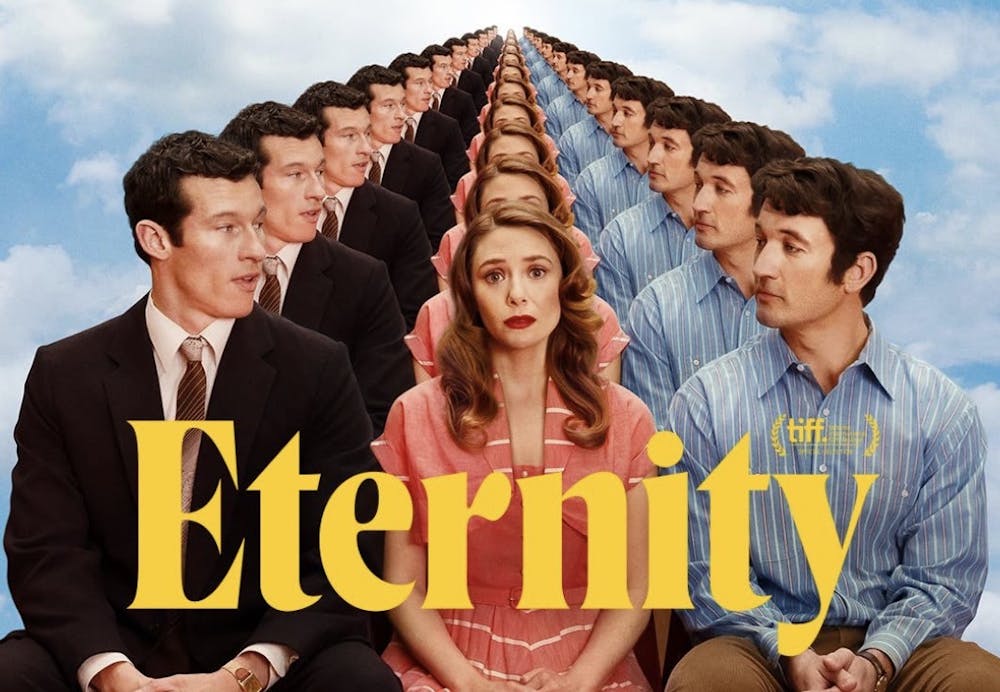
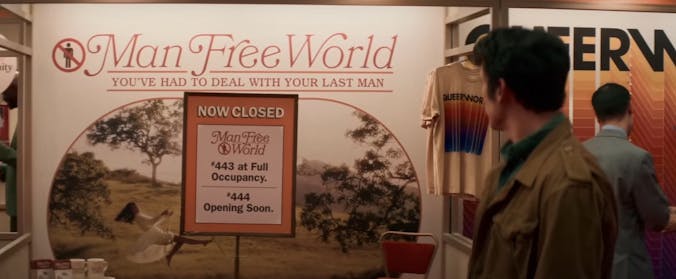
Imagine an afterlife where you can shop in an infinite mall, relax on an endless beach, or stroll through an unlimited museum. In David Freyne’s depiction of the afterlife, all of these can be true. In “Eternity” (2025), when everyone dies they are shuffled through a train station-airport fusion place known as “The Junction,” in which they choose one of these worlds to spend the rest of their afterlives. It’s like choosing a vacation!
But there is a catch: once you choose your afterlife, you can’t change your mind, and you are to spend the rest of eternity there.
This brings us to the difficult choice for Joan, played by Elizabeth Olsen, who, upon her death, is reunited with both of her late husbands. Her first husband, Luke, played by Callum Turner, tragically died in the Korean War, and waited 67 years for Joan to arrive in the afterlife so that they could live out eternity together. Her second husband, Larry, played by Miles Teller, who died shortly before Joan, built a family and life with her over the course of 65 years of marriage, and he planned to continue that marriage at Beach World. Both husbands are absolutely opposed to sharing Joan, and she has a week to decide her eternity. So what will she do?
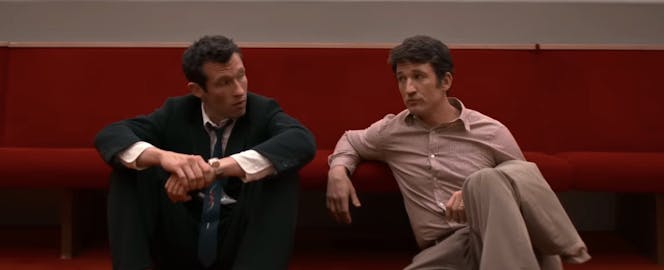
With a runtime just shy of two hours, “Eternity” is packed with colorful visuals, lively performances and a well-paced balance of both heartache and comedy.
Though performances from the main three — Olsen, Turner, and Teller — are undeniably strong, the supporting roles are also worth mentioning. Da’Vine Joy Randolph and John Early as afterlife coordinators and Olga Merediz as Joan’s lifelong friend, Karen, shine in bringing relatable perspectives to this unfortunate situation.

The importance of “Eternity’s” visuals cannot be emphasized enough. In an era when darker, muted color palettes seem to be the trend, the movie’s vibrant color and vintage aesthetics make the surrealist afterlife feel almost familiar. The settings, seemingly inspired by a softer version of 1950s modernism, give the afterlife a nostalgic, comforting feeling that is uncommon in other depictions. Freyne’s afterlife isn’t daunting, pessimistic or necessarily religious. Yes, it’s strange, but still refreshing.



“Eternity” also revels in the recent love-triangle revival. Joining other popular movies such as “Materialists” (2025), “Challengers” (2024), and “Past Lives” (2023), the love interests in this movie are charming and provide Joan great options with the trademark impossible choice.
Though Joan is the clear main character of the film, her role doesn’t feel as dynamic as Luke’s or Larry’s until the second half of the movie. It feels like her entire purpose in the film is to be a prize won over by the competing husbands. This isn’t uncommon for the love-triangle trope, but the sense of agency she seemingly gains in the second half of the movie helps to make her feel significantly less static of a character in a way that may have helped her in earlier scenes.
This small critique aside, “Eternity” is a great choice for movie night for those who either can’t get enough of these 2020 love triangles, love a philosophical exploration of love and death or want a visually pleasing watch with many laughs and occasional cries to share.
“Eternity” is now available for streaming on Apple TV and Amazon Prime.
This article was edited by Alfie Pritchard, Jessica Ackerman and Walker Whalen. Copy editing done by Avery Grossman, Arin Burrell and Nicole Kariuki.
