
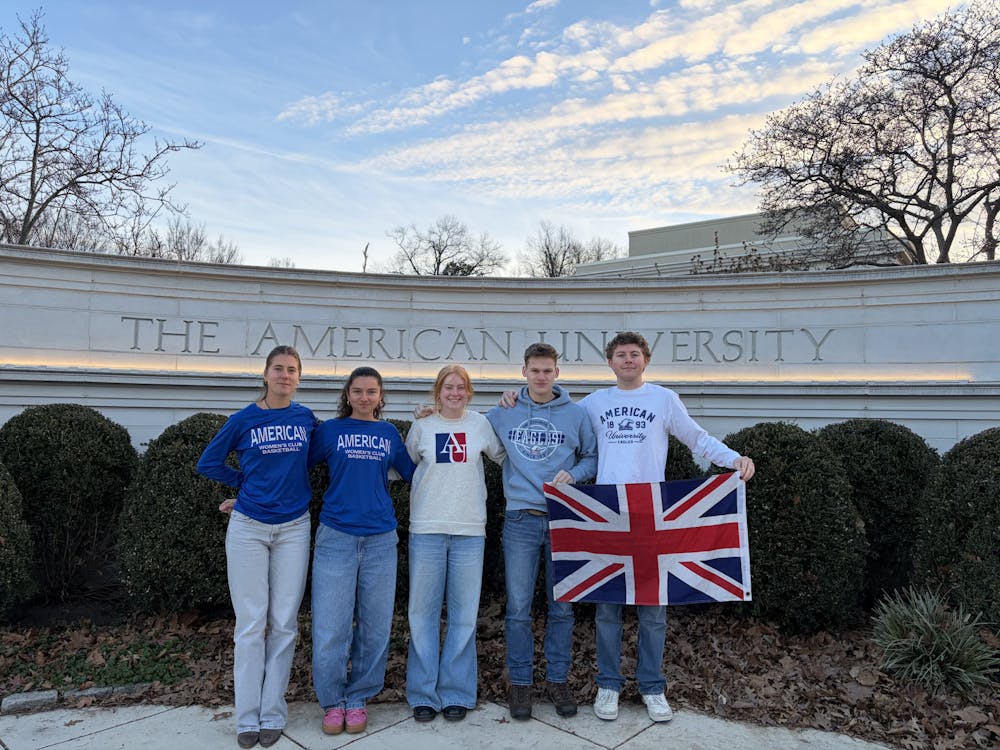
Moving to another country, starting a new life surrounded by strangers speaking a foreign language, navigating a different school system and trying to excel in class — all while making friends and socializing — are just a few of the challenges faced by exchange students undertaking the difficult task of switching continents to pursue their education.
But joining a club sports team proved to be an ideal way to make the move more manageable for exchange students at AU.
For Tallulah Salmon, a junior in the School of Public Affairs from New Zealand — who joined the club field hockey team this semester — participating in club sport has been a perfect opportunity to meet new people and feel more like herself a long way from home.
“It’s definitely been an adjustment,” she said, “but everyone has been really lovely and supportive.”
Salmon highlighted that it was much easier to forge deeper social connections in a team sport environment than in a classroom or around campus.
“To play sports with someone you have to really trust them and get to know them,” she said. “On the team, we see each other every week and go to social events together. We had a Halloween party, a few pasta parties and the girls made a real effort to get the team together.”
She added that the experience has taught her the importance of playing sports to support both physical and mental wellbeing and to maintain a balance between academic and social pursuits.
“It’s helped me organize my time a lot better and given me something to focus on outside of class, so that’s been really great,” she said.


Charlie Bedford, a sophomore in the College of Arts and Sciences, also competed for the club field hockey team and spoke of the comfort of familiarity in helping him settle at AU.
“I’ve played hockey for 10 years, and so to join the team here was a nice reminder of home,” Bedford said. “Sport is an environment I feel comfortable in, and so it helped me to be a lot more social.”
He also mentioned the challenges of navigating the “completely different dynamic” of being the only male player on the team in a sport popular among both genders in the United Kingdom but played primarily by women in the United States.
“Of course you get a few jokes,” Bedford said. “They like to make fun of my accent a bit, but I’ve got a fairly thick skin for it, and I know it’s all good fun.”
Bedford added that he recently traveled to Virginia to join a team captain’s family for Thanksgiving, noting that participating in club sports had given him access to aspects of American culture he might not have experienced otherwise.
“You learn a lot more about a place through the relationships that you build,” he said. “It’s definitely taught me to get involved in things and have as many experiences as I can,” Bedford said.
Angus Grinstead, a junior in CAS from Scotland, noted that having a shared interest makes forming friendships abroad much easier, and club rugby provided exactly that.
“It’s been a great way to meet Americans. I think if I wasn’t part of the team I would have very few American friends as most of my friends are on exchange,” Grinstead said. “I’m really glad I decided to join.”
He also highlighted the importance of the element of familiarity in facilitating his transition to studying abroad. “I know that rugby is something I enjoy doing and it’s definitely made the move easier. The other day it rained, and the pitch was wet and muddy and it was a nice reminder of home.”
However, he admitted experiencing some “frustration” in the early training sessions as some members of the team had never played rugby before.
“That was a bit of a surprise,” he said, “because rugby is such a popular and competitive sport back home.”
He noted the difficulty of adapting to certain differences in training drills and coaching practices but praised the consistent focus and effort of his teammates. He also said the American style of rugby felt far more aggressive compared to what he’d experienced in the U.K., but emphasized that the team environment was always supportive and encouraging.
“I’m a bit of a novelty to them as the only foreign student, so everyone is very friendly,” Grinstead said. “I think my knowledge of rugby helped the team, and I think there was a strong sense of bonding towards the end of the season.”
Ana Suescun Sabadell, a junior in the School of International Service from Spain, undertook the task of playing a familiar sport in a foreign language as part of the club basketball team.
“It was confusing at times because we have the same plays, but they have different names for it here,” she said.
However, she also highlighted the enjoyment of encountering the popularity of basketball in America and the attitude of her teammates towards the sport.
“There is a passion for basketball. They love basketball. You can really tell,” she said. “They watch the WNBA. They have a lot of knowledge of the sport.”
Suescun also praised the supportive team environment in helping her integrate within the squad as a foreign student.
“I felt like I was really included in the team even if it’s not my first language and everyone made an extra effort to involve me,” she said.
Susecun referred to joining the basketball team as one of her best decisions while being abroad. She noted that it was a fantastic way to stay active and engage more fully in campus life with American students, rather than only spending time with fellow exchange participants.
“The girls introduced me to their friends, and I got to know many more people that way,” she said. “It made things a lot easier and helped me settle in quicker too.”
Lisa Strujan, a junior in the School of Public Affairs from France, also joined the club basketball team. She noted that the open and positive team culture was a welcome surprise as “It’s very unusual to compliment someone’s game like this in France.” She added, “The girls are very nice, the team is very supportive and it’s very cool to have that culture.”
Despite certain difficulties with the language barrier, such as uncertainty over how to refer to her position at team trials and confusion over specific terminology, Strujan noted that these challenges are easier to overcome in sports than in other settings. On the court, players can rely on demonstration and brief, direct communication rather than the longer, more complex interactions typical of professional or academic environments.
Strujan also noted that the friendships she formed soon after arriving were key to allowing her to settle into life at AU.
“Almost all of my American friends are from the basketball team, and I think that has really helped me,” Strujan said. “I would recommend joining club sports to anyone and I am very glad I made that decision for myself.”
This article was edited by Matthias Jaylen Sandoval, Penelope Jennings, Jack Stashower and Walker Whalen. Copy editing done by Avery Grossman and Jaden Maitland Anderson.
sports@theeagleonline.com
