
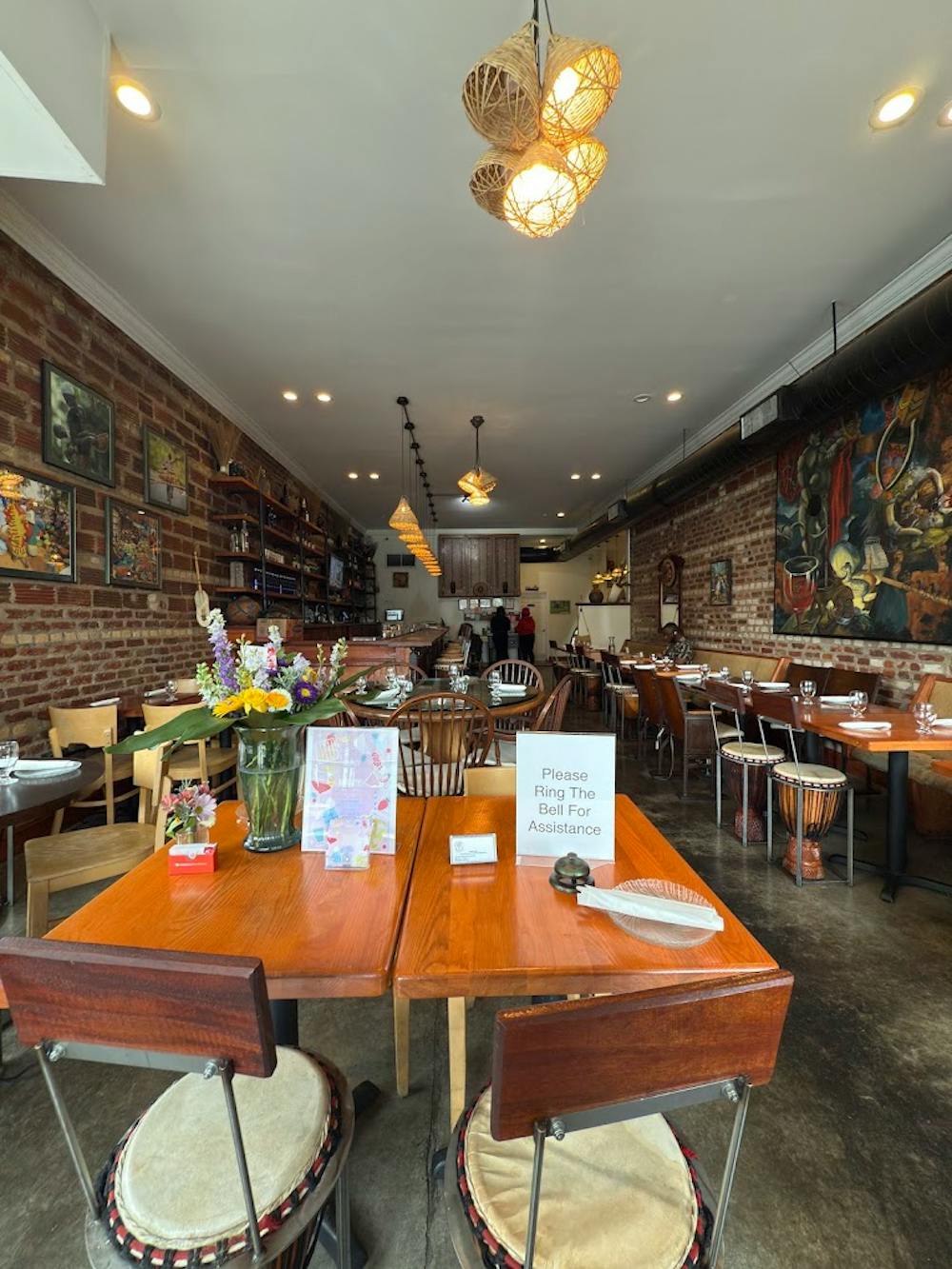
The smell of peanut stew greets patrons before they even step inside. The air is thick with spice and heat — the sharpness of ginger, the deep roast of groundnut, the faint tang of grilled onions. The dining room glows a warm orange, with African artwork lining the walls. Tables are often packed with regulars: families, students and curious first-timers. At Mansa Kunda, they want the aromas — the smoke, the spice, the roasted peanuts — to linger long enough for guests to tell their friends.
Hatib Joof, founder of Mansa Kunda, made it his mission to emphasize warm decor that reflects modern Africa.
“When people come in, I want them to feel like they’re not in America for a little while,” Joof said. “I want them to feel like they’re in Africa, at home.”
Joof, who was born and raised in The Gambia, opened Mansa Kunda seven years ago after noticing that few restaurants in the D.C. area offered a sit-down experience for West African food. Most were takeout spots with limited menus.
“I wanted to introduce people to West African cuisine, West African culture and, most importantly, our civilization,” Joof said.
The menu reads like a map of the Sene-Gambian coast, with each dish carrying the weight of history and migration. Menu items include Yassa, a tangy mix of caramelized onions, lemon and garlic often served with fish or chicken; Peanut Butter Chu, a slow-cooked Mandingo stew born from necessity — when farmers had to use peanuts the government didn’t buy for export; and Benachin (Chep Bu Jain), Gambia’s national dish, a luxurious version of jollof rice where the rice and protein cook together until the flavors fuse into something deeper than spice.
“African food is not yet mainstream,” he said, “but we’re getting there.”
Nearly 90 percent of the menu can be made vegetarian, a choice shaped by his own practice. “Our owner is a vegetarian,” the menu reads, and Joof said he’s proud that dishes like fonio grain, attieke couscous and tofu yassa bridge tradition with accessibility. He said food adapts, but never forgets.


And for Joof, that truth extends beyond the plate. When asked what he misses most about home, he laughs softly.
“There are a whole lot of things,” he said. “But the world is so intertwined now … Ingredients we used in Africa are available here. People understand and appreciate what we use.”
Still, some things can’t be replicated. Cultural expectations, ingredient sourcing and what he calls America’s “stiffness” shape what ends up on the plate.
“As much as we try to make it the same, certain things just are not the way they are,” he said.
The longing for the untranslatable flavor of home ran quietly through his words. Yet, Mansa Kunda doesn’t read as nostalgia. It’s evolution: a living, breathing archive of Gambian cuisine shaped by new soil.
When planning Mansa Kunda, most people advised Joof to open elsewhere.
“The District has more traffic,” he said. “It’s the capital of the country.”
But he chose Takoma Park — a residential pocket known for its diversity and neighborly energy.
“I wanted to open in a community that would be more sympathetic to my shortcomings,” he said, smiling. “When you open a restaurant, you don’t know if it’s going to work. You need humility.”
Here, humility builds loyalty. Joof knows his customers by name. If something goes wrong, he hears it firsthand “... before it hits social media,” he joked. And if something goes right, word spreads faster than any marketing campaign.
“You have to give the customers their job, too,” he said. “Their job is to brag about my restaurant.”
In seven years, they’ve done that job well. Mansa Kunda has been featured in VOA Africa, WETA’s Signature Dish, The Washington Post’s Top Ten Casual Dining Restaurants of 2019 and The Washington City Paper. But Joof values the quiet recognition most — the college students from nearby American University who stop by between classes, the neighbors who bring out-of-town guests to “the kingdom.”
“You must add that I thank American University for recognizing what I do and patronizing my business,” he said.
For Takoma Park, Mansa Kunda isn’t just a restaurant — it’s a gathering place. For its owner, it’s a form of storytelling. Every dish remembers something: the migration of people and spices, the balance of adaptation and authenticity, the power of food to name what words can’t.
In Mandingo, mansa kunda means “kingdom.” But here, in this small Maryland kitchen, it means something softer too – a kingdom built not on crowns, but on care.
This article was edited by Sydney Hemmer, Jessica Ackerman and Walker Whalen. Copy Editing done by Avery Grossman, Arin Burrell, Paige Caron, Andrew Kummeth and Ryan Sieve.
