
Editor’s Note: This article contains spoilers.
“Lost Highway” (1997) was David Lynch’s seventh film and the first in his unofficial “LA Trilogy,” followed by “Mulholland Drive” (2001) and “Inland Empire” (2006). All three take place in Los Angeles and feature incredibly dark, surreal, fragmented storylines and cinematography. Even within Lynch’s notably surreal filmography, these films are arguably his darkest and most surreal. But “Lost Highway" takes first place as my favorite LA Trilogy film.
Lynch’s most widely-loved films follow a linear, somewhat heavy-handed and easy-to-follow narrative with a satisfying ending, whereas “Lost Highway” purposely confuses and terrifies the viewer.
“Lost Highway” challenged how I assess and judge film quality. This confused reaction is common among people watching this film or any other David Lynch project.
Lynch, in interviews, welcomed this disorientation and famously refused to explain any of his films. Instead, he understood his films as subjective works of art for viewers to interpret in their own way.
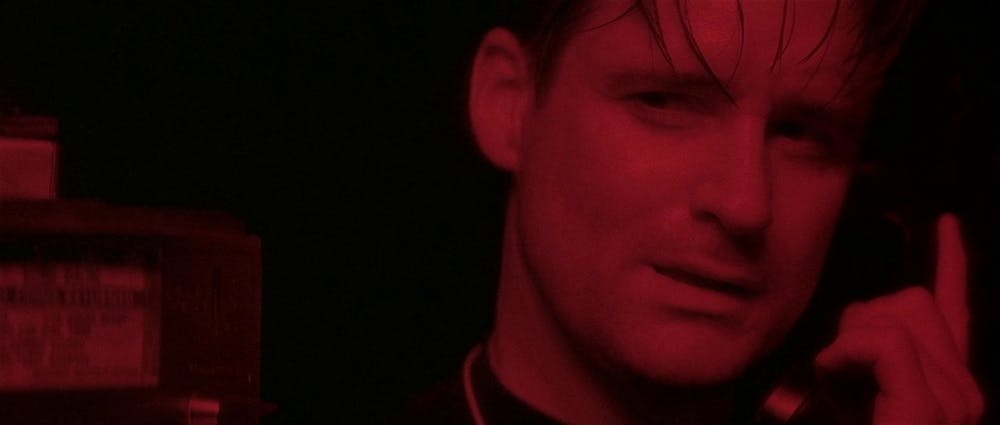
This unique view on the nature of film shines brightly throughout “Lost Highway.” A perfect embodiment of this is the Mystery Man (Robert Blake), one of cinema’s most chilling and cryptic figures. He appears suddenly, defying logic and explanation, as if he’s a manifestation of the main character, Fred Madison (Bill Pullman), whose paranoia and conscience bubble up to the surface after he murders his wife. His existence, both within and outside of reality, demonstrates Lynch’s belief that meaning in film comes not from clear explanations, but from the feelings someone like the Mystery Man conjures.
Take the lead-up to the scene where Fred is convicted of murder and is randomly swapped with another character, Pete (Balthazar Getty). This exchange is as surprising as it is inexplicable. This scene is preceded by various creepy and surreal scenes depicting Fred in the days before his conviction, viscerally paranoid that his wife is cheating on him.
“Lost Highway” brilliantly shifts between points of view and worlds in its first section to convey Fred’s thoughts and inner demons, thrashing the viewer without warning between reality, dream sequences and a murky blend of both. This mix of perspectives puts the viewer in the same state of paranoid terror and confusion as Fred. The distorted reality that the viewer experiences through Fred’s mind creates subjectivity throughout “Lost Highway.”



The disorienting scene in which Fred murders his wife is a perfect example of subjectivity created by the viewpoint of Fred’s mind, because we observe the murder through one of many videotapes that randomly appear in his apartment. These videotapes appear in Fred’s apartment without explanation but they are thought to be a physical representation of Fred’s conscience. Although we see the murder occur on a fuzzy pre-recorded and delivered videotape, Fred’s wife is understood to be alive, waiting outside Fred’s house in the same scene.
When viewers first see “Lost Highway,” they may not believe that Fred actually killed his wife, even though he was quickly convicted of murder in the next scene. However, they might realize later that the videotape could be a figment of Fred’s conscience, alongside everything else we see happening in “Lost Highway,” as Lynch makes it purposely unclear if anything we see happening in the film is actually happening in reality, given that we are watching the film through Fred’s distorted perception. It’s scenes like the one where Fred’s wife appears to be murdered, that display the subjectively-driven brilliance of “Lost Highway” and showcase Lynch’s vision of a movie that represents the absurdity and inexplicability of the external world with flying colors.
Despite its surreal atmosphere and scenes, “Lost Highway” is a film that uniquely captures a figment of the human experience: one where you desire closure and routine but do not get it, and where you desire an explanation for everything happening around you, but get none.
“Lost Highway’s” simultaneously surreal and realistic nature is heightened by its unexplainably weird characters, who abruptly appear like the Mystery Man, who seem jarring and over-the-top at first, until it becomes clear that they represent a buried part of the human conscience personified. It's this depth hidden inside a very surreal and subjective movie that makes “Lost Highway” a must-watch film.
“Lost Highway” is available on Amazon Prime.
This article was edited by Alfie Pritchard and Jessica Ackerman. Copy editing done by Avery Grossman, Arin Burrell, Paige Caron, Andrew Kummeth and Ryan Sieve.
