
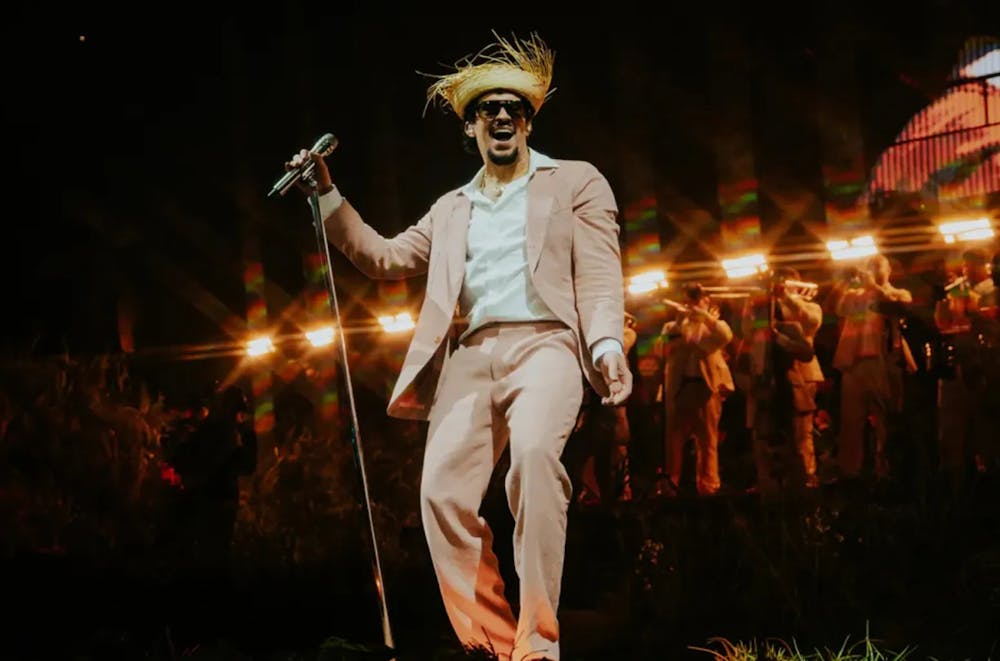
On Sept. 29, 2025, the NFL announced that Benito Antonio Martínez Ocasio, known as Bad Bunny, will headline the Superbowl LX halftime show in February 2026. The announcement sent social media users into both an excitement and frenzy as debate and controversy grew online.
The 31-year-old Puerto Rican singer and rapper has won three Grammy’s, and the Billboard Latin Music Awards will soon honor him as the “Top Latin Artist of the 21st Century.” Organizers expect Ocasio to attract a total of 600,000 attendees. His upcoming 2025 tour, which will include a 30-show run in San Juan, Puerto Rico.
Bad Bunny’s songs are written and performed predominantly in Spanish, which is the main point of contention among internet users in the U.S. The language barrier between the Super Bowl audience and the halftime show performer has raised questions about identity, politics and what it means to be an American.
Jordyn Sesler, a junior in the School of Public Affairs, said she hopes that, “people who are really reluctant to listen to songs in other languages realize that music is music and it’s good regardless.”
Bad Bunny is a particularly political musician who proudly represents his Puerto Rican heritage. His most recent album is described as a “love letter to Puerto Rico,” according to AP News and other reviewers of the album.
However, the album is also political in nature, advocating for the preservation of Puerto Rican heritage, a denouncement of United States imperialism and the honoring of individuals who have been lost along the way.
The NFL halftime show is the first time Bad Bunny will be performing in the continental United States since 2024. He chose not to include U.S. tour dates during his most recent world tour due to concern of increased Immigration and Customs Enforcement (ICE) presence outside of his venues. During an interview with I-D Magazine in September of 2025, Bad Bunny said he was concerned ICE “could be outside my concerts.” Out of an abundance of caution for his fans, he chose to tour in other countries across the world including Sweden, Columbia and Japan.
He does this in a multitude of ways, one of the most prominent being in his song “LO QUE LE PASÓ A HAWAii,” where Bad Bunny points out similarities between the gentrification of native Hawaiian lands by non-native settlers and how the same kind of gentrification and imperialism is happening in Puerto Rico.


The New York Times reports that tax breaks after the COVID-19 pandemic have made certain idyllic towns appealing to investors from outside of the territory. These investors raise up prices and drive out native Puerto Ricans who can no longer afford to live there. The real estate boom started in the capital of San Juan, but has since extended across the island according to their reporting.
“I think that [Bad Bunny] has a way with storytelling,” said Kare Coley, a sophomore studying International Relations in the School of International Service. “I think that Bad Bunny does a beautiful job of honoring an island that he calls home, and also [one] that so many Latinx people have some kind of connection to.”
Music, now more than ever, is being used as a tool for celebration as well as resistance. Musicians in states like Colorado and California use music to protest the increasingly aggressive presence and activity of ICE agents in their cities and the shooting of Renee Good by an ICE agent . Protesters have used music as a way to show non-violence, despite President Trump describing them otherwise.
As of January 27 2026, ICE continues to use its power granted by the Supreme Court of the United States (SCOTUS) to profile Americans based on perceptions that they look like an immigrant, according to reporting from the Brookings Institution.
The Brookings Institution also states that the SCOTUS decision allows ICE to use the location they encounter individuals, their accent and the way they speak Spanish, their job and their race or ethnicity to profile and detain people.
This recent decision and escalation of force used on immigrant communities, specifically Latino people, adds a new level of significance to Bad Bunny’s upcoming performance.
The Trump administration has made their discontent with Bad Bunny’s superbowl performance publicly apparent. Homeland Security Secretary Kirsti Noem said that ICEwould be “all over the superbowl” while talking to right-wing podcaster Benny Johnson on his episode that aired Oct. 3, 2025. President Donald J. Trump also called the selection “absolutely ridiculous” during an interview on NewsMax’s “Greg Kelley Reports” via Entertainment Weekly.
Saniyah Bolton, a sophomore in the School of Public Affairs, told The Eagle that, “despite [Bad Bunny] being so heavily involved within helping marginalized communities and being a great artist in general, it still boggles my mind how quick people are to dismiss him as a person.”
Resistance of the upcoming superbowl performance has been very vocal with organizations like Turning Point USA, a conservative advocacy group founded by Charlie Kirk, hosting an alternative halftime show to be aired counter to Bad Bunny’s performance on Feb. 8 at Levi’s Stadium in Santa Clara, California. titled “The All American Halftime Show,” organized in direct protest to Bad Bunny’s performance. Details of the show, including concerning headliner artists, have not been announced.
Despite these online public outcries, the Super Bowl halftime show is no stranger to politics and political messaging. Kendrick Lamar’s Superbowl LIX performance in February 2025 was filled with political and pop culture commentary.
One of the most obvious references to American politics in the show was actor Samuel L. Jackson, who played the iconic American symbol of Uncle Sam, and addressed Lamar as being “too loud, too reckless” and “too ghetto.” His role in the show directly addressed many Americans’ fears that Lamar and his style of music were too dangerous for the general public.
Lamar is not the only artist who has used this opportunity to take a stance on social and political issues. Other notable artists include Shakira and Jennifer Lopez during Superbowl LIV. The two stars showcased young children sitting behind cages during their performance of “Let's Get Loud.” This was a direct protest of the mistreatment of children being held in cages in detention camps along the border of Texas and Mexico where children were separated from parents and guardians while awaiting processing.
“You can’t separate that music is an outlet for people,” Coley said. “What’s going to bleed through that is identity, is politics, and is what's going on in the world. [Music] turns it into a joyful collective celebration and remembrance.”
On Jan.16, 2026, Apple Music officially dropped Bad Bunny’s official halftime show trailer on YouTube. It features Bad Bunny dancing to his song BAILE INoLVIDABLE alongside a cast of people of all different genders, races and ages. The trailer is upbeat and encompasses Bad Bunny’s mission of being unapologetically himself despite the backlash he has received.
As of now, the NFL is standing firm on its decision to keep Bad Bunny as their headlining performer. Setlist details teasing the songs he will perform have not been released and both fans and critics are eagerly anticipating the performance.
In a time of political unrest and uncertainty in the United States, Bad Bunny’s upcoming performance is leaving many with hope, pride and something to look forward to come February 2026.
This article was edited by Alia Messina, Jessica Ackerman, Isabella Polak,
Copy editing done by Avery Grossman, Arin Burrell, Paige Caron and Nicole Kariuki.
