
From the Newsstands: This article appeared in The Eagle’s December 2025 print edition which can be viewed here.
On Thursday nights, musicians across American University’s campus drop their homework, projects and responsibilities to spend a few hours together in the Katzen Arts Center writing, performing and sharing what fuels them most: original music.
Their space and creative forum is Songwriters’ Hub, an open-to-all songwriting and performance workshop for student musicians, solo artists and bands. The brainchild of the University’s Orchestra and Symphonic Band Director Matthew Brown, the group has doubled in popularity each year since its introduction three years ago and has allowed on-campus musical talent to perform on and off campus, find collaborators, get signed and flourish.
“I wanted to make something to support the endeavor of original songs,” Brown said. “Something that would be a great outlet for not only people who wrote songs, but people who were supporting musicians, like drummers, bass players, guitarists, keyboard players as well as audio engineers.”
The class — listed as MUSC-145 or MUS-045 for one or zero credits in the University’s course catalog — came to be because Brown would run into students after his late-night classical ensemble rehearsals sneaking around Katzen in search of open rooms for their rock bands to jam after hours.
The Songwriters’ Hub was then conceived as a dedicated ensemble-style class period for musicians on campus who wrote original songs, with the first official iteration being pitched to incoming freshmen via email in 2022.
Incoming students eager for a dedicated space to cultivate their own music on campus found themselves in the Katzen Recital Hall for the first meeting, listening to Catherine Brennan – a freshman then, but now a senior in the School of Public Affairs – interrupt Brown’s opening lecture to play the first original piece ever performed in the Songwriters’ Hub, “Masquerade.”


Songwriters’ Hub has gone through a few structural changes since its formation, as Brown continues to adjust the class to accommodate the growing student roster’s genre and style interests. The fall 2025 structure of the course groups student musicians and songwriters according to the stage their original songs are in: Writer’s Room, Open Mic or Main Stage.
The Writer’s Room is the first step in the songwriting process and the core of Songwriters’ Hub. It consists of students bringing in original lyrics for a chorus, a verse or even just a melody and workshopping with other members until it becomes a full-fledged song.
“I’m partial to the Writer’s Room because it’s the most raw,” Liam Chapin, one of the founding members of the Songwriters’ Hub and a graduate audio technology major who often produces for artists in the class, said. “Everyone can put their heads together and think, what could we change here? Do we like the rhyme scheme? The melody? We really talk about composition.”
Open Mic is the middle breakout room and is an opportunity for students to perform finished songs in an acoustic, stripped-down form, accompanying themselves singer-songwriter style on piano or guitar. At every stage, students receive feedback and opportunities to collaborate with other musicians and producers in the class.
“I feel like my song ‘Masquerade’ grew, developed and matured through Songwriters’ Hub because there was a space to show it in different stages,” said Brennan. “People would give suggestions at every stage and I would take that into account to help develop it.”
Main Stage, the last breakout room, is reserved for student artists with bands and a setlist of finished original songs in their repertoire, or those with polished songs in search of a band to accompany them.
The workshop functions as a concert where musicians often jump in with their instruments to improvise additions to a student’s song as it is being performed.
Rhi Rueda, a junior in the Kogod School of Business’ business and entertainment program, had never been in a music group before joining the Songwriters’ Hub.
“I came from a STEM high school where there wasn’t that much music,” Rueda said. “When I got to AU, I jumped into Songwriters’ Hub and showed off my song and then people just added to it naturally.”
Although the Songwriters’ Hub was designed for on-campus musicians, Brown does not limit course eligibility to declared music majors or people with a musical background.
Alizeh Jawaid – known simply as alizeh on all streaming platforms – is another student songwriter who joined Songwriters’ Hub to sharpen her writing skills, only to find a band of musicians to perform with and carry her original tracks to a set at AU Student Union Board’s on-campus music festival, Amfest.
“It was so intimidating when I went for the first time,” said Jawaid, a junior in the College of Arts and Sciences. “I remember hearing the first few performances and I was like, ‘Oh, I’m toast. I am not as good as these people.’ And then it turns out I was. Everyone was really, really kind and supportive.”
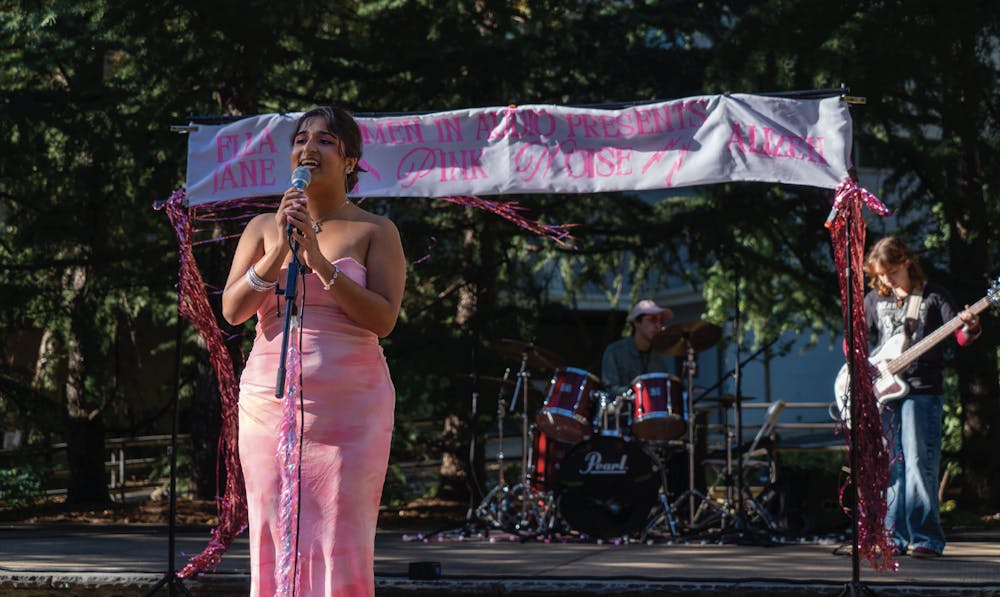
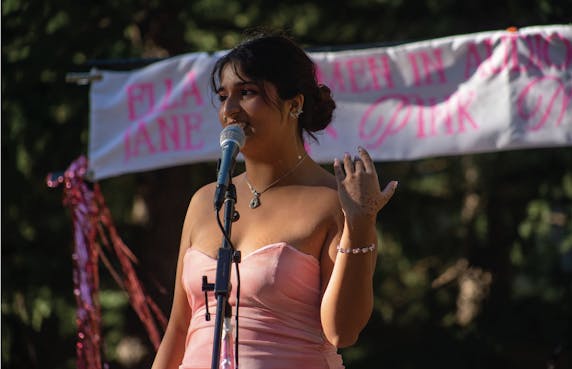
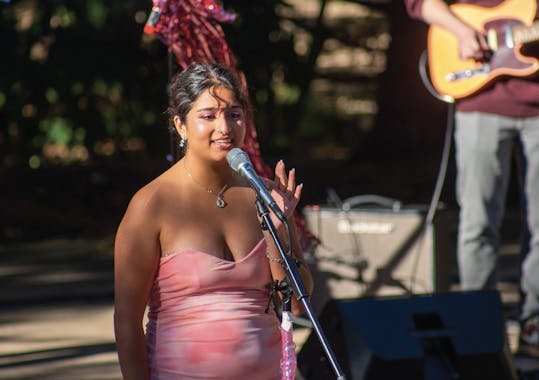
Since joining Songwriters’ Hub and finding her artistic identity, Jawaid has grown into a performer. She recently opened with a 45-minute set of original songs for professional artist ella jane, at Women in Audio’s free concert, Pink Noise, on Oct. 17.
“I’ve improved my songwriting skills and my theory knowledge and I feel like my skills have been growing exponentially,” Jawaid said.
On-campus success and recognition from clubs can take artists far, as most students part of the Songwriters’ Hub often find themselves being signed to Second District Records, the University’s student-run record label, after building a repertoire and performing live.
SDR offers more than performance and studio opportunities for artists, giving them the resources to turn their songs into music videos, master music for streaming services and help with promotional marketing.
As more student musicians and writers pour into Songwriters’ Hub, the structure of the class might change, but the benefits of creating a place for original music to grow, take shape and flourish remain the same.
“The biggest reward for me is seeing what they do, what they develop and how they find their people in Songwriters’ Hub,” Brown said. “It’s good for campus, not just good for the students.”
This article was edited by Sydney Hemmer, Jessica Ackerman. Copy editing done by Sabine Kanter-Huchting, Arin Burrell, Paige Caron, Ryan Sieve, Andrew Kummeth and Ariana Kavoossi.
