
From the Newsstands: This article appeared in The Eagle’s December 2025 print edition which can be viewed here.
The following piece is an opinion and does not reflect the views of The Eagle and its staff. All opinions are edited for grammar, style and argument structure and fact-checked, but the opinions are the writer’s own.
In a particularly busy cafe, I secured a subpar corner spot. A man beside me scribbled into his book, “Beloved” by Toni Morrison, and the cafe bar displayed LGBTQ+ inclusivity with flags.
In the midst of it all, I removed language that promoted racial affinity groups in my club constitution. It felt like I was single-handedly sending my corner back in time.
A few weeks after the temporary pause on new club registrations, the Center for Student Involvement at American University introduced a new club manual, almost twice the length, with a section dedicated to openness expectations.
As an Asian American student — apparently serving the University with diversity points only when it’s convenient for them — I’m disheartened with AU pushing “inclusivity” policies to target affinity groups without listening to and respecting our voices.
My club, the AU Asian American Journalist Association, which is still working to be recognized by the University, was affected throughout the application process. We became a victim of AU policies that seemingly respond to the White House crackdown on diversity, equity and inclusion, forcing us to counter the role of affinity groups in providing a space to affirm each other’s shared experiences.
Affinity groups should have been consulted before implementing changes that essentially eliminated our ability to declare a club a safe space for marginalized groups.


As I write this, AUAAJA members are actively editing our constitution to remove words that suggest that we cater to Asian American, Native Hawaiian and Pacific Islander journalism students.
AAJA’s national organization has produced Pulitzer Prize-winning writers and offers scholarships and networking opportunities. For me, it represents proof that people who look like me can succeed in journalism.
Although AUAAJA was never about exclusivity, prioritizing club marketing towards the whole AU student body feels wrong. The University already required inclusivity in club clauses, but CSI’s new enforcement unintentionally targeted affinity clubs rather than uplifting already-vulnerable communities on campus.
AU Asian American Student Union, another impacted club, had its status set to “frozen” by CSI for suggesting that membership is identity-based, according to AASU senior advisor Kamila Park. Park expressed disappointment that CSI’s suggested revisions were implemented without including students in the conversations surrounding the new language.
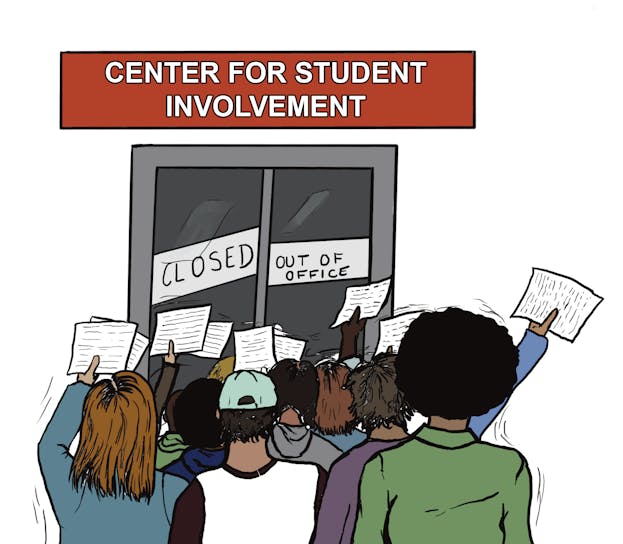
AASU’s revised constitution reads as though the words “Asian American” are just an afterthought to language that treats “all students” as the default, rather than acknowledging that our community has specific needs. The mission statement begins with the phrase “open to all students,” even though the club’s focus is to support AANHPI students.
In an email obtained and reviewed by The Eagle, CSI told Park that AASU’s purpose in its constitution must be “revised to avoid suggesting that membership is identity based.” The revised clause restricts language that advocates only for AANHPI and intersecting communities, limiting the group from focusing on issues directly affecting them.
According to CSI in a statement to The Eagle, during the last spring semester, it “conducted a survey and two focus groups with students to inform updates to the new club registration process.” Those focus groups consisted of student representatives from AU Club Council and AU Student Government.
“Among other themes, feedback from students indicated the importance of evaluating organizations seeking recognition in terms of the extent to which they are open, inclusive and welcoming to students,” the statement from CSI’s Senior Associate Director for Training and Development Matthew Galewski read.
Even with the focus groups and surveys, no affinity groups — and, in turn, no spaces for Asian students — were notified. In implementing such strict enforcement of policies, CSI should have made the surveys mandatory or flagged their importance, especially for affinity groups who would be most affected.
CSI also emphasized in the statement that the Openness and Inclusion Expectations reflect the University’s long-standing requirement that all student organizations be open to all students. However, as a group that should be working to build and protect the AU community, it should not be difficult for CSI to recognize that the recent changes will have a detrimental impact on affinity groups.
The lack of transparency throughout the process reflects the University’s superficial consideration for students of color. Instead of supporting students who were stripped of their ability to create a safe space, the University flashed its authority by forcing clubs to adhere to unnecessary policies, expecting us to be content with just existence.
AU was incorrect in making “inclusivity” additions that prey on affinity groups without our input. This move effectively prevents us from advocating for our own inclusion on campus in a way that acknowledges the specific challenges we face as students of color.
Students understand the difficult position the University is in. However, before a new policy or any written guideline, AU should’ve recognized the students who would be directly impacted and included these voices in the discussion. Even if the outcome had been similar, the University’s effort to ask for our opinions would have made us feel seen.
The University should never push students into a corner that sets them back in time, but rather, be a cornerstone of change and support during uncertain times.
Sara Shibata is a senior in the School of Public Affairs and the School of Communication and a columnist for The Eagle.
This piece was edited by Quinn Volpe, Alana Parker and Walker Whalen. Copy editing done by Sabine Kanter-Huchting, Emma Brown, Arin Burrell, Paige Caron and Andrew Kummeth. Fact-checking done by Aidan Crowe.
