
From the Newsstands: This article appeared in The Eagle’s December 2025 print edition which can be viewed here.
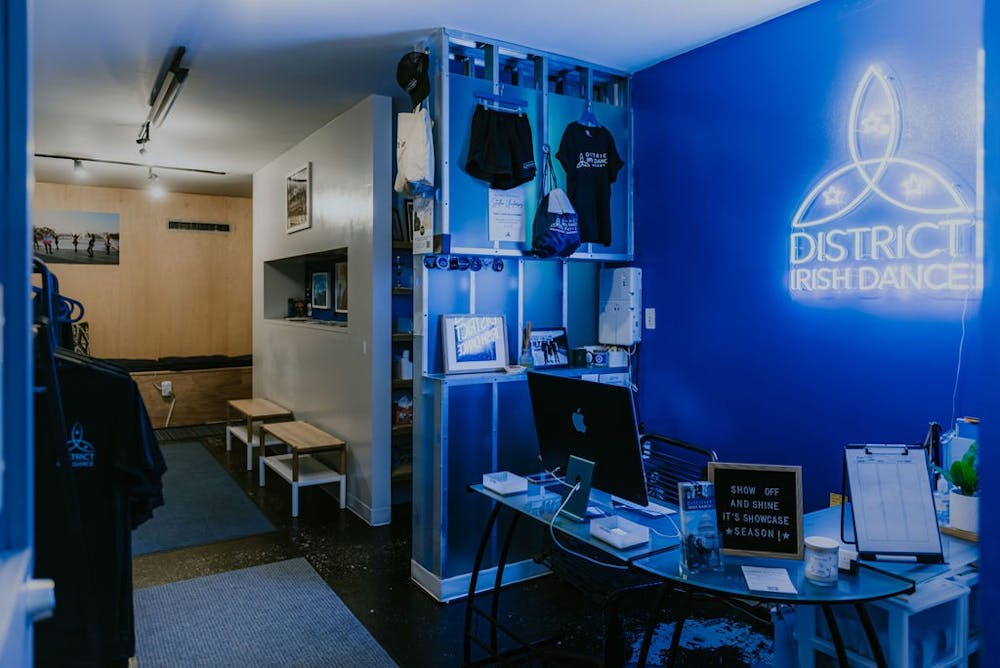
District Irish Dance Academy, located along Wisconsin Avenue in Tenleytown, offers a unique style of classes to all D.C. residents. The studio sits unsuspectingly between Mayflower Chinese Restaurant and the Chase Bank — just a short walk from where the American University shuttle drops students off for the Tenleytown - AU Metro station.
Joe Duffey is the proud founder, owner and creative director of the studio. Local to the D.C. area, Duffey graduated from George Washington University in 2013. He began his Irish dancing career at six years old, and has since performed in Williamsburg, Virginia, Orlando, Florida, London, various parts of Russia and in the Broadway production of The Riverdance Musical in 2015.
“I got to perform on some of the most prestigious stages with Michael Flatley, who was this kind of real icon of Irish Dance,” Duffey said.
After Duffey fulfilled his dreams of performing, he said it felt natural to start teaching in the District, a place that he has lived and called home for a large portion of his career.
As a dance style, Irish dance dates back to the 1400s and skyrocketed in popularity after the debut of The Riverdance Musical in 1994. Riverdance has a total of 18 scenes that are performed in seven-minute intervals, each rich with Irish culture.
“I think that by nature, the art form of Irish dance and Irish music is infectious,” Duffey said. “It is a very satisfying visual art form and naturally, people get very curious about that.”
Stepdancing is integral to Irish history and heritage, as both a cultural celebration and an act of resistance. During the 17th century, England passed and enforced Penal Laws over their Irish colony. These laws targeted Irish Catholics and prohibited them from practicing all Gaelic traditions, including dance. Despite these laws, the Irish resisted by passing down this art form in secret. There are many kinds of Irish dance performed, but all of them emphasise quick and precise movements in the feet to keep in time with the fast-paced music.



“The notion of Irish dancing includes the ability to have rhythm, fancy footwork, but above all a solid internal drum beat, and when I dance, I literally feel myself creating rhythm and music. I feel complete,” Duffey said.
Today, Irish dance is performed during celebratory holidays and events to showcase national pride and in competitions across the globe.
Duffey’s studio emphasizes technique, tradition and teamwork since its beginning. The company’s number of enrolled students has been steadily growing fast since its opening.
District Irish Dance also maintains a great relationship with the Irish embassy and with the current ambassador, Geraldine Byrne Nason, who was an Irish dancer herself, according to Duffey.
“We had one class and rented a pilates studio in the area,” Duffey said. “It grew to two, three classes, and in our first year, we had 1,520 students and quickly sized up from there.”
Irish dance is not just for professionals or people who have a connection to Irish culture, Duffey said; it is a style that can be learned and performed by anyone.
“It doesn’t matter who you are or where you are from, there is something to gain from getting to do Irish dance, but having said that I am really proud to be a kind of cultural institution,” Duffey said.
District Irish Dance is also no stranger to collaborating with American University. The studio took part in D.C. Art All Night this past September, where members of the American University and the Tenleytown community were able to tour District Irish Dance Academy’s studio and watch performances.
“It’s been wonderful to get to meet people in the neighborhood and community, and we can be a place, as a dance studio, that gives a sense of community,” Duffey said. “Especially for college students who have grown up dancing and want to continue to dance.”
Community, culture and discipline are the pillars of this small Irish dance studio. The classes that Duffey offers tie people back to their heritage and create new connections. It is a hidden center of life and art that deserves attention and happens to be right down the road from the University.
“I absolutely love getting to have a studio and creating a home for our community members and dancers,” Duffey said. “As long as we can continue to do that, I feel like we’re offering something unique to the D.C. area.”
This article was edited by Alia Messina, Jessica Ackerman and Walker Whalen. Copy Editing done by Sabine Kanter-Huchting, Arin Burrell, Paige Caron, Ariana Kavoossi and Andrew Kummeth.
