
Despite being such a diverse genre, animated movies are often written off as ‘immature’ and ‘for children.’ This is a limiting perspective because animation actually allows for boundless storytelling opportunities, with many animated films pushing the boundaries of what’s possible in the medium of filmmaking.
One movie, in particular, that showcases the complexities and beauty of animation is “The Wolf House” (2018).
Directed by Cristóbal León and Joaquín Cociña, “The Wolf House” is a Chilean stop motion animated film inspired by the actual case of Colonia Dignidad. Colonia Dignidad was established in central Chile post World War II and run by former Nazi, Paul Schäfer, the German colony was responsible for committing multiple atrocities, including torture and abuse, during General Augusto Pinochet’s dictatorship.
“The Wolf House” tells the story of a young girl named María who, after accidentally letting three pigs escape, runs away from her colony to flee punishment. María finds refuge in an abandoned house that changes and distorts according to her feelings.
In the house, she discovers two of the missing pigs. Through her imagination, María gradually transforms the pigs into human children that she names Ana and Pedro. A wolf, who wants to bring María back to the colony, makes it impossible for them to leave the house. As food begins to dwindle, tensions rise.
Animated over the course of five years, the film is a combination of drawn and stop-motion elements, linked together in a continuous shot. Much of the story was improvised which adds to the distinctiveness of the film.
Due to the uniqueness of the movie's visual style, it's difficult to characterize. Yet, its dark themes and surreal aesthetic are almost reminiscent of a David Lynch movie.
The mix of animation styles creates a sense of eerie confinement that intensifies as the movie progresses. Scenes and characters are always changing and blending into each other from one moment to the next, adding a feeling of fluidity to the film.



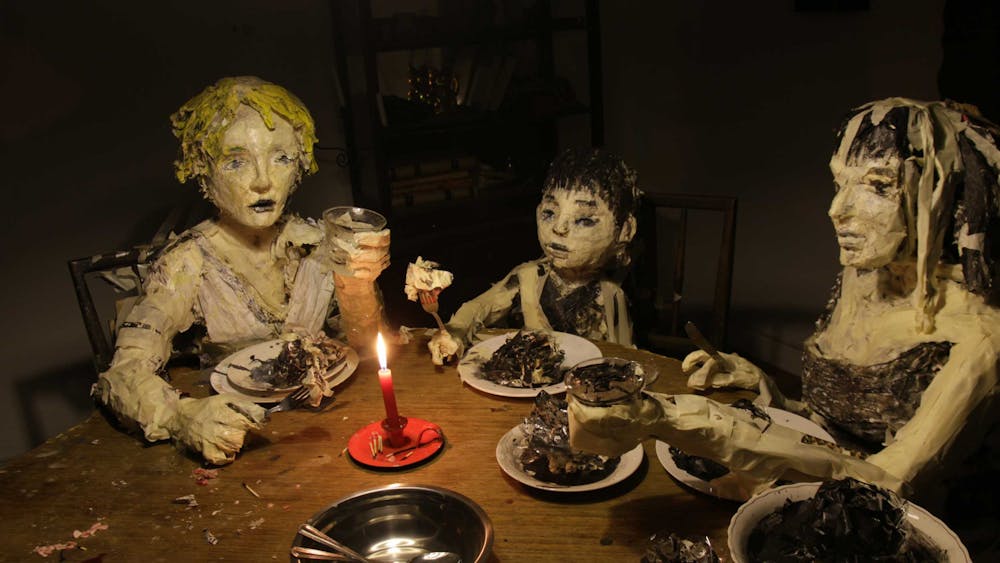
A scene that captures this unnerving fluidity perfectly is when María, Ana and Pedro are at the dinner table mid-movie.
María, standing next to the dinner table, thinks, “I wake up crying. Ana and Pedro can’t see me crying. It isn’t good.” The lights flicker and María’s body begins to be broken down and reconstructed with paper-mache, as if she is recomposing and separating herself from her thoughts.
María being “peeled away” and put back together is a constant occurrence in the film that emphasizes the instability of her situation and how transformation is necessary for her survival.
The scene continues with María raising her glass for a toast, accidentally knocking over a candle and lighting a napkin on fire. Instead of actual flames, the fire is depicted as paint slowly covering the table, reminiscent of the idea that darkness is steadily encroaching on María’s life.
This blackness spreads on the floor towards Ana and Pedro, and once it touches them, Ana and Pedro begin to squeal as black cylinders pop out of their eyes. The sound of flames and pigs squealing becomes all encompassing, and further adds to the feeling of dread created by the visuals.
The form of animation shifts from purely stop-motion to include 2-D drawings on the wall. The wolf’s voice appears and he reprimands María for burning the pigs — saying she ought to come home. His voice takes on the visual appearance of a big eye on the wall, but when María refuses to let him in the entire room is suddenly covered in white paint.
The sound of fire is replaced by the noise of a clock ticking.
Outside of the traditional connotations of white meaning innocence and black meaning darkness, this scene highlights María’s inner turmoil. The dramatic transformation from black to white paint indicates her struggle with wanting to be free but lacking the control to reach freedom. The house has become another cage, just like the colony was.
Through the use of multiple types of animation, “The Wolf House” beautifully explores themes of freedom, isolation and confinement.
Even though animated movies are often deemed children’s entertainment, that’s simply not the case. “The Wolf House,” with its stunningly, unnerving visuals and complex plot, depicts mature themes that hit hard no matter the audience’s age.
“The Wolf House” is available to stream on fuboTV, PLEX and AppleTV.
This article was edited by Alia Messina and Marina Zaczkiewicz. Copy editing done by Sabine Kanter-Huchting.
