
President Donald Trump’s March 28 executive order to “beautify Washington, D.C.” has led to the removal of homeless encampments across the city — but advocates say the policy lacks any plan to actually house displaced residents.
“It’s kind of pushing the problem off to somewhere else,” said Acil Mecham, a senior in the School of Public Affairs. “It’s impeding on the sovereignty of Washington, D.C., which is important to residents and the local government.”
Executive Order 14252, “Making The District of Columbia Safe and Beautiful,” calls for the elimination of graffiti, coordination of federal and local law enforcement agencies in deporting undocumented immigrants and the immediate removal of homeless encampments on federal land.
“As the capital city of the greatest Nation in the history of the world, [D.C.] should showcase beautiful, clean, and safe public spaces,” the order reads. “Our citizens deserve nothing less.”
Though the Trump administration claims the goal of this order is to make “residents, commuters, and tourists” feel safe at all hours in D.C., critics argue that this order prioritizes appearances over aid.
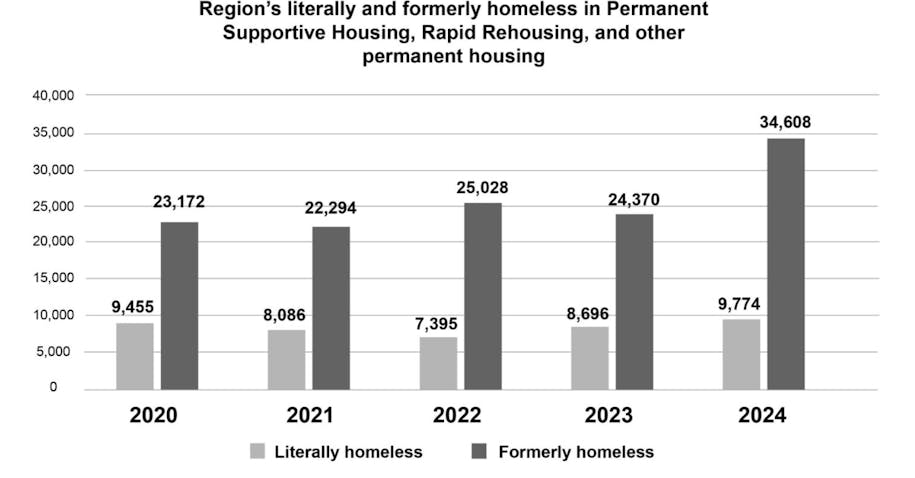
Homelessness in D.C saw a 14 percent rise in 2023, according to the most recently released Point-in-time, or PIT, Count from May 2024. The PIT Count occurs yearly in January and employs volunteers to measure the state of homelessness on a single night, according to the Department of Housing and Urban Development.


American University sophomores Ronan Tanona, a student in the School of International Service, and Andrew Obara, a student in the College of Arts and Sciences, have been interviewing individuals experiencing homelessness for their honors challenge course. They said that as encampments have been dismantled, new ones appear where there hadn’t been before.
“These are people who are struggling to find a place to live,” Tanona said. “If you just get rid of their encampment, they’re not gonna find a place to live and disappear. They’re just going to be homeless somewhere else, maybe just down the street.”
The order also established the “D.C. Safe and Beautiful Task Force” to coordinate and carry out the directives while maximizing resources.
According to the executive order, the task force includes representatives from several federal bureaus and agencies, including the Department of the Interior and Department of Homeland Security. No members of the D.C. local government are included. NBC4 reported that the task force held its first meeting on April 7.
The order followed months of Trump suggesting a federal takeover of the District. On March 14, less than two weeks before signing the order, Trump said the federal government could run the city if D.C.'s government “can’t do the job.” Weeks earlier, on Feb. 19, he told reporters on Air Force One that the city cannot have tents on its “once magnificent plazas, lawns and all,” especially when hosting foreign leaders.
Mayor Muriel Bowser responded on X with an infographic celebrating D.C’s various accomplishments and called the District a “world-class city.” D.C Attorney General Brian Schwalb tweeted the next day in support of home rule, saying violent crime reached a 30-year low in 2024 while family homelessness has been down 50 percent in the past decade.
“Our budget is balanced, our economy is growing, our small business community is thriving, and we are one of the most visited places in the country,” the post read. “A federal takeover of DC would violate the fundamental principle of self-governance on which this nation was founded.”
The city government recently ordered Black Lives Matter Plaza removed after a Republican-controlled Congress threatened to cut city funding over the street mural’s existence. Removal of the plaza was complete by the end of March.
The order requires the Secretary of the Interior to instruct the National Park Service to completely remove all homeless encampments on federal land. A month prior, Trump had notified Bowser to clear encampments near the State Department and the White House.
Chris Rutledge is the vice president of external affairs at Friendship Place, a nonprofit housing service provider in the D.C. area with a drop-in center in Tenleytown. He said that while the executive order is unprecedented, Friendship Place is prepared to help those displaced get back on their feet.
“Our number one job is to help people get to stability,” Rutledge said in an interview with The Eagle. “That’s what we do every day.”
Friendship Place, which served about 5,400 people last year, operates multiple drop-in centers and manages city-owned apartment buildings. One such building, The Aston, is nearing full capacity after an encampment next to the nearby E Street Expressway was cleared March 5.
Trump had previously expressed support for moving homeless people into designated places where addiction and mental health treatments would be mandatory for “reintegrating them back into society,” according to a 2023 presidential campaign video.
However, the executive order does not mention any such relocation strategies or federal efforts to house homeless people in the District.
Matthew Morgan has been living on the streets of the D.C. metropolitan area for 15 years and has been moving around D.C. proper for three weeks.
While Morgan thinks the federal government has too much on its hands to tackle solving the homelessness crisis in D.C., he hasn’t had any issues with law enforcement under the home rule government.
“All the resources are here. All the resources are pretty much all throughout America, everybody can find the help if they want it,” Morgan said. “Some people don’t want it. Some people would like to take a break and be lost from it.”
For Anagha Rao, a sophomore in SIS, the executive order reflects a broader issue of government neglect towards individuals experiencing homelessness — particularly in cities like D.C. and her hometown of Seattle, Washington, where she has seen similar attitudes to homeless encampments.
“Such policies disrupt the lives of people already suffering hardship and fail to support the people being displaced on top of being unhoused,” Rao said. “They also disproportionately affect people of color, and the goal of ‘beautifying’ the city shows a really apparent lack of empathy and care for the lives of people who don’t even have their basic need of shelter met.”
Rao emphasized the importance of taking action at the local level.
“I think at the very least, there has to be an awareness of the homelessness in D.C. and policies such as this Task Force that are unjust and disproportionately affect certain communities,” Rao said. “We live in one of the richest neighborhoods in D.C., and advocating for unhoused people is what AU and AU students can be doing to address homelessness.”
This article was edited by Abigail Hatting, Maya Cederlund, Tyler Davis and Walker Whalen. Copy editing done by Luna Jinks and Olivia Citarella.
