
The American University administration canceled a Students for Justice in Palestine workshop called “Debunking Zionist Lies” in a public statement on Feb. 25, eliciting outrage and support among University students and faculty.
Historically, there have been tensions between AU’s chapter of SJP and the University administration. Most notably, the group announced on April 8, 2024 that the administration had placed it on probation. Administrative members — who appear to be Vice President of Student Affairs Raymound Ou and Assistant Vice President University Police Services and Emergency Management Phillip Morse — were seen in a verbal clash with the student group during a demonstration on Oct. 7, 2024.
The University did not respond to The Eagle’s request for comment on this incident.
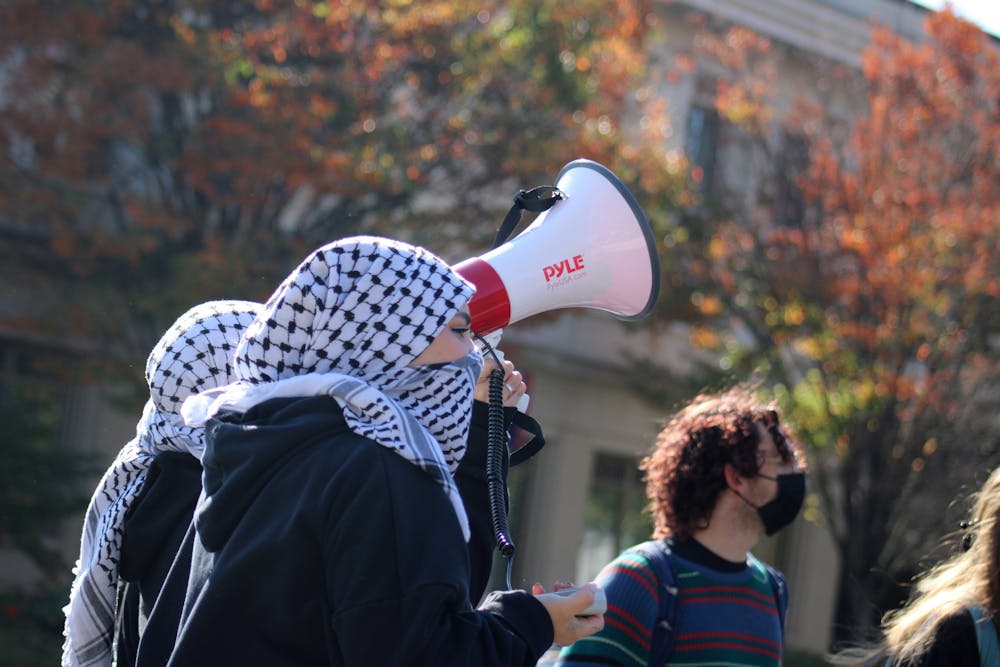
In the post’s caption for the protest, SJP said they were reading the names of their “eternal Palestinian martyrs … to mark one year of the genocide in Gaza” when the University told them to stop using amplification devices, threatening disciplinary action. Hours later, the American University Police Department arrived with zip ties.
More recently, the organization received a cease and desist from the University on March 4, which ordered members to “immediately halt all organizational functions and operations,” according to an Instagram post made by the D.C., Maryland and Virginia chapter of Students for Justice in Palestine and United 4 Palestinian Liberation on May 1.
“We always prioritize the well-being of our community and regularly conduct safety assessment for campus events,” the administration said in their statement.
The statement listed three reasons why the administration canceled the event, which was going to take place on Feb. 25:
- The workshop “did not undergo the required safety assessment,” which appears to be in reference to the University’s Threat Assessment Policy.
- The Instagram post marketing the event “contained imagery and language that contributed to the safety concerns about the event, does not represent AU’s values and creates discord in our community.”
- The “advertisement was hurtful to members of our Jewish community.”
The University added that the content “was not submitted to or reviewed by the university prior to its posting.” The statement said the unreviewed post was being assessed to decide whether the group violated any codes of conduct and if the situation would affect their ongoing probation.


SJP’s flyer read, “Debunking Zionist Lies Workshop” and “Smash Zionism.” The caption under the social media post read, “Join us as we discuss the origins of the zionist project and then begin to dismantle the lies & propaganda that seek to normalize its existence.”
SJP did not respond to The Eagle’s request for comment.
The AU chapter of the American Association of University Professors responded to the event’s cancellation in a public statement on Feb. 27, writing that the University violated its own policies surrounding expressive conduct and freedom of expression.
“Speech suppression must not be allowed for arbitrary political reasons, which is why US law establishes robust speech protections and why AU adopted a freedom of expression policy modeled after First Amendment law,” AU AAUP wrote. “This ex post facto requirement of a safety assessment for a student-led workshop is targeted only at SJP, and if applied to every event or discussion would shut down student life and our community of inquiry entirely.”
It added that various University student, academic and administrative groups have organized and facilitated events that did not undertake any safety examination.
“There’s no rule that events need to have a safety assessment. So if you’ve ever been to an event that’s scheduled in a classroom at AU, this isn’t a thing,” senior professorial lecturer in the School of Public Affairs and AU AAUP Vice President Lara Schwartz said in an interview with The Eagle. “If they did want to come up with such a procedure, they would need to engage in the shared governance principles that we have.”
Schwartz said she has experience with planning events on campus, as she runs the Project on Civic Dialogue, which sometimes involves student and faculty-led dialogues.
“We don’t have safety assessments as a norm. It’s not a procedure that exists in order to use a classroom,” Schwartz said. “The standard thing is … you book a room, you make a flyer, you tell people to come. Usually, a safety assessment would be something that you might request, not something that is required of us.”
Carolyn Gallaher, a professor in the School of International Studies and AU AAUP secretary said there is “clearly not an expectation” that a department conduct a safety assessment in advance of events. She added that it looked to her like the safety assessment was used as “an excuse to cancel the event.”
“There’s no requirement that students do this,” said John Bracht, an associate professor in the College of Arts and Science and AU AAUP president. “And it was disingenuous of the University to basically imply the students had done something wrong by not doing their own safety assessment.”
Melissa Miller, a sophomore in the Kogod School of Business, responded to the University’s claim that SJP’s flyer was hurtful to AU’s Jewish community.
“I feel like there was really nothing antisemitic about the flyer,” Miller said. “I feel like it’s antisemitic to conflate antisemitism and Zionism.”
Adah Nordan, a sophomore in CAS, criticized the administration’s decision to cancel the workshop, calling it an attempt to “suppress student voices.”
Andrew Scibvilia, a sophomore in SPA, said he would like the University to provide more spaces on campus “for people to express their beliefs without being worried of being disciplined.”
Some students supported the choice to cancel the event.
Chris Nieker, a freshman in SPA, agrees with the University's decision to cancel the event, as he does not think that student-led spaces are ideal for facilitating discussions on contentious subjects.
“It’s not going to be an environment where people can have a conversation,” Nieker said. “It’s going to be people saying terrible things about other people … I’m concerned that it’s going to be putting targets on Zionists’ backs.”
Although Nieker does not think these conversations should occur in student-led spaces, he said he still thinks “it’s important for colleges to foster events that promote freedom of speech and allow students to discuss controversial topics.”
Teddy Gillman, a sophomore in Kogod and SPA, agreed with the University’s decision to cancel the event and its claim that the flyer was harmful to the Jewish community.
“I find the imagery of the posting disturbing, and I think that if I were to be walking around and seeing this poster, it [would make] me feel unwelcome,” Gillman said.
As a Jewish student on AU’s campus, Gillman said, “I feel safe. And knowing about this post and seeing this post, I don't think makes me feel less safe. But, while I feel safe, I do find the post threatening.” He added that he also finds the post “menacing.”
Gillman also found the advertisement’s visuals and use of the word “smash” to be “disconcerting.” He said he was unsure what SJP meant by using the word.
“Are they going to smash me? Like are they going to assault people that are Zionists?” Gillman said. “There's definitely an implication of — if not hurting someone — then making someone weary of being attacked.”
Gillman said he thinks the individuals who designed the advertisement violated AU’s standards for free dialogue. He said the post was “threatening to smash the speech of people that are Jewish and sympathetic to Israel.”
In response to the administration’s criticism of the flyer’s language, Bracht referenced the part of the flyer that read “smash Zionism.”
“We call them combat analogies in civil dialogue, in civic discourse, in general in society. And often these analogies are sort of violent analogies,” Bracht said. “Nevertheless, you ‘smash the patriarch.’ You might ‘smash fascism.’ You might ‘smash racism.’ … That’s a common phrase for debunking what you see as a harmful ideology.”
Schwartz said the free expression policy that the University had in place at the time did not say “images that include violence are not protected speech.” Instead, according to Schwartz, the policy said that speech is unprotected when it indicates a plan and likelihood of provoking violence and when it targets a person.
“It says ‘smash Zionism.’ Will there be some people who say, ‘I am horribly offended by that’? Absolutely,” Schwartz said. “But our standard isn’t about offense. And when we talk about things like threat, violence, safety, when it comes to speech, we don’t think of those things.”
Correction: A previous version of this article quoted an instagram post from an Oct. 7, 2024 demonstration by AU’s chapter of Students for Justice in Palestine and attributed it to a Feb. 25, 2025 workshop. It has been updated to accurately reflect that the post was in reference to the 2024 protest.
This article was edited by Payton Anderson, Maya Cederlund, Tyler Davis and Walker Whalen. Copy editing done by Luna Jinks, Olivia Citarella, Sabine Kanter-Huchting and Hannah Langenfeld. Fact Checking done by Luna Jinks, Olivia Citarella and Tatiana Pruss.
