
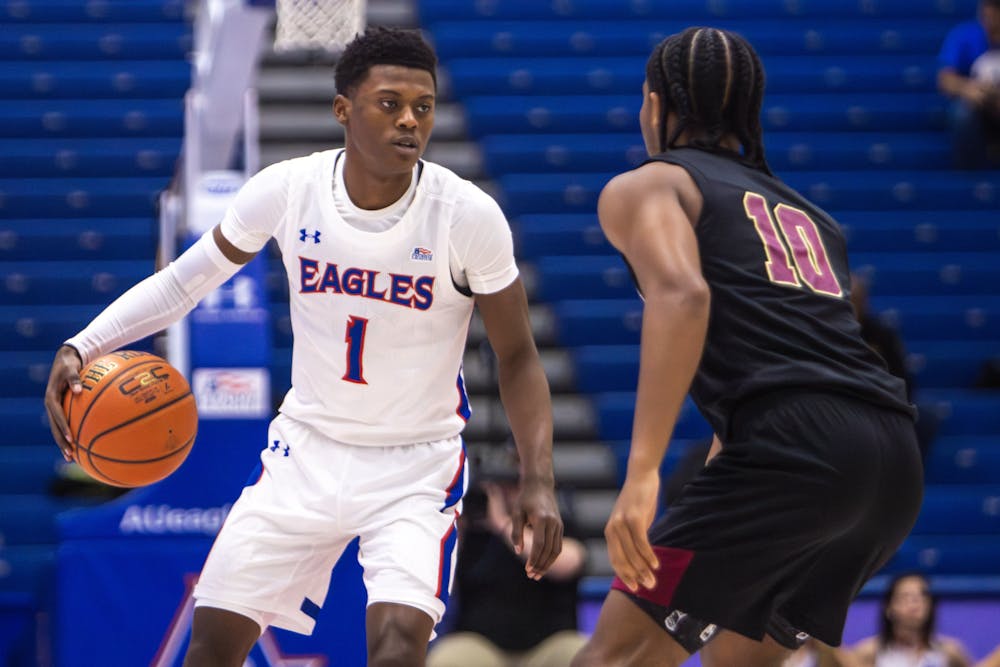
When American University’s men’s basketball team clinched its first Patriot League title in over a decade, it was more than a championship for Elijah Stephens: it was a promise kept.
From the moment he arrived in D.C. as a freshman guard from Texas, Stephens had set a quiet goal. “I told myself I was going to win a championship here,” he said.
Four years later, he did just that with discipline, steadiness, and the kind of leadership that doesn’t always draw the spotlight. The stat sheet captures his production, more than 1,000 points, 400 assists and a top-ten spot in program steals. But, his most important contributions were harder to quantify: tempo, trust, and the calm, unshakable presence that made everything around him work.
Before Stephens ever suited up for American University, he had already built a legacy back home in Waco, Texas. At China Spring High School, he finished with over 2,000 career points and became one of the most decorated players in program history: a two-time Waco Tribune-Herald Super Centex Player of the Year, two-time All-State honoree, and the driving force behind the Cougars’ first regional tournament appearance since 1989. His teams played fast, pressed constantly, and leaned on Stephens to lead every possession on both ends of the floor.
It showed from the moment he arrived at AU.
Stephens wasted no time showing he belonged at the college level. Under former head coach Mike Brennan, he played in all 31 games as a freshman, starting 13 of them and leading the team with 2.7 assists per game. While most freshmen spent time adjusting to college basketball, Stephens was already running the Eagles’ offense.
“I was always trying to prove I belonged,” he said.
Stephens’ freshman season was promising, but the program around him was struggling. American finished 10–22 that year, and by the end of his sophomore season, Brennan was out. Teammates left, the portal opened, but Stephens stayed.
“I had my mind set on staying,” he said. “I didn’t want to worry about my education, my major and everything. I just wanted to see what the new coaches would bring.”


In an era where players bounce from program to program, Stephens made a decision that was increasingly rare in college basketball, he committed to building something. He stayed with the team that gave him a chance, trusting that change would come, and that the championship he had promised himself was still possible.
When Duane Simpkins took over as head coach ahead of Stephens’ junior season, he made one thing clear: he wasn’t starting from scratch, he saw the potential already in place.
One of the first things the new staff did was challenge Stephens to step into a bigger role.
“They definitely wanted me to step in and score more,” Stephens said. “They put the ball in my hands a lot more and wanted me to expand my role as a leader.”
It worked. In his junior year under Simpkins, Stephens averaged a career-high of 12.1 points and 4.9 assists per game. He was named to the All-Patriot League Second Team and the Patriot League All-Defensive Team, marking Stephens as a point guard who contributes on both ends of the court.
His growth wasn’t just statistical, it was personal. “He became more vocal as the year went on,” graduate student forward Lincoln Ball said. “When Eli was going, we were all going. He was probably our most important player.”
Simpkins agreed. “Matt [Rogers]’s a big part, obviously, but some things Matt wouldn’t have been able to do without Eli,” he said. “He initiated things that didn’t show up in the stat sheet: pushing the ball, breaking down defenses. He was as valuable as Matt; it just showed up in different areas.”
Assistant coach Isaiah Tate added, “He put the pieces together, for himself and for us.”
Stephens wasn’t just a point guard, he was running the show. The player who tied together all the moving parts, often without anyone noticing.
“Eli connected the dots,” assistant coach Jackie Manuel said. “There were so many moments in games where he just knew what needed to happen, a shot, a reset, a change in pace, and he did it.”
Stephens didn’t always get credit for the momentum he created. He wouldn’t be listed on the assist if his pass started the transition two passes earlier. He wouldn’t be on the highlight if he broke down the opposing defense that led to someone else’s open shot. But everyone inside the program knew: the offense ran through him.
“There were a lot of things Eli did that didn’t show up in the box score,” Simpkins said. “But people who really know basketball could see it, he was initiating the things that made us successful.”
What stood out to the coaching staff wasn’t just his basketball IQ, it was his reliability. He brought the same approach every day, in practice and in games, no matter the opponent or the moment.
“He was one of our most steady guys,” Manuel said. “What he gave us physically, mentally, emotionally — that consistency mattered. And our younger players got to see that.”
But before Stephens was a floor general, he was a defender. His father made sure of that.
When Stephens first started playing basketball, he wasn’t allowed to focus on offense, not until he proved he could play defense. “My dad wouldn’t let me do anything on offense,” he said. “He had me guarding my older brother, guarding everybody. I wanted to play a lot, and defense was how I earned it.”
That foundation became his trademark. Stephens didn’t just play defense, he was a disruptor. He picked up the ball early, pressured for 94 feet and made life miserable for the other team.
Simpkins called him a “tremendous on-ball defender” and said it plainly: “That’s something you just can’t replace.”
Manuel, an elite defender in college himself, said he saw something in Stephens even he didn’t have: the ability to pressure the ball and take it from people. “We were always hyping him up to do it more,” Manuel said. “Get in passing lanes, make people uncomfortable, he had that kind of impact.”
It was the other side of what made Stephens so valuable: as calm as he was on offense, he brought intensity and disruption on defense. He never backed off a matchup.
Elijah Stephens rarely needed the spotlight, he was more interested in making sure his teammates had it. That mentality was most visible in his partnership with graduate forward Matt Rogers.
“It was amazing,” Stephens said of playing with him. “It’s always good to have somebody you can just sit back and watch be great. He’s a great guy, great teammate, always encouraging me in every aspect.”
Stephens was often the one setting Rogers up, drawing defenders, collapsing the lane, delivering the pass that made the bucket look easy. But the connection went beyond the court.
“They were always on the same page,” Tate said. “All our conversations started with ‘Eli and Matt.’ That pairing was everything. It set the tone for the team.”
That unspoken understanding between Stephens and Rogers mirrored something bigger, the culture shift the team had been undergoing. As Stephens grew into his leadership role, he helped create the team chemistry that held the group together.
By the time his senior season arrived, Stephens had become the steady presence his team leaned on. He wasn’t just the point guard anymore, he was the tone-setter, the floor leader, the veteran with the plan.
American didn’t start the year as favorites, but the team believed, and Stephens had unfinished business.
“We wanted to fight for each other,” Stephens said.
That bond showed as the Eagles made their run through the Patriot League. As the postseason built momentum, the crowds started to follow.
“It was crazy,” Stephens said. “My sophomore year there were maybe ten people in the stands. Then we’re selling out Bender over spring break.”
The energy peaked in March, when AU secured the Patriot League title and earned a trip to the NCAA tournament, the program’s first since 2014. The dream had come true, and for Stephens, it meant more than anyone knew.
The championship wasn’t just the end of a season, it was the fulfillment of his quiet promise.
“After the first year, I thought my goal was going away,” he said. “But it actually came back — Came back full circle.”
Stephens’ impact stretched beyond the box score and beyond the locker room. Fans who had watched him grow from day one felt it too.
“Since he was the only person in the class of 2025 to start freshman year, a lot of folks in my class, and especially Suit Mafia, have a huge amount of respect for him,” said Shane Gardner, senior in the College of Arts and Sciences. “That’s our guy. He was in the freshman dorms with us. We have a soft spot for him.”
Gardner, who helped lead the student fan section, pointed to Stephens’ ball handling as one of the most underrated parts of his game.
“There are so many point guards at higher levels who don’t have the handles he does,” he said. “People don’t talk about how technical his moves are. His hesitation? You can’t stop it.”
Now, with his college career behind him, Stephens is preparing for the next chapter. He’s been in touch with agents and plans to continue playing overseas.
He’ll graduate with a degree in African American and African Diaspora Studies, a path he chose after realizing how much of his own history hadn’t been taught in school.
Looking back on his time at AU, Stephens says he’s glad he stayed.
“I got to experience a lot of different people,” he said. “It’s very diverse here – different backgrounds, new personalities. And I got to experience D.C., all the history here. It was a great experience.”
What he’ll miss most, though, is the team, the dinners, the long bus rides, the games of Among Us and the locker room jokes that don’t make it to the stat sheet.
“I love the guys,” he said. “They were always there for me with anything I needed.”
He plans to come back for alumni events, maybe even sit in the stands at Bender Arena next season. But when future players come through, he hopes they’ll remember him a certain way.
“I was hardworking. I was quiet. But I always looked out for others before myself,” he said. “I tried to get my teammates involved before I got myself involved.”
And in doing so, Elijah Stephens did more than just win a championship. He set the standard for what it looks like to lead without demanding attention, to draw up the blueprint, then quietly, persistently, make it real.
That next step, the one beyond AU, is what excites his coaches most.
“He’s just starting to scratch the surface of how good he could be,” Simpkins said.
This article was edited by Jack Stashower, Penelope Jennings, and Walker Whalen. Copy editing done by Luna Jinks Sabine Kanter-Huchting and Nicole Kariuki.
