
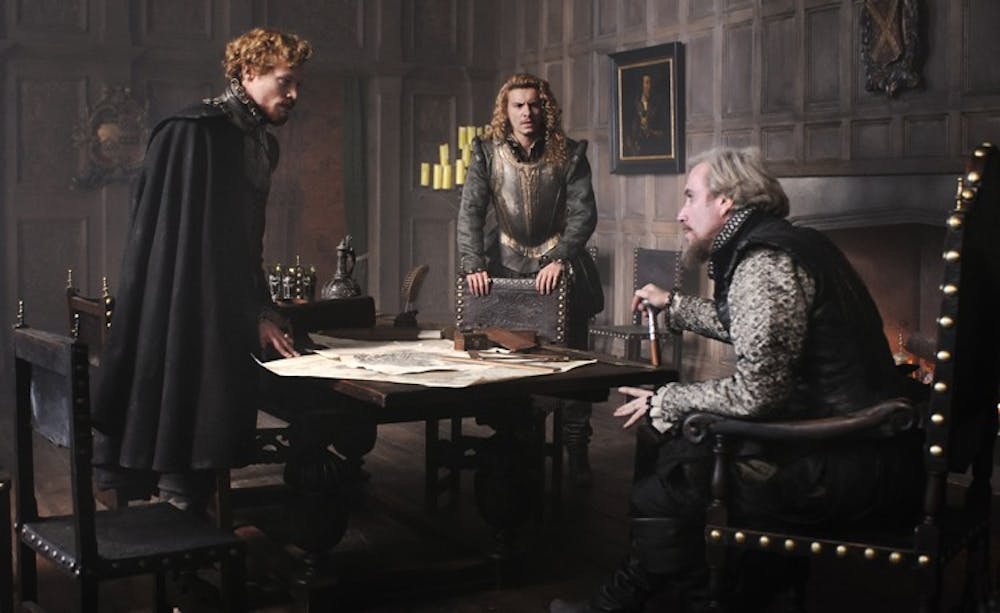
One of the most disturbing and complex questions that have puzzled literary critics for centuries is: Did Shakespeare really write all of his plays and sonnets? “Anonymous” offers an answer to the thought-provoking question.
Directed by Roland Emmerich (“2012”), the film is a political thriller set primarily in Elizabethan England, during the time of political turbulence following the end of Queen Elizabeth’s reign.
The answer to the literary question, suggested in this movie, is a resounding no.
However, the plot does not revolve around the question of the authorship. Instead, the answer is provided at the very beginning — that the man who stands behind Shakespeare’s works is in fact Edward de Vere, 17th Earl of Oxford (played by Rhys Ifans, “Notting Hill”).
Viewers are pulled into a political confrontation between the Tudors and the Cecils, fighting over who will ascend to the throne after the end of reign of Queen Elizabeth I (played by Vanessa Redgrave, “Atonement”).
Edward hopes to prevent Robert Cecil (Edward Hogg, “Bunny and the Bull”) from getting King James of Scotland as Elizabeth’s successor. In order to do so, he turns to his greatest love — writing.
He believes that theater is the perfect place where his words have enough power to prevail upon peasants and make them stand up for what he believes in. But his exalted position in Elizabethan society prevents him from revealing his identity, so he needs to find someone who will embrace his plays as their own, thus concealing his name.
At first, he sees Ben Jonson (Sebastian Armesto, “Pirates of the Caribbean: On Stranger Tides”) as an ideal alternative. But Jonson, confiding in Shakespeare (Rafe Spall, “Shaun of the Dead”) about his inability to do it, only finds out later that Shakespeare, at the end of the moving performance of “Henry V” in the Globe, proclaims himself as the author of the very play and becomes instantly elevated by the rapturous crowd.



From that moment onward, the culmination of the political unrest arises, resulting in the Essex rebellion against Queen Elizabeth I and its leaders being eventually captured and sentenced to death.
Shakespeare is represented as an illiterate fellow who can’t even write, let alone create some intellectually superb plays. That is one of the reasons, stated at the very beginning of the movie, why it is completely plausible to attribute his works to someone else, such as the Earl of Oxford, who is on much higher educational and social scale than Shakespeare.
Whether you are a fan of Shakespeare or not, you should not disregard this film as a preposterous fantasy degrading Shakespeare and relying on the Oxfordian theory which is based on no tangible evidence whatsoever.
The great thing about the story is that it proposes a completely new perspective, challenging you to go beyond the traditional ideas.
There are many inaccuracies in the film, however, mostly in the historical context.
Queen Elizabeth I is depicted as an irresponsible and incestuous woman manipulated by the Cecils, who, during her youth, was romantically and physically involved in a relationship with the Earl of Oxford, who, to our amazement, turns out to be one of her many illegitimate children.
Furthermore, there are too many jumps in the timeline, as the action often shifts from past to present or vice versa, and many new characters emerge which, to some extent, keeps the film from making a lasting impression.
Nonetheless, strong and credible performances of the cast as well as the brilliant recreation of Elizabethan London, from its untidy and congested streets to authentic theaters crammed with boisterous spectators deliver a truly captivating experience.
“Anonymous” sheds a new light on arguably the most important literary mysteries of all time. Whether you will eventually be convinced, skeptical or outraged by the explanation this movie bestows, you will indisputably be entertained.
thescene@theeagleonline.com
