
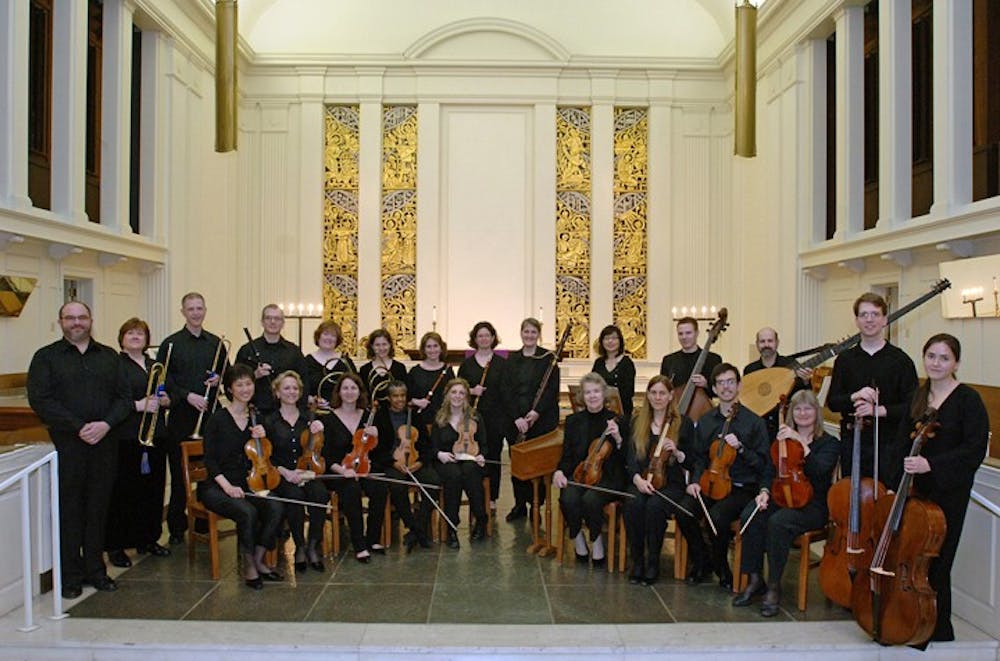
To say that Daniel Abraham’s symphony is just another group performing Baroque music is not only a bold understatement, it is also an insult to Bach Sinfonia’s merits.
In addition to being the director of choral activities and an associate professor of music at AU, Abraham is also the artistic director of the highly lauded Bach Sinfonia orchestra based in Maryland. And if his unmistakably exuberant season opener has anything to prove, it is that if the spirit of the 18th century were to ever fade into antiquity, he would be there to revive it.
“The Story of the Baroque Concerto Grosso” is an exploration into the origins of that idiosyncratic time in history that came right after the Renaissance, a creative outbreak that still holds its influence to this day. While the delightful collection of ensemble pieces may seem daunting to a lot of newcomers, they are quite capable of pulling one through the looking glass into the musical landmark that is Baroque. For anyone who is not an expert in classical music but is hoping to introduce it into their life, the Bach Sinfonia can be seen as an educational endeavor.
While it can be technical and abstruse at times, it is never heavy-handed.
Opening on Oct. 24 with Arcangelo Corelli’s “Concerto Grosso in D Major, Op. 6, No. 7,” the ineffable Baroque style became apparent from the frenetic swiftness of the violas working in almost unlikely harmony. This was further punctuated by the mercurial shifts in tempo from each movement to the next.
Oddly enough, with less than 20 performers, the Bach Sinfonia is able to achieve an admirable level of grandeur — perhaps a testament to the ingeniousness of the conductor. With stock-still composure and muted body gestures, Abraham belies the incredible feeling of triumph that is conjured in this near-perfect revival.
The choice to segue into George Muffat’s “Dulce Somnium” could not have been a more jarring one. Whereas Abraham’s rendition of Corelli was uplifting and flavorful, his take on Muffat was weepy and pensive — a song that is constantly pining away, hoping to rise above the dirge.
The simple gestures of the individual instruments became profound in the tonal context of its accomplices, shown in the untarnished way that they were able to build off of one another beautifully. Abraham is able to wring powerful emotion from the simple sheet music to make it touching and thoughtful.


From Handel to Locatelli, the breadth of the Baroque influences covered by the program was reinforced by the constancy of one element: sincerity. While chemistry between performers in an orchestra is mostly crucial, sometimes it just isn’t enough. When observing the Bach Sinfonia for the first time, there is an immediate sense of the shared consciousness between the performers and how much they thrive on intuition.
During some of the more fast-paced songs, performers were able to smile, laugh and even give subtle facial cues across the stage. The performance was clearly a production of love, as one can only imagine how many neck-breaking rehearsals it must have taken for this to become a conditioned habit.
The sincerity between the players was most evident in their performance of Antonio Vivaldi’s “Concerto Grosso in B Minor,” which also happened to be the last song on the list. It was then that the violins adopted a more avant-garde attitude by frantically shifting from well-crafted solos to harmonious duets with flawless timing. Taken separately, it would seem that the disjointedness of these elements would be its own pitfall. But Abraham has an uncanny ability of bringing it all together to make the whole thing sound great.
There are upcoming Bach Sinfonia performances in the spring with focuses as diverse as woodwind quintet pieces of the 1800s and Bach’s complete choral works. With a solid opener like “The Story of the Baroque Concerto Grosso,” it’s clear that these performances can be both culturally enriching as well as entertaining.
You can reach this writer at thescene@theeagleonline.com.
