
Astro Boy
Grade: B+
If America has Mickey Mouse, then Japan has Astro Boy. The iconic super-powered, speedo-wearing child hero with Betty Boop eyes takes the spotlight in the new CGI-animated film hitting theaters this Friday, Oct. 23. While it does little to maintain most of the original story of the black and white ‘60s classic aside from its main premise and a few characters, it’s sure to be an enjoyable movie for both old fans and newcomers alike.
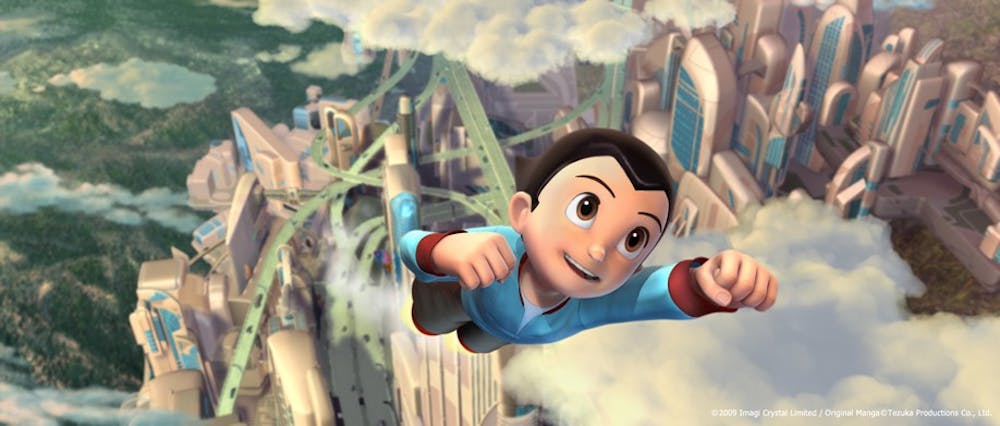
Set in the futuristic, floating haven known as Metro City, “Astro Boy” is technological escapism at its best. In this pristine microcosm made up of the opulent and the social elite, humans have long mastered robotic engineering, assigning menial chores like scrubbing windows and picking up discarded trash to their mechanical servants. Some of the more advanced robots even maintain positions in the corporate world.
At the center of this industrial crescendo is Dr. Tenma (Nicolas Cage), a brilliant member of the Ministry of Science. He has a son named Toby (Freddie Highmore), a happy-go-lucky child prodigy who is constantly vying for his dad’s affection. When Toby decides to visit his dad at work, things go horribly awry, and Toby is vaporized by a large robot on the warpath.
Unable to cope with the sudden loss of his son, Dr. Tenma builds a new Toby, implanted with all of his son’s memories and equipped with advanced gadgetry to ensure his safety. However, the doctor soon realizes that his son — his real son — is dead, and no high-tech replica will ever replace him. He half-heartedly disowns the new Toby within days of its creation.
Toby then finds himself on a quest for acceptance as a boy on the periphery of robot and human. He meets a bevy of eccentric characters, including a group of junkyard orphans, a kooky repairman and a trio of robot revolutionaries, and becomes known as “Astro Boy.” While there are enough over-the-top fight sequences to keep the kids entertained — including a free-for-all battle in a Colosseum-like arena — some of the darker themes of alienation, classism and cloning are sure to zoom past their heads like the contrails of an airborne superhero.
In a time when purists cry foul at the dehumanizing effect of technology, “Astro Boy” can be seen as the lone voice of opposition with its addition of one element to the robotic world: emotion. The robots of the movie are not your garden-variety brand of stoic Terminators and RoboCops: they make us laugh, they act against orders and they empathize with others. There’s an almost communal feeling of guilt in being told to trash something that wears the face of a loved one.



The tragic appeal of Toby’s story stems from the realization that while he has all of the characteristics of Dr. Tenma’s son in both countenance and personality, he’s nothing more than a half-empty vessel of his original self at best. Blinded by grief, Dr. Tenma hastily uses the tools at his disposal to craft a new son without once pondering its moral implications, only to find himself even more sorrowful upon its creation. In turn, Toby, who only wanted his father’s attention, begins to question the importance of family.
Traditionalists of the original series might not agree with the following sentiment, but the 3-D animation and character designs are beautiful. The amazing attention to detail during some of the exhilarating fight sequence can even distract the viewer from what’s going on as they pause to gawk at the screen. The glossy quality really pulls through during some of the overhead shots of Metro City and when Astro Boy is inadvertently causing mayhem when trying to shake off his enemies.
The “Astro Boy” franchise has quite the storied history in Japan, where animation is not just a booming industry, but a staple of modern culture. He single-handedly captured the hearts of the baby boomer generation, eventually lending his influence to the popular subculture known colloquially as “anime.” There’s even a whole museum for him on the south side of the country that pays tribute to the original creator, Osamu Tezuka, a man who has been hailed as the godfather of Japanese comics.
It goes without saying that this film adaptation had to be thoroughly sanitized for its North American release, a far cry from the less than idyllic happenings of Tezuka’s creation. Let’s just say “Astro Boy” becomes anime’s first environmental martyr in the original series. Sure, the film takes certain liberties, and there may be times when the sap is just so overwhelming that you’ll have to wipe the treacle from your eyelids in disbelief. But it’s sure to be a satisfying ride for all ages and a nostalgic treat for those who are older.
You can reach this writer at thescene@theeagleonline.com.
