
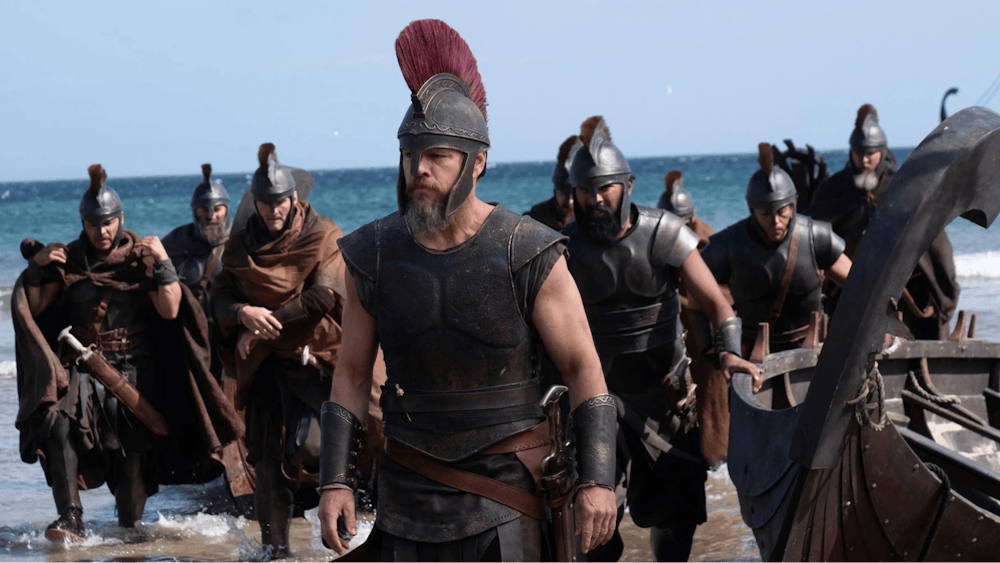
Christopher Nolan’s “The Odyssey,” a headlining film of summer 2026, turned the Mediterranean into a crossing where each horizon radiates distance and the promise of return threatens to fall apart.
Odysseus (Matt Damon) moves between wreckage and memory like a man already out of time. Penelope (Anne Hathaway) has reigned over Ithaca for 20 years beside their son Telemachus (Tom Holland), while Antinous (Robert Pattinson) and the suitors feast upon a life that isn’t theirs.
Under all of this is Zeus’s law: “treat strangers as we be treated because they might be gods in disguise.” However, Penelope’s suitors’ residence in Odysseus’ palace while he is away is a violation of this law. They eat another man’s food, bother his wife and treat a house that isn’t theirs as if hospitality were a right — the home Odysseus is attempting to come back to is already falling apart.
Being released in a decade filled with arguments about borders, refugees and what makes a stranger, “The Odyssey” demonstrates what it looks like to lose your home, and how people who fear outsiders become the outsiders themselves.
After leaving home to support the Greeks in the Trojan War, Odysseus’ years spent at sea are flooded with figures who make the old tale feel alive rather than mythological. Athena (Zendaya) appears like a conviction Odysseus can’t escape, serving as a reminder of the violence he and his men left behind.
Circe (Samantha Morton) and Calypso (Charlize Theron) turn delay into a trap. Circe offers refuge and a hot meal, then shifts Odysseus’ men into pigs. Calypso offers a peaceful life and a quiet place to hide from the guilt of the Trojan War. Significantly, neither temptress had to drag Odysseus off course but instead provided a reason for him to stop; the longer he stops, the more he forgets his way home.
Circe, in particular, is portrayed as a traumatized old woman with a worn-out appearance and dirt-smudged face living in a gloomy hut and small animal farm. When Odysseus’ starving, aggressive men arrive seeking food, she serves them a home-cooked meal, which they greedily devour. She then grotesquely transforms their bodies into pigs as if playing with clay.
The spell is used to reveal the men’s true violent and animalistic nature. In an interview, Morton has expressed that she viewed Circe’s character as a survivor who evokes women to speak out against abuse.


The innovative cinematography keeps the film from becoming a lecture. The camera doesn’t rise above Odysseus to explain the monsters or reduce his journey to a lesson. It’s positioned close enough for the audience to count the number of men who don’t survive Odysseus’ journey, depicting the cleverness with which Odysseus won Troy as the same cleverness that keeps costing him his crew. This makes the later violence at the palace harder to accept as justice, as the audience has already watched him survive at the expense of others’ lives.
Working with cinematographer Hoyte van Hoytema, Nolan shot the entire film on IMAX 65mm, a format traditionally avoided for dialogue because the cameras are usually too loud. Nolan utilized new sound-dampening cases and a quieter camera built for production to allow the actors to speak in the same frame as the sea.
Van Hoytema often carried the camera on his shoulder, sometimes with Nolan steadying him, allowing the camera to move like a person rather than a machine — the glass obeys Nolan’s command. The camera lenses remain close enough to make the audience feel as if they are on deck without flattening the water into a postcard. Through this technique, the esteemed director wanted the audience to feel as if they were inside the Trojan Horse and on the ship.
By the time Odysseus returns to his palace, the horizon hasn’t drawn any closer. The distance the film opened on remains, only now it rests between the man who left and the palace that waited. In Odysseus’ return, Penelope and Telemachus receive someone the voyage has remade and the victory at Troy has followed home in the form of guilt, wisdom and blood. The Mediterranean stays wide, the promise of coming back still threatening to fall apart and the last meeting in the palace can’t gather what the sea has already scattered.
Odysseus has made it home, but Nolan leaves the audience questioning whether the man who returned can ever truly recover what he lost along the way.
This article was edited by Vaughan Noble, Jessica Ackerman and Gabrielle McNamee. Copy editing by Avery Grossman, Arin Burrell, Jaden Maitland Anderson, Ryan Sieve and Rena Jalon. Fact-checking done by Josie Burnette.
