
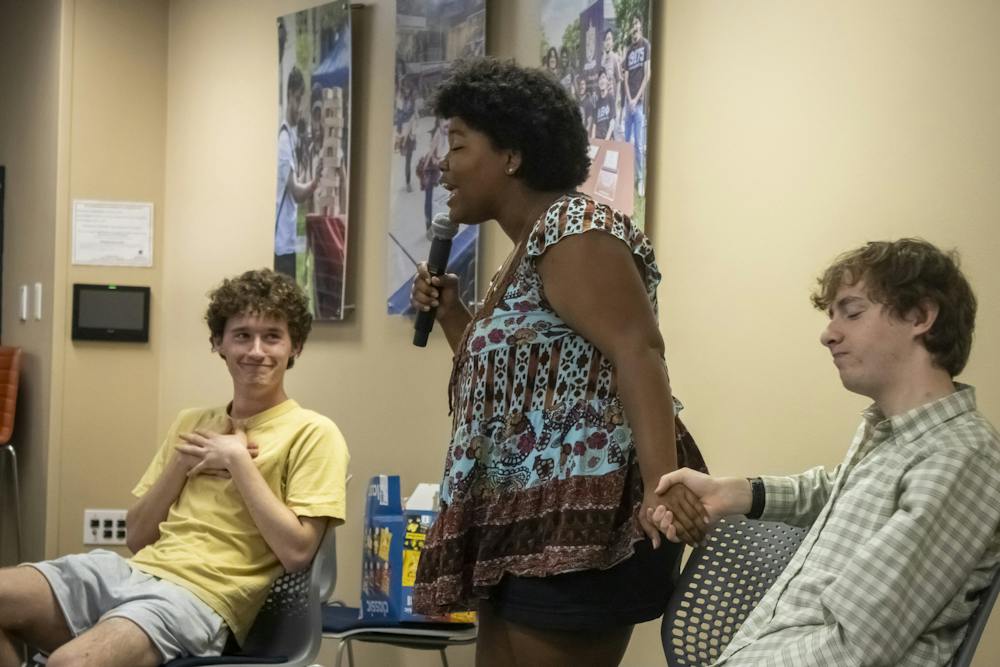
When Eric Steinberg took personality tests at the beginning of high school, his results were always the same: introvert. Now, after years of performing improv, the American University junior says his results are closer to a 50-50 split.
Steinberg, a public relations and CLEG major and the director of AU Improv, credits the club with helping him become more comfortable in his day-to-day life. Instead of worrying about how he comes across, improv has given him the ability to step into unfamiliarity.
“It’s allowed me to come out of my shell more,” Steinberg said. “I can approach a situation like I’m playing a character, or like I’m doing a scene.”
For the 13 members of AU Improv, the stage is more than just a place to make their audience laugh; it’s a space to try something new and make mistakes. Actors learn to trust the people around them even when a scene falls apart.
AU Improv spends Sunday and Thursday evenings rehearsing different games, trying out new material, working on scenes and giving each other feedback, even when the jokes don’t land. Their performances are unscripted, so performers respond to audience suggestions and build scenes in the moment. Upcoming shows are scheduled for Oct. 23, Nov. 13 and Dec. 11, giving the American University community opportunities to see these spontaneous performances come to life on stage.
When Holland Swan, a sophomore in the School of International Service, first joined AU Improv during her freshman year, she wasn’t looking to become a performer. She went along with two friends who decided to audition on a whim, and though she had never done anything like it before, she was asked to return.
During her first performance, Swan said she felt the same anxiety as if she were being called on in class, only now, she was in front of an audience of about 60 people. Over time, it got easier to respond without knowing exactly what to say, and she said she felt support from the club’s community.
“Everyone is really committed to making it a safe environment,” Swan said. “Respect is the baseline, which I really appreciate.”


For Steinberg and Swan, improv has helped them become more comfortable with uncertainty and public speaking. For Lizzy Fleming, a senior in the School of Public Affairs, the club became a place where she could test her social anxiety and find a community.
Fleming had performed improv in high school, but swore that she would never do it again in college. Though she had enjoyed the time spent with friends, she remembered feeling terrified while performing. After arriving at the University and failing to find a club that felt “fun,” Fleming ended up at improv auditions.
Four years later, Fleming said the club has become a unique place where she has developed close friendships and watched members grow.
“It’s an art space where you kind of get your own place to exist, and make a community, and then you can invite other people to come watch it, which feels special,” Fleming said.
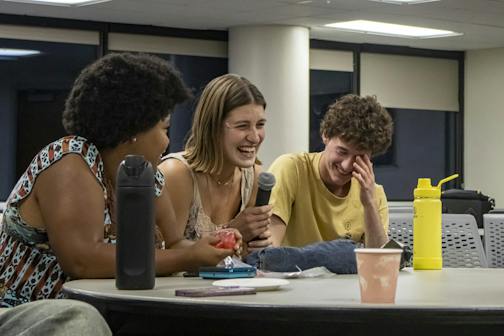
From the audience, improv might look effortless: performers respond to random suggestions, build scenarios and make decisions without knowing what will come next.
That uncertainty is also part of the value for Brady Sternberg, a junior in SPA. Sternberg participated in debate in high school and said the experience helped him develop skills that transferred into performing, including thinking quickly and working toward another person’s shared goal.
In debate, Sternberg was working toward a specific argument. But in improv, he has to be willing to let go of that control and follow wherever a scene takes him, as well as not take himself too seriously.
“When you do improv, you have to leave all ego at the door,” Steinberg said. “It’s only when you have released all expectations from yourself and from any sort of public persona that you are then allowed to be funny and allowed to actually have some sort of fun, because otherwise, it’s mortifying.”
For members of AU Improv, becoming comfortable on stage doesn’t necessarily mean turning into a whole new person, or fitting into a personality test. Instead, it means learning to let go of the pressure to perform a version of themselves that feels safe or expected.
“Most people can do improv,” Steinberg said. “They don’t realize they’re doing it. I think that we do it a lot, just in our everyday lives, when we’re trying to have a conversation with people, and we don't know what to talk about, but we're gonna make it work.”
This article was edited by Olivia Wood, Cara Halford and Gabrielle McNamee. Copy editing by Avery Grossman, Arin Burrell, Abigail Jose and Mattie Lupo. Fact-checking done by Josie Burnette.
features@theeagleonline.com
