
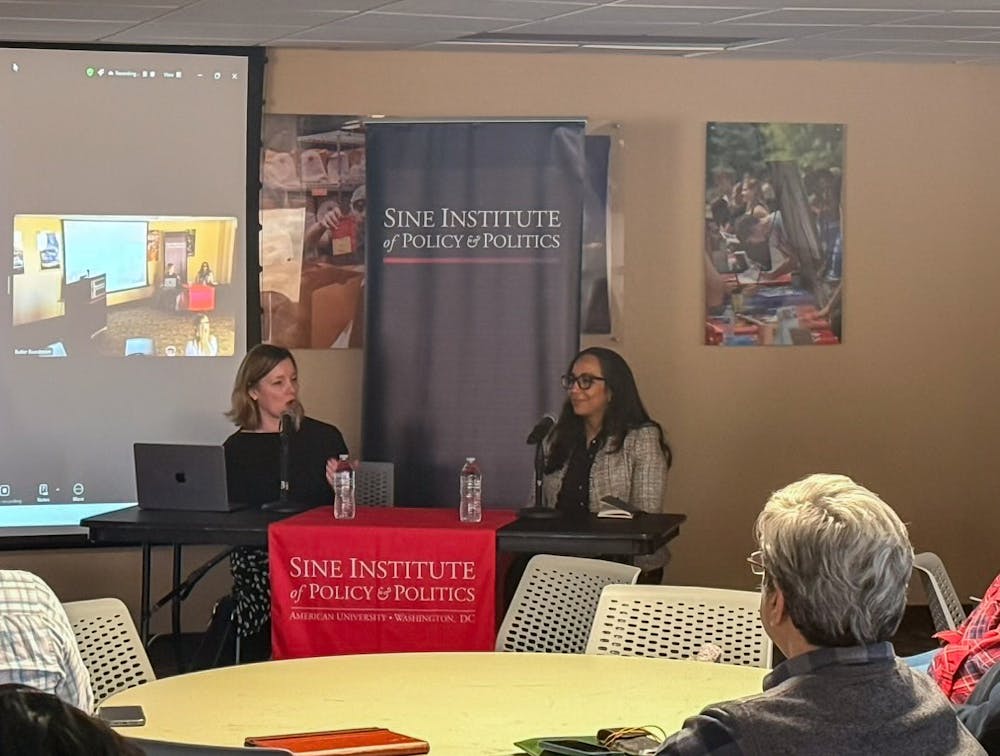
Pollster and founding partner at Echelon Insights Kristen Soltis Anderson challenged students at American University to re-evaluate how their fellow companions can engage more in conversations on political engagement, looking past the increasing polarization.
On March 19, Anderson joined students during a seminar hosted by the Sine Institute of Policy and Politics 250+ American Fellows series. The panel also featured journalist Rachel Janfaza and Future Caucus President and CEO Layla Zaidane.
Anderson opened the discussion on the need for young voters to understand today’s political climate, stressing the importance of amplifying perspectives that are often overlooked.
“It’s going to have to involve listening to voices who aren’t always the loudest, aren’t always the most extreme,” Anderson said.
Zaidane also discussed how young people are stepping into political roles to make an impact within their communities. She said many are motivated to act as a representative voice for their generation.
“They have gotten excited about making change because they saw a problem that they felt like nobody else was solving,” Zaidane said.
Young people enter politics by growing their communities through consistent advocacy and policy change. Despite the growing involvement of younger people in politics, Zaidane said there are still significant barriers, like financial challenges and safety concerns, that discourage them.
Janfaza echoed a similar sentiment, adding that Gen Z is often misunderstood in political conversations due to sweeping generalizations and stereotypes of being unmotivated and ill-mannered.


“The biggest misconception about Gen Z is that we all think, act, behave, dress, look the same,” Janfaza said.
She explained her theory about how there is a division within the generation, which she described as Gen Z 1.0 and Gen Z 2.0.
According to Janfaza, both groups are shaped by differences in major global events as well as developments in technology. The COVID-19 pandemic and rise of new social media platforms have created distinct perspectives and daily challenges that could differ across the generation that spans 15 years, Janfaza said.
“You look at someone who’s born in 1997 and someone who was born in 2011 and they have sort of little in common,” Janfaza said.
Zaidane said her organization connects young lawmakers across differences to encourage collaboration rather than political division.
“What we saw in our political system was that there were two rooms, the Democrat room and the Republican room, and young people … weren’t actually connecting with each other,” Zaidane said.
Janfaza said that the disconnect between groups leads to misunderstandings in how older generations interpret Gen Z’s needs and priorities, which means policies aimed to appeal to younger voters end up not addressing their needs.
Ozzie Salarini, a freshman in the School of Public Affairs, said this discussion helped him better understand the generational differences in politics. He also said the talk shifted his mindset on younger leadership, nationally and locally.
“I don’t feel like a 45-year-old is a young person, but then relative to the rest of Congress, they are,” Salarini said.
The panel speakers all emphasized how civic engagement extends beyond elected officials and institutions, starting with students participating in discussions and community-building efforts.
Sydney Haughton, a sophomore in SPA, said the importance of improving collaboration across different political groups stood out to her.
“We need to have a lot of discussions and collaborations, even from different viewpoints and then bringing those together,” Houghton said.
Janfaza said that, growing up today, there are constant periods of instability that are shaping how Gen Z views politics and society. As a result, young people are more aware of what is happening in the world, but also still struggling to process it all, she said.
According to a 2024 Sine Institute survey, 83 percent of America’s youth reported feeling worried about the state of our democracy.
“It’s just a hyperawareness to our surroundings and to a lot of the chaos that we have grown up with,” Janfaza said.
This has contributed to growing frustration among younger voters toward political institutions where trust has eroded, she said. This growing frustration can make it more difficult for young people to break into political roles, feeling as though their voice does not matter as much.
Nonetheless, Janfaza said that Gen Z remains persistent in politics despite the growing frustrations with political institutions.
“Just because Gen Z is so frustrated … doesn’t mean that they aren’t still participating in the political process,” Janfaza said.
This article was edited by Natalie Hausmann, Payton Anderson and Walker Whalen. Copy editing done by Avery Grossman, Paige Caron, Mattie Lupo and Ava Stuzin. Fact-checking done by Andrew Kummeth.
