
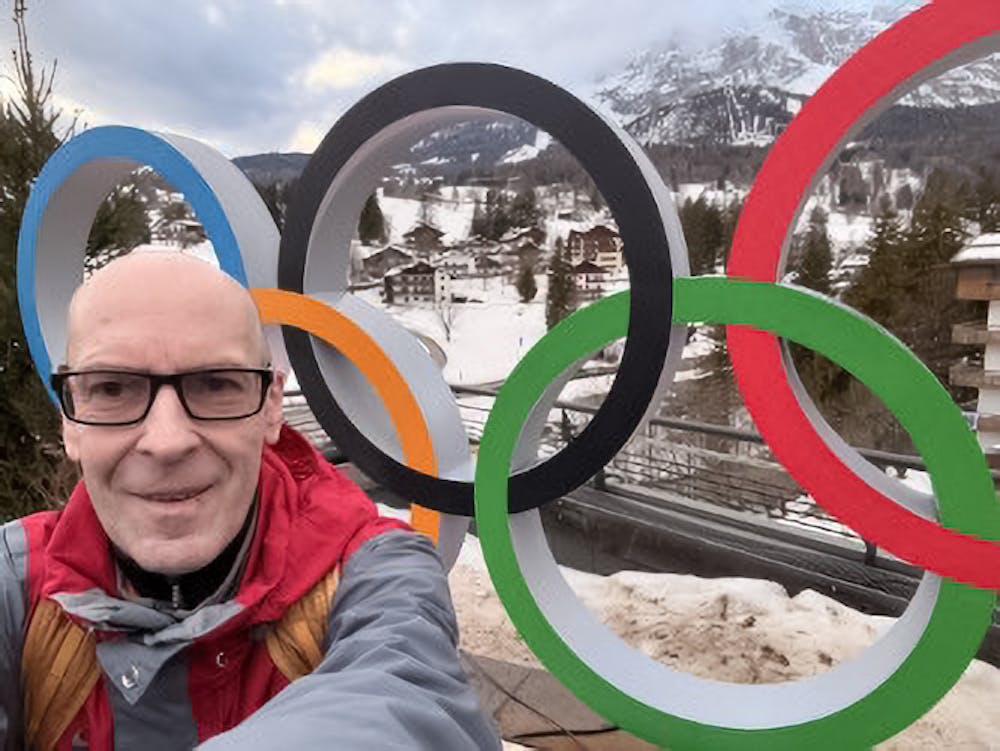
In February, over 22.7 million viewers watched the 2026 Winter Olympics held in Milan and Cortina, Italy. One member of the American University community was on the ground for all the action.
It was a conversation with a former student that sparked the interest of Scott Talan, a professor in the School of Communication, in going to the 2008 Summer Olympics in Beijing.
“I remember clear as day, we were talking about what people do over spring break, and she goes, ‘Oh, I went to the Olympics.’ And I started to think, ‘Wow, I’ve never been to the Olympics, and here’s a student going,’” Talan said.
With a background in media and journalism, he found watching other countries’ coverage of the games and human interest stories to be an eye-opening experience.
“It’s a reminder that even though the world comes together, each country has their own broadcasting rights and their own interests with showcasing their athletes,” Talon said.
Since then, he’s attended the Olympics in Beijing, Vancouver, Paris and just returned from Italy with plenty of stories to share. For Talan, the scenery and walkability of the host cities distinguished the 2026 Winter Games from his past experiences.
“You could just walk through the main pedestrian-only thoroughfare, Corsa Italia, and go see an Olympic sport,” Talon said. “Being surrounded by literally 360 degrees of amazing mountains sort of makes you seem like you're in the center of the universe.”
The Winter Olympics in particular showcase many sports that the average viewer doesn’t get to see every day. Curling made headlines at the 2026 Games, which Talan considers his favorite event because of its slow pace and friendly culture.



“In a chaotic, crazy, busy world filled with notifications and too much news, curling is a relaxing breath of Zen sportsmanship,” Talan said. “They have a thing called broom stacking, where after you play someone, your opponent, you stack the brooms in the corner and you have a beer together.”
Outside of sporting events, Talan shared his admiration of the cultural elements of the Games.
“That was part of the [Pierre] de Coubertin sort of vision that culture would be part of athletics, they were not separate,” he said, a reference to the founder of the modern Olympic Games who awarded medals for cultural pursuits.
Among the cultural Olympic events Talan attended was a water show in Venice that highlighted the city’s history — featuring flaming barges, acrobats and vertical jet skiers. Talan said he'd love to see more coverage of the Olympic’s cultural events in NBC’s programming.
Talan said his experience meeting fellow spectators was also positive, noting that they were eager to make friends from around the world.
He also visited several countries’ hospitality houses, many of which were open to the public and offered food, cultural activities and opportunities to meet fans. Some countries, such as Slovenia, used their hospitality houses to attract business to their country.
At such a global event, you never know who you’re going to meet. One big surprise was running into actor Jeremy Renner, with whom he got a selfie and talked about the games.
“You have to keep your eyes open at the Olympics,” Talan said.
As a communications professor, Talan said he incorporates the Olympics into his teaching to apply course concepts. This semester, he had his Public Speaking class watch and grade a speech by International Olympic Committee President Kirsty Coventry and his Understanding Media class write about advertisements that stood out to them during the Games. He also created a photo journal to share with his classes about his lessons and experiences from his trip.
Looking ahead to the 2028 Summer Olympics in Los Angeles, Talan said members of the American University community hoping to attend should check out the sports they don’t always see on TV. There are several opportunities to purchase tickets during and leading up to the event, but he said finding accommodation is the trickiest part of planning a trip to the Olympics, and suggests tapping into personal networks or using Airbnb.
He also recommended that students interested in sports, event planning or international affairs should apply to be a volunteer.
“People were friendly and happy who were volunteering, it really helps the experience,” he said.
Talan’s strategy for LA 2028?
“I’m going to be literally very chill,” he said.
Skateboarding, which will be inducted as a mandatory sport starting in 2028, is at the top of his list, along with catching a California sunset and trying some Los Angeles tacos. He hopes Los Angeles takes the opportunity to distinguish itself from past host cities by highlighting what makes it unique.
“That’s part of why cities are willing to do this investment, is this hope and expectation that people are like, ‘Oh man, I love being in that city. I want to return sometime when the Olympics aren’t there after the games are done.’”
From celebrity encounters and action-packed sporting moments to lessons for the classroom, it’s safe to say Professor Talan made the most of his 2026 Winter Olympics experience.
This article was edited by Matthias Jaylen Sandoval, Jack Stashower and Walker Whalen. Copy editing done by Avery Grossman, Ryan Sieve, Mattie Lupo and Nicole Kariuki.
