
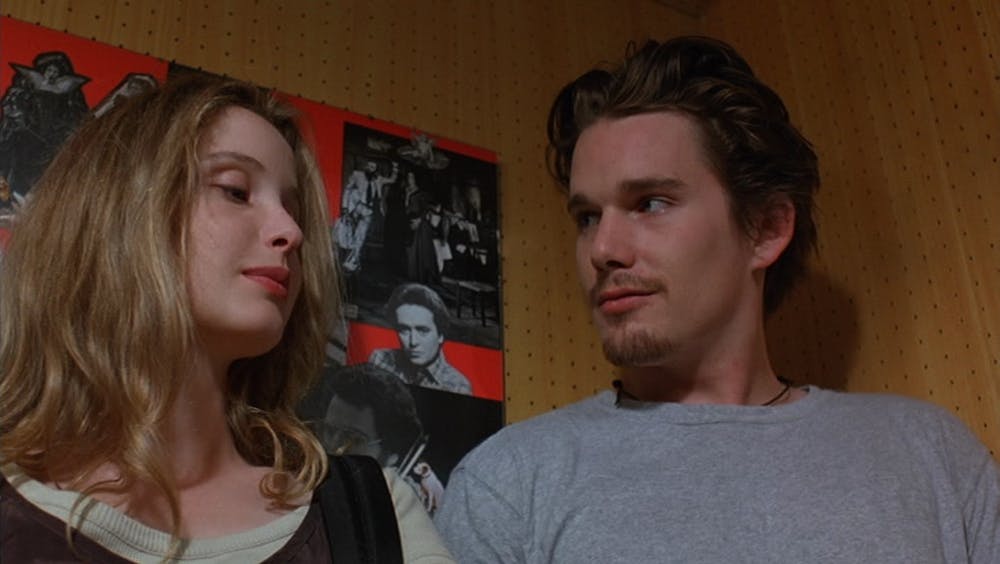
Richard Linklater’s unique approach to cinematic expression solidifies his place as one of the most influential directors of all time.
Linklater’s films are much more in tune with real time and are less focused on fast-paced, conflict-driven storytelling. In his feature releases and short films, the Texas-based director’s filmography explores the complexities of change and coming of age, through character-driven stories and distinctly Linklater dialogue exchanges.
“I just like the idea of moments because to me that’s what cinema is,” he said during a New York Film Festival panel.
“Slacker” (1990)
Linklater’s second film, “Slacker,” is a snapshot of youth experiences in Austin, Texas. The film has no lead character or ensemble. Instead it moves through 24 hours, ebbing and flowing between over 100 different people — or so-called “slackers.”
“Slacker” is a quintessential example of Linklater’s iconic dialogue-based style. Viewers often question whether the film was scripted due to its realism and documentary-based nature.
The director’s debut film highlighted the shared feeling of a generation capturing counterculture in Austin. The movie was brought to life on a $23,000 shoestring budget.
“Slacker” is available to stream on Tubi.


“Dazed and Confused” (1993)
In “Dazed and Confused,” Linklater transcends the boundaries of time. The film, which can be considered one of the most iconic of the 1970s, was actually created in the 90s. Linklater’s “Dazed and Confused” is a cult classic chronicling the last day of high school in 1976.
The film makes for a loveable and comedic ensemble cast. Describing the plot of the film is meaningless because, in all honesty, not much happens. Despite this, the characters, dialogue and soundtrack are unforgettable. The film places greater emphasis on feelings than on historical accuracy.
Linklater revealed to Variety that his goal with the plot wasn’t to glorify or reminisce about what it was like to go to high school in 1970s Austin, but rather to convey how he actually felt in a way that deeply resonated with viewers.
“Before Sunrise” (1995)
“Before Sunrise,” the first of the iconic “Before” trilogy, is sometimes labeled the greatest love story of all time.
Over the course of one day, Jesse (Ethan Hawke) and Celine (Julie Delpy), explore the city of Vienna. The two converse about the state of the world, their own lives and deeper questions of the universe. As the night progresses, their intimacy grows.
Linklater’s ability to craft a beautiful story, primarily through dialogue and connection. In contrast to the common third act argument between the couple followed by a romantic resolution, astounds the viewer, immersing them into the city and scenes.
The film is followed sequentially by “Before Sunset” (2004) and “Before Midnight” (2013) as the characters and their romance mature. It is a great way to start tackling Linklater’s filmography and admittedly, my favorite film of all time.
“School of Rock” (2003)
Richard Linklater told Variety that “School of Rock” had been brewing in the back of his mind for a long time. He explained to Variety that at the time, he didn’t think he could direct a studio comedy, but reluctantly did after becoming a father.
“School of Rock” became one of his most popular movies and a masterclass in comedy. The film iconically stars Jack Black as Dewey Finn, a small-time musician who poses as a substitute music teacher and introduces his students to hard rock music and its legends.
While the film has more plot than other Linklater essentials, it is still grounded in character connection and heartwarming moments.
“Boyhood” (2014)
“Boyhood” has one of the most unique approaches to plot in cinema history. The film follows Mason (Ellar Coltrane) as he grows from a first grader to a senior in high school. What is especially fascinating is that it truly does; the film’s production occurred a little bit every year of Coltrane’s life as the actor actually grew up.
In addition to Coltrane, the rest of the cast, such as his parents and sister, remain the same actors as well. It is composed of vignettes of Mason’s life. “Boyhood” is a true and unprecedented coming-of-age film and a staple of the genre.
Linklater’s filmography is unlike any other. Each film will undoubtedly leave an invaluable mark on the viewer, no matter what stage of life they are at. His films are for the slackers, the romantics and the creatives.
Discover your favorite Linklater film through the list on The Eagle’s Letterboxd.
This article was edited by Alfie Pritchard, Jessica Ackerman and Walker Whalen. Copy editing done by Avery Grossman and Ava Stuzin.
