
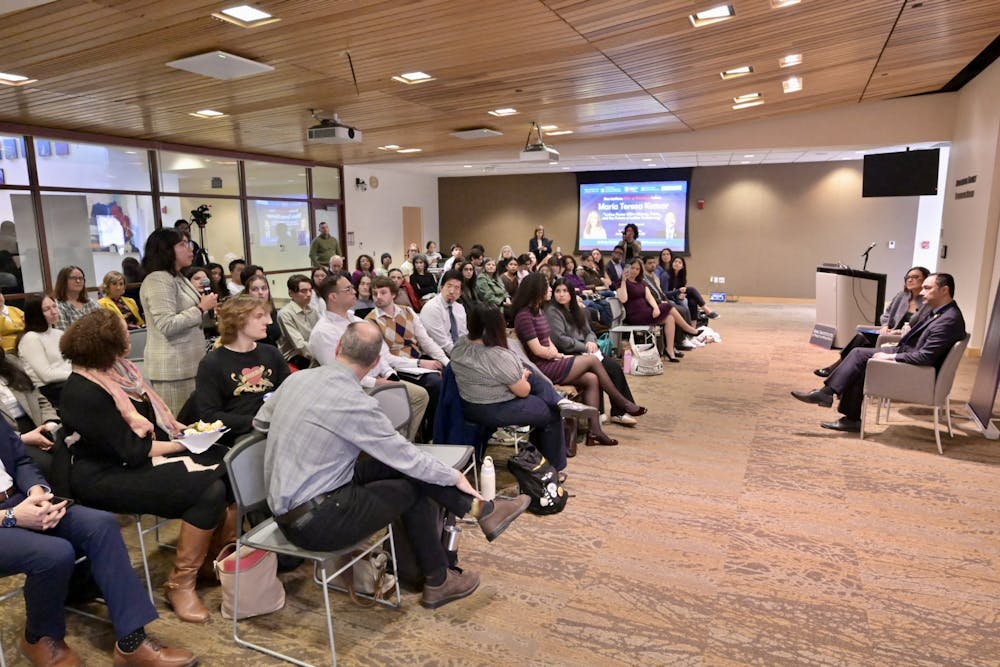
Students heard from Texas Congressman Joaquin Castro and activist Maria Teresa Kumar at a Sine Institute of Policy and Politics event on Feb. 25, featuring a timely conversation on how Latino identity and leadership shape American civic life.
The event was hosted collaboratively with 250+ at American, the Democracy Innovation Lab, The Immigration Lab and the Center for Latin American and Latino Studies.
Kumar said that the majority of attendees were younger voters who she said can affect the country by being politically active and voting.
“When you decide to participate,” Kumar said, “It will change the course of the country.”
Kevin Gomez-Salazar, a freshman in the School of International Service, said his main takeaway was to get involved in voting and encourage others to do the same.
“One-hundred percent making sure that as a young voter, that you are encouraging others to vote,” Gomez-Salazar said. “That you are doing what you can to be involved.”
Kumar began the moderated conversation by talking about the State of the Union address and the SAVE America Act, a bill that would require proof of U.S. citizenship when registering to vote in federal elections, which resulted in controversy due to millions of people lacking access to the documents they would need, as well as the implications for married women. She asked attendees to raise their hands if they knew what the act was. Most did.
She also spoke about previous cases like the Shelby County v. Holder (2013), where voting access was restricted in a landmark Supreme Court decision. Speaking to the congressman, Kumar said that there is a battle surrounding gaining access to voting in America.


“And so right now, there seems to be really, Congressman, a battle of a multicultural America within access to the voting booth,” Kumar said, “and a really strong effort to prevent that from happening.”
Castro said diverse countries like the United States resolve their differences by voting. He said when the government steps in and takes away a certain group’s right to vote, it is trying to remove a certain viewpoint from the polls. He said that when the government begins implementing obstacles to vote they are essentially attempting to disenfranchise a group of people.
“Whether it’s a racial minority or racial ethnic minority, or a group of folks who believe certain things,” Castro said.
The speakers also noted how technology allows us to document what is happening and share it, which can help change public opinion and eventually public policy.
Rep. Castro also highlighted the case of Liam Ramos, a five-year-old who was taken into Immigration and Customs Enforcement custody along with his father in Minnesota despite both being legal residents. Castro helped to release them both. He said there are hundreds of kids in the same detention facility, but Ramos’ case stands out because it was documented on social media.
“So that’s what made it especially powerful,” Castro said. “Without those images, I don’t know that his story or his case gets even half the attention that it would, and I met many other kids who are just like him.”
Rachel Gonzalez, a freshman in the School of Public Affairs, said she has been following Voto Latino, a non-profit organization founded by Kumar in 2004 dedicated to educating and empowering Latinx voters, for a while. She said that her takeaway from the event was that you can keep educating yourself and participating without feeling like democracy is irreparable.
“This was a really good way to demonstrate how you can keep, you know, being educated and keep participating without feeling that hopelessness,” Gonzalez said.
In the closing remarks, Julia Cucchiara, a student associate at Sine and a junior in SPA and the School of Communication, said she hopes attendees leave with more of an understanding of the importance of the Latino community to democracy in the United States.
“I hope we take with us not only a deeper understanding of the remarkable contribution that Latino communities have made to American democracy,” Cucchiara said. “But also a renewed commitment to active citizenship and inclusive participation.”
This article was edited by Natalie Hausmann, Payton Anderson and Walker Whalen. Copy editing done by Avery Grossman, Jaden Maitland Anderson, Mattie Lupo and Ava Stuzin. Fact-checking done by Andrew Kummeth.
