
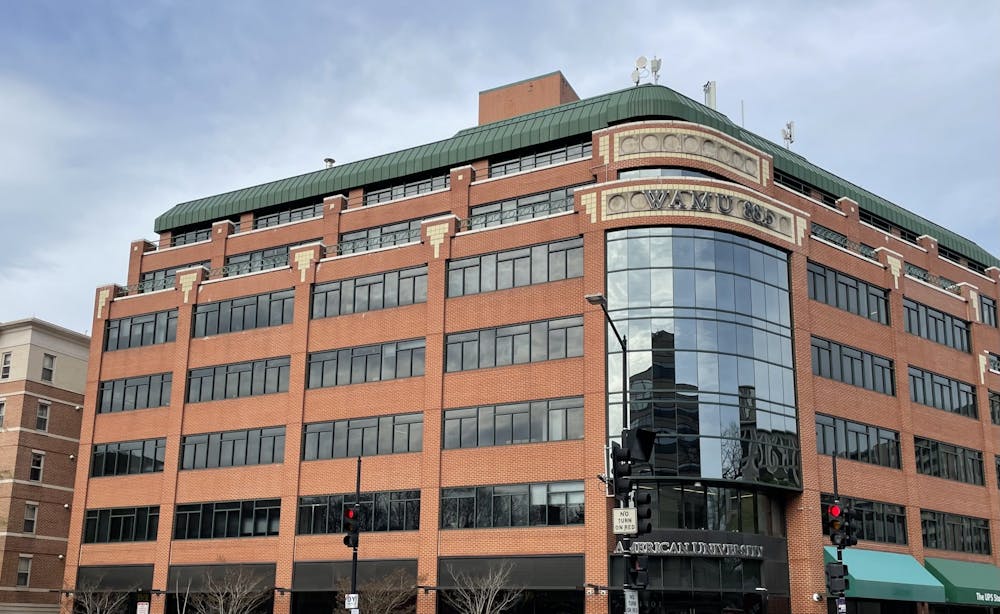
WAMU has been one of D.C.’s leading radio stations for years. When Congress cut federal funding to all public media, it was ready to weather the storm.
The D.C. affiliate of NPR has shifted its focus to audio programming with increased arts and culture reporting, following the congressional rollback of the funding from the Corporation for Public Broadcasting in July.
This resulted in an approximately $1.5 million annual loss for the local station.
Michael Tribble, WAMU’s chief content officer, said shoring up popular radio programs has been important in sustaining the American University-owned news station after losing 4-5 percent of their operating budget. In an effort to stand out, WAMU has honed in on shows like the nationally syndicated “1A,” which invites listeners to call in about political topics.
“When you hear people talk about their experience, there’s an empathy to it and an understanding that you’re human,” Tribble said. “It’s not just about numbers, it’s not just about a certain policy.”
But changes began even before the financial cuts came along. In February 2024, WAMU eliminated the station’s digital site, DCist, alongside laying off 15 staff members. The former WAMU staffers soon joined forces to open a reporter-led newsroom called The 51st to compensate for what they saw as a void in local accountability journalism.
In places like Alabama, Florida and Oregon, stations have dropped national programming in favor of prioritizing local reporting.
At WAMU, attention has turned to more arts and culture news with airtime for both NPR classics and WAMU originals. While Tribble said reporting hard news, especially reliable breaking news, remains a priority for WAMU, bringing a sense of levity and “capturing excitement” remains equally important for community engagement.


Without excitement to tune in to the news in the first place, Tribble asserted, then no news would be heard at all.
Tribble said changes have paid off as the station’s share — or percentage of total listeners, compared to the time spent listening — has increased in recent months.
In 2023, listeners spent five hours on average tuning in to WAMU each week, according to the station’s annual report. No listener data is available for 2024 or 2025.
While Tribble said WAMU “[doesn’t] share numbers,” he added that the station has “seen a steady share of growth in the mornings, which has been our big focus since the spring.”
According to the station leader, WAMU is getting closer to its objective of one in five people in greater Washington turning to the station for daily news.
One of those listeners is Nidhi Kallur, a senior in the School of Public Affairs and self-described “NPR baby.”
Originally from Austin, Texas, Kallur said she has been listening to her local station, KUT 90.5, since her car rides to school in a car seat.
When she came to D.C. for college, it was only a matter of time before her dad found WAMU and made sure she had it programmed on her car’s radio Kallur said both her parents loved Diane Rehms “On My Mind,” a production of WAMU that ended just earlier this year in May.
A strong base of supporters has kept the station afloat as well, with an influx of donations through the Protect My Public Media campaign after funding cuts were first announced.
“Our community values WAMU and the service we provide, and they’ve been consistently supporting our work at increased levels for most of the last year,” Tribble wrote in an email to the Eagle.
And it’s not just those in D.C. who listen to D.C. news. For Gerry O’Malley, of San Marino, California, the radio show has been a staple since his son became a student at the University.
O’Malley said he wanted to feel more connected to his son’s new community, and the reporting at WAMU offered more consistent programming than some of his own local stations.
“I’m retired now,” O’Malley said. “So I’ve fallen into a routine where I go out and do some errands during the day and then I come back and put [WAMU] on in the afternoon.”
While O’Malley referenced nationally syndicated shows like “Fresh Air” and “All Things Considered, as two of his favorites, he noted that learning about the city his son lives in is what keeps him coming back.
Segments with original reporting from WAMU include “Morning Edition,” “The 1A,” “Hot Jazz Saturday Night,” “The Big Broadcast” and Kojo Nnamdi’s The Politics Hour.
“The strength of NPR is their truth-telling and research,” O’Malley added about the national station, and voiced concern over how both funding cuts to and political attacks on public media might affect coverage.
Tribble echoed this sentiment as he noted the difficulties in reporting during a time of greater intensity in politics. In D.C., the administration’s animosity toward the media and policies that impact community members, like the deployment of the National Guard, has compounded general fear and adversity toward the media at large.
That’s why it’s been a priority for WAMU to establish trust within the community and sustain listener momentum by working toward better community presence and engagement across its social media platforms.
“It’s also not declaring victory,” Tribble said. “It’s going to be a lot more work to try and manage to fill those gaps.”
This article was edited by Gabrielle McNamee, Abigail Hatting and Walker Whalen. Copy editing done by Sabine Kanter-Huchting, Emma Brown and Ariana Kavoossi.
