
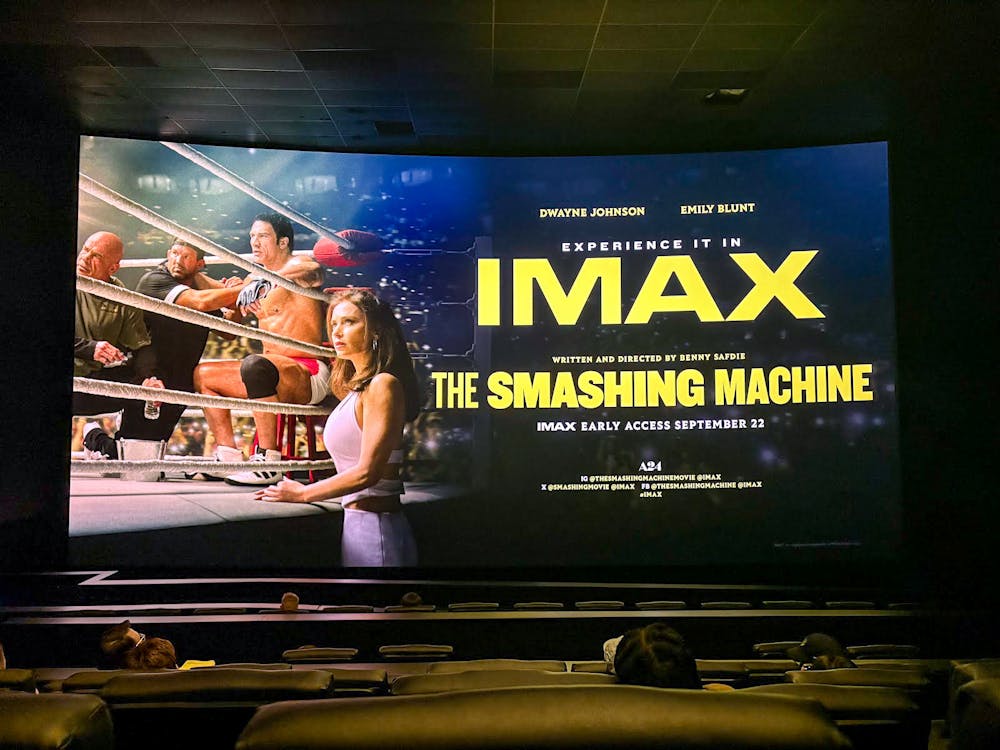
“The Smashing Machine” marks Director Benny Safdie’s first major film award, the Silver Lion, presented at the Venice International Film Festival earlier this September. The Silver Lion is an award presented to the runner-up nominee for best directing achievements. But prior to “The Smashing Machine,” you may recognize Safdie from “Good Time” (2017) and “Uncut Gems” (2019).
Many viewers may see the “The Smashing Machine” trailer and think: “Wait, another movie where Dwayne Johnson plays himself?” Especially with his most recent movies —”Moana 2” and “Red One” — it seems he has a specialty for the strong and comedic archetype. He’s a well-known actor, but not for the emotional depth he brings to his characters.
So when “The Smashing Machine” hit theaters on Oct. 3, it was no wonder that audiences were taken aback by Johnson’s noticeable shift in persona for his role as Mark Kerr.
The biopic follows the latter half of Mark Kerr’s Mixed Martial Arts (MMA) career, as he struggles with the first shakes to his winning streak, drug abuse and a complicated relationship with then-girlfriend Dawn Staples (Emily Blunt). As a side plot, the film also showcases Kerr’s friend, the MMA fighter Mark Coleman (Ryan Bader), as he steps back into the spotlight of the famed wrestling league.
The film also features cameos of the real Mark Kerr at the end, as well as former MMA fighter Bas Rutten, who helps Kerr train for the competition on-screen.
One of the most memorable parts of the biopic is the development of the relationship between Staples and Kerr. Romantic, toxic and dramatic — the development of the relationship throughout the film parallels Kerr’s career and drug abuse. Although the acting of Blunt and Johnson is undeniably serious in subject matter, there are moments of comedic relief that can help draw the audience out of the drama.
Watching this relationship unfold on IMAX, I was caught off guard by the laughter in the theater; Blunt’s particularly emotional moments, paired with Johnson’s exhaustion from her antics, apparently struck audiences as funny.
The camera work and music of “The Smashing Machine” — especially in IMAX — is a chiefly memorable aspect of the film. Taking inspiration from the earlier documentary by a similar name, “The Smashing Machine: The Life and Times of Extreme Fighter Mark Kerr,” it feels like a stock VHS film with its intentionally gritty and raw aesthetics.



The experimental jazz that plays over fight scenes throughout the movie contributes to a heightened emotional atmosphere, placing viewers in the ring with Kerr as he fights other competitors in the Pride Fighting Championship from 1997 to 2000.
If you like other dramatic action films about professional fighters like “Warrior,” “The Wrestler” and “Raging Bull,” “The Smashing Machine” may be your next must-see.
“The Smashing Machine” is available in theaters now until late October. Then, it will be available for streaming on HBO Max.
This article was edited by Alfie Pritchard, Jessica Ackerman and Walker Whalen. Copy Editing done by Sabine Kanter-Huchting, Paige Caron, Ariana Kavoossi, Andrew Kummeth and Ryan Sieve.
