
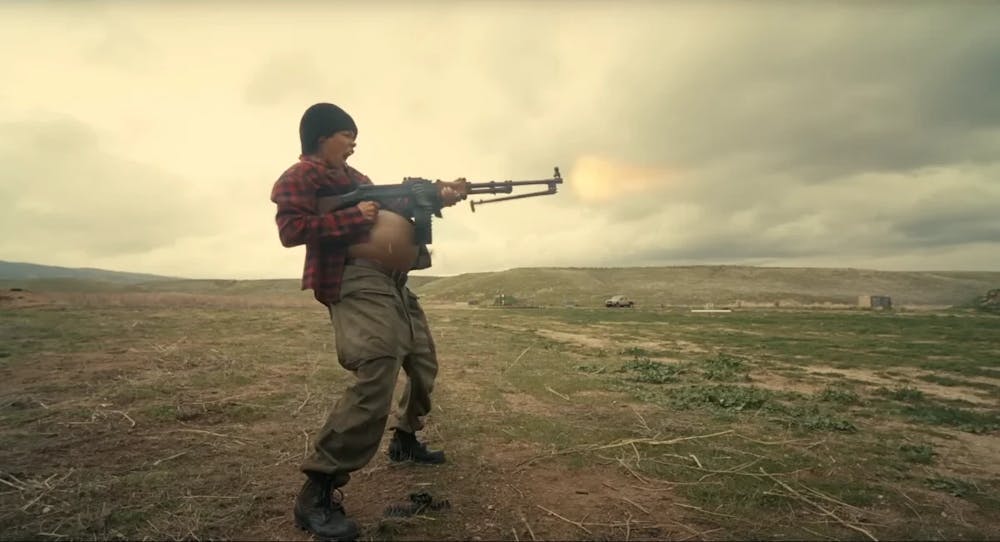
I’ve attended three early press screenings as a critic for The Eagle: “Napoleon” (2023), “Civil War” (2024) and now “One Battle After Another” (2025). “One Battle After Another” finished this strange, politically-charged trilogy of action and war films, and it showed me why I was so negative about the first two. And why I will instead sing the third’s praise for many years to come.
All three were ambitious and laced with a curious sense of humor. They carried the necessary narrative tools to become socially relevant pictures, but “One Battle After Another” achieved this alone, and it has only just been released in theaters.
“One Battle After Another” is the 11th in a long line of hits from writer-director Paul Thomas Anderson, who once again proves his credibility as an auteur with this film.
Set in a barely reinvented America, “One Battle After Another” kicks off by jumping into a story worthy of its own movie: the French 75, a group of dedicated revolutionaries, on a mission to take control of an immigration center and release the immigrants.
Spearheaded by the fearless Perfidia Beverly Hills (Teyana Taylor) and the group’s demolition man, “Ghetto” Pat Calhoun (Leonardo DiCaprio), the French 75 succeeds. Not without making a few enemies after Perfidia’s “provocative” interaction with Col. Steven J. Lockjaw (Sean Penn).
Perfidia and Pat’s child, Lockjaw’s obsession with Perfidia and a botched bank robbery eventually force the French 75’s hand. The members go into hiding, Pat takes the child, and the two adopt the identities of Bob and Willa Ferguson (Chase Infiniti).
Cut to 16 years later, cue “Dirty Work” by Steely Dan — a classic Anderson needle drop — and we’re now ready to take on “One Battle After Another.”
An appropriate title for the film, the next two hours form a sprawling epic of chase scenes and explosions, twists and turns and more. Or, to put it simply, the film is one battle after another — and another and another.

As we follow Bob’s search for his daughter, his journey becomes a wild one. Led by unrelenting kinetic camerawork, spectacle stunts and intense physical characters, the movie has more life and energy than most.
Unsurprisingly, DiCaprio does a great job as our leading man. He embraces Bob as the coarse demolitionist, the paranoid stoner and the devoted father. His daughter’s portrayer, Chase Infiniti, can surely expect an influx of offers over the next few months — she is yet another gem that Anderson has unearthed.
The star of the show, however, is Sean Penn. Penn demands all attention when he’s on screen as Lockjaw, bringing a ridiculous quality to the perversion and anger of this racist army officer. Penn could easily expect to bring home the gold were there an Oscar for best on-screen walk. Alas, he can settle for Best Supporting Actor.
Penn was also one of the reasons why my entire theater was in hysterics half the time. Anderson always had a knack for a laugh, but never on such a scale before.
From Lockjaw’s absurdism to “Mo Bamba” by Sheck Wes and WALK THE MOON’s “Shut Up and Dance” appearances on Willa's high school prom setlist, Anderson and crew always keep the viewers on their toes. I wonder if they can look into trademarking “semen demon.”
The film’s vigor ultimately amounts to its powerful revolutionary attitude. Touching the highest and lowest echelons of power — from a secret society of white supremacists to an underground web of freedom fighters spread across America — it pokes and prods against the film’s fascist antagonists.
Bob’s taste in movies perhaps best exemplifies the strength of “One Battle After Another’s” attitude. Joint in hand, his choice for movie night is the classic staple of anti-imperialist cinema, “The Battle of Algiers” (1966).
Unlike “Napoleon” and “Civil War,” “One Battle After Another” makes solid contact with real structures of power.
An aimless chronicle of the rise and fall of one of history’s most notorious dictators, “Napoleon’s” step back in time renders the film irrelevant to contemporary life. Meanwhile, when “One Battle After Another” opens a door to the past, it results in a movie that is conscious of how history has shaped and still affects the modern world.
“Make sure you’re teaching them the right history,” Bob said to Willa’s teacher after seeing portraits of Benjamin Franklin and Theodore Roosevelt on her classroom walls. “You tell them about the Philippines?”
As seen here, Anderson is not afraid to ask the important questions in “One Battle After Another.”
The dystopian vision of “Civil War” loses impact by distancing itself from the real America. But “One Battle After Another” does not need to go through such leaps and bounds to become poignant.
Anderson knows when to draw heavily on real life, the French 75 liberating an immigration center, versus when to let the film’s imagination run wild — a secret society of white supremacists behind the curtain of the American empire. Even then, it’s not that far-fetched.
“One Battle After Another” is not another political thriller that trembles at the feet of the beastly political landscape it faces. It weaves through it with its striking sense of humor.
Any movie that can effectively include both the esteemed “The Battle of Algiers” and era-defining “Mo Bamba” is a special one. One of Anderson’s funniest and most important works, and one hell of a ride — “One Battle After Another” is a must-see.
“One Battle After Another” is in theaters now.
This article was edited by Sydney Hemmer, Jessica Ackerman, Walker Whalen. Copy editing done by Sabine Kanter-Huchting, Ariana Kavoossi and Emma Brown.
