
The following piece is an opinion and does not reflect the views of The Eagle and its staff. All opinions are edited for grammar, style and argument structure and fact-checked, but the opinions are the writer’s own.
During one Advanced Placement Biology lab in high school, my friend looked blue as she sat on her stool, hunched over the lab table.
Apparently, she was in agony from her period, which she claimed was a normal occurrence from her diagnosis of polycystic ovary syndrome, a hormonal disorder known as PCOS. Unfortunately, the story ends with her doubling over in pain, eventually vomiting and fainting during the lab.
That was five years ago, and yet, her symptoms persist with no remedy. Her doctors never dug deeper and claimed the only treatment was to take birth control, which worsened her PCOS symptoms and caused hair loss and irregular cycles.
She is not alone.
Women’s health concerns and pains are constantly downplayed by doctors and, combined with the lack of research for women’s health, inadequate treatment is not uncommon. Experts at Northwell Health write that female patients are often gaslit about their health, misdiagnosed or dismissed.
In a 2024 Kaiser Family Foundation study of over 5,000 women, one in three reported at least one of several experiences — doctors did not believe women, shifted the blame onto the patient, refused to prescribe pain medication, made assumptions or ignored a direct request — when seeing a provider in the past two years. Out of those women, one in five said their provider did not believe they were telling the truth, and one in seven said they were blamed for a health problem they were experiencing.
It is especially disappointing when reproductive health issues are ignored, since women’s reproductive health is already understudied, despite affecting women daily. Whoever said the menstrual cycle only affects women once a month lied. The physical, emotional and hormonal changes we undergo in each month-long cycle beg to differ.



So when a doctor brushes off pain or defaults to a single treatment for a complex issue, we carry the consequences daily.
To make matters worse, the Trump administration’s recent layoffs and comments on women’s health have pushed the country backwards at a time when women’s healthcare needs change.
In June, the Trump administration fired staff at the Department of Health and Human Services, which oversees the Centers for Disease Control and Prevention, who created national guidelines for clinicians to prescribe contraception for women with certain characteristics or medical conditions that places them at risk. It also downsized the Division of Reproductive Health, threatening resource access.
If women’s health were better funded and researched, doctors might not have to resort to one treatment. They’d have more resources and information to search for better options.
I would argue that the research disparity was at least partly responsible for what I call my “five months of hell” from birth control, similar to my friend.
As a journalism major with no background in science or medicine, the basis of my claim isn’t based on evidence with control groups, independent groups or any other fancy scientific term. All I know is that, for the first time, when I started birth control, I had severe panic attacks. Each time, I genuinely believed I was going to die, and I experienced major mood swings, heightened anxiety and borderline depression.
I was never debriefed on those side effects, and my gynecologist had no answers when I reached out. I later found out, through an investigation from my own curiosity, that most of my friends who took birth control experienced effects that took a serious toll on their lives before getting off the pill.
If there were more research on women’s health or reproductive medicine, the women who begrudgingly take on the adverse side effects may finally have answers.
Recently, President Donald Trump called for pregnant women to “tough it out” and avoid using Tylenol while citing an unproven link between the drug and autism in their unborn children. This undermines women’s pain and essentially blames mothers for causing autism in their children.
This double attack of cutting funding and attempting to control women through irresponsible announcements is a reflection of our country’s regression.
While research disparities, lack of funding and doctors’ harmful attitudes have systemic roots that will take years to untangle, the current politicization of women’s health makes advocacy for change more urgent than ever.
This issue calls for a multi-layered solution.
Doctors must recognize gender bias in their treatment and hear our calls for help instead of brushing them off. The government, rather than cutting funding, needs to increase it effectively. Men must use their privilege to advocate for our health.
As women, we need to continue speaking out, but remember to give our bodies grace and reject the agenda of “toughing it out.”
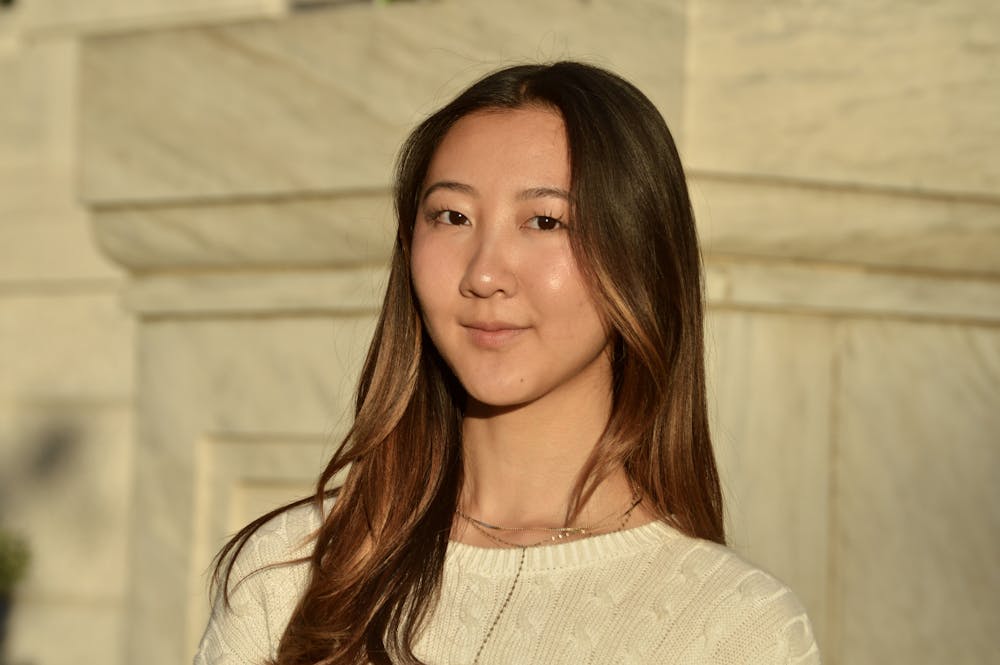
Sara Shibata is a senior in the School of Public Affairs and the School of Communication and a columnist for The Eagle.
This piece was edited by Quinn Volpe, Alana Parker and Walker Whalen. Copy editing done by Sabine Kanter-Huchting, Emma Brown, Arin Burrell, Paige Caron and Andrew Kummeth. Fact-checking done by Aidan Crowe.
