
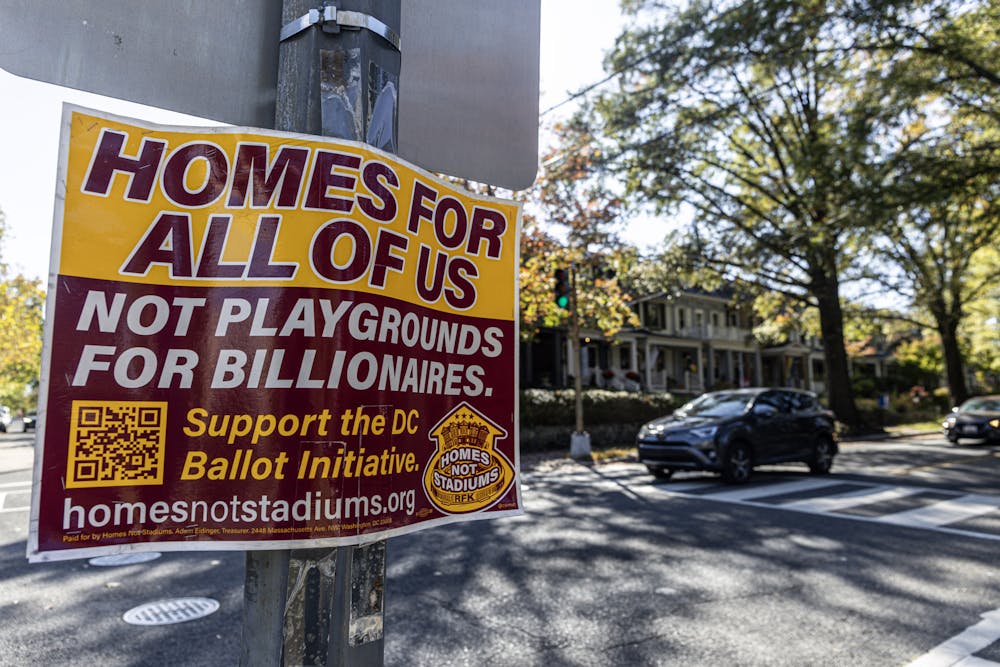
D.C. residents and activists first organized “Homes Not Stadiums” in response to the proposed Robert F. Kennedy Stadium for the Washington Commanders. Once a bill approving the stadium’s construction passed, they redirected their focus to creating more affordable housing for residents across D.C.
Homes Not Stadiums argued that the stadium would raise taxes for D.C. residents and responded by proposing a ballot initiative. The stadium will bring the Washington Commanders back to D.C., replacing their current Northwest Stadium in Landover, Maryland.
Adam Eidinger, one of the proposers for the initiative and an American University School of Public Affairs graduate from 1996, said the organization was founded by the coalition No Playground for Billionaires, which wanted the RFK site to benefit D.C. residents instead of housing a stadium.
The community responded to their cause and raised around $10,000, according to Eidinger, and about 100 people signed up to stay in touch with the organization.
Eidinger criticized Mayor Muriel Bowser and the Democrats on the D.C. Council for their support of the RFK stadium.
“There are oligarchy Dems that are really not going to stand up for the interests of taxpayers and the interests of the average person when a billionaire comes to knock,” Eidinger said. “If [Mayor Bowser] loses her job as mayor, [she] should probably go work for the NFL. She's done a lot for the NFL.”
On Sept. 17, the D.C. Council passed the amended bill with a vote of 11-2, and the bill is now being directed to Bowser. The legislation provides 6,000 units of housing, 30 percent of which would be affordable, according to an article from Street Sense Media. The $3.7 billion deal requires D.C. to pay $500 million for the infrastructure of the stadium, over $350 million for parking garages and $202 million for a transit study and utilities.
On June 12, before the bill passed, the Advisory Neighborhood Commission 3E, representing AU Park, Tenleytown and Friendship Heights, spoke about the proposal when the deputy mayor of education presented the mayor’s budget. Tom Quinn, treasurer and representative of 3E, shared his opposition, along with many other commissioners.


In an interview with The Eagle, Quinn said that he does not oppose a stadium, but that it is a bad deal for D.C.
“I think the District of Columbia is giving the team too much land without enough in return,” Quinn said.
While the ANC Commissioners discussed passing a resolution in their meeting, they ultimately chose not to.
“We sort of decided that the D.C. Council does not have to give great weight to an ANC resolution,” Quinn said. “So we could have passed something, but it just wasn't likely to have an impact on what the D.C. Council did.”
Homes Not Stadiums responded to the bill’s likely passage by drafting a new ballot initiative, according to their website.
The proposers titled it the Affordable Housing Act of 2026, intending to apply the D.C. rent control law to rental units permitted before 2001, instead of 1975. It also recommends lowering eligibility based on income for affordable housing benefits under the Inclusionary Zoning Program, creating more affordable housing and reserving more for the lowest-income families.
The organization hopes to define extremely low-income households as households of one or more persons with a total income of less than or equal to 15 percent of the area’s median income. Eidinger said this plan could benefit students.
“Students also often fall in this category of extremely low-income, and they need housing off campus,” Eidinger said. “We want to reshape the way people look at housing production allocations that are required by law.”
Eidinger predicts there will be a massive impact on the D.C. community because of the stadium.
“We’re going to have less money for services because of this deal. We're going to have traffic jams maybe nine times a year that are really bad in the central eastern part of the city,” Eidinger said. “We're going to have a stadium that primarily caters to people from outside the District.”
This article was edited by Gabrielle McNamee, Abigail Hatting and Walker Whalen. Copy editing done by Sabine Kanter-Huchting, Emma Brown, Ariana Kavoossi and Avery Grossman. Fact checking done by Aidan Crowe.
