
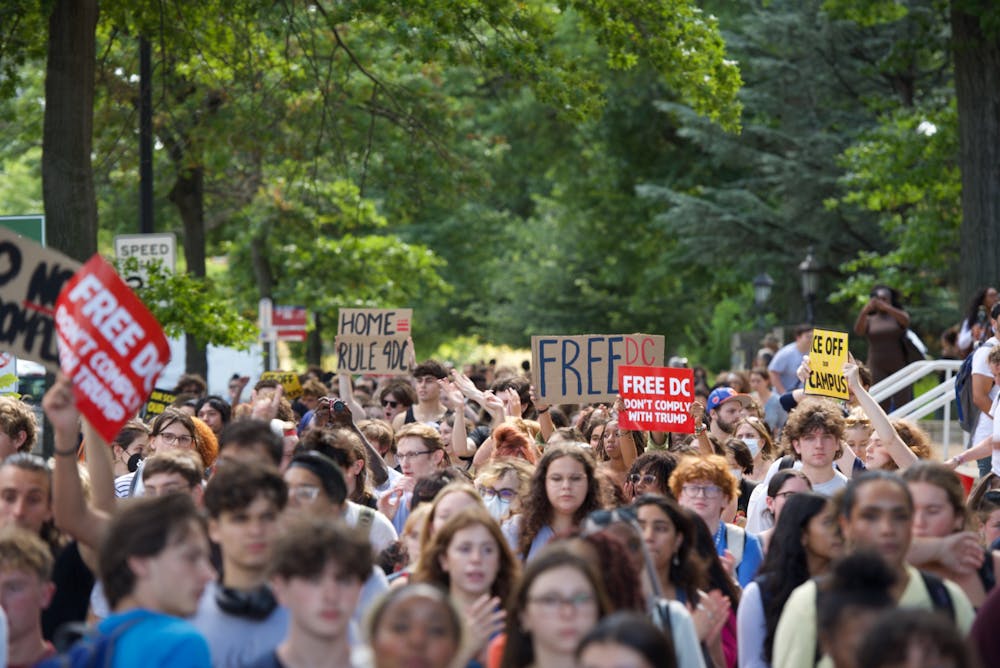
Over a hundred American University students and community members participated in a walkout Sept. 9 to protest President Donald Trump’s federal takeover of the city.
The University was the last of four D.C.-based universities to participate in the walkout. Georgetown University was first at 10 a.m., followed by Howard University at 11 a.m., George Washington University at 1 p.m. and finally AU at 2 p.m.

Protesters gathered on the quad in front of Kay Spiritual Life Center to hear from a series of speakers ranging from students to professors and local activists. Speeches and chants continued as the crowd walked towards Nebraska Avenue and settled on the stairs of the School of Public Affairs. The demonstration ended around 3:30 p.m. in front of the AU sign facing Ward Circle. Cars driving by honked in support throughout the demonstration.
One of the speakers was Carl LeVan, a professor in the School of International Service. LeVan expressed concerns about AU’s overall response to Trump’s actions throughout his time in office.
“I knew we were in trouble when this University hesitated to stand up for the ideals it was founded on,” LeVan said.
Matthew Bennett, vice president and chief communications officer at AU, stood to the side and watched the start of the demonstration.
“You know, it’s the members of the community expressing their views on important issues, as happens all the time,” Bennett said to The Eagle, when asked to comment on the walkout.


AU’s chapter of the Sunrise Movement spearheaded the walkout, with a coalition of student-led organizations and student activists participating in its planning. The organizations involved included AU American Civil Liberties Union, AU Student Government, the AU Community Garden, AU Amnesty and Students for a Just Society at AU.
The students were advised by activists from Free DC and the national Sunrise Movement. Yet, according to Free DC’s Campaign Director Alex Dodds, those activists “really followed the leadership of students” and they weren’t involved with the specific planning of the demonstrations. Dodds said she attended all the campus walkouts except Howard’s, and AU’s walkout was the largest “by far.”
Many demonstrators also demanded that the University’s administration take a stronger stance against Trump’s deployment of the National Guard in D.C.and increased ICE activity.
Kaden Ouimet, a junior in SPA and one of the walkout’s head organizers, called for sanctuary campus status and for the AU administration to refuse to comply with Immigration and Customs Enforcement.
Last semester, an individual wearing a “ICE - Immigration” jacket was spotted on campus. This person was not an ICE agent, according to the University.
Asher Heisten, another coordinator for the walkout and a junior in SPA, said he hoped that a sanctuary campus status would ban ICE and the Department of Homeland Security from participating in career fairs.
“We also want our own information to be protected,” Heisten said. “We don’t want our administrators to turn over our information to ICE, Department of Homeland Security, FBI [or] any other organization without good cause.”
Heisten donned a keffiyeh underneath his bright yellow vest that signified his marshall status for the walkout. A handful of participants also wore keffiyehs and held signs advocating for a variety of issues, signifying that the demonstration provided a platform for a number of other causes on protesters’ minds.
“One of the main core principles [of Free DC] is to stand in solidarity with other resistance movements across the world,” Heisten said. “We fight for the same rights that are being fought for across the entire world. So that’s why we’re standing in solidarity with movements such as the Palestine emancipation.”
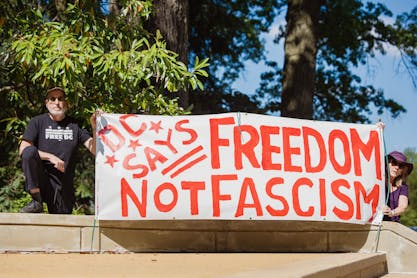
The Free DC movement dates back to the 1960s, with obtaining statehood for D.C. being its primary objective. The modern Free DC Project first began organizing in 2023 during the Hands Off DC campaign, a response to Congress’s overturning of the District's Revised Criminal Code Act. Since Trump’s takeover of the Metro Police Department in August, the movement has shifted towards fighting for the protection of D.C. streets from Trump’s actions.
According to Heisten, student activists across the four D.C. universities were mainly connected a few weeks ago when Free DC and national organizers from Sunrise hosted a meeting to explore resistance avenues.
“[Student organizers] talked about this, and we decided this is something that we want to do, and we’ve been talking with them throughout this entire process. They provided us [with] a ton of resources, but it’s really been us who’s leading the on-campus walkout itself,” Heisten said.
Ouimet stressed that more nationwide student support for the Free DC movement is critical.
“It’s just the start,” Ouimet said. “It’s just the test. And we’re seeing it right now, in Baltimore and Chicago and possibly Portland, that they want to militarize those cities and deploy National Guard. And if we don’t put up a strong enough resistance here in D.C., then the Trump administration is going to feel a lot easier going into these other places.”
Demonstrators also called for D.C. Mayor Muriel Bowser to stop cooperating with the Trump administration. “Bowser! Bowser! You’re a coward! Students have all the power,” the crowd chanted. Bowser recently faced backlash for an executive order she signed on Sept. 2 allowing for an emergency operations center, which was created following the increased presence of federal law enforcement, to continue working.
The Home Rule Act, which Trump invoked via executive order on Aug. 11, expired Sep. 10 at midnight, with Congress choosing not to vote to extend the order. The Home Rule Act allows the president to take control of the District’s police force for up to 30 days before needing congressional approval to continue. The Trump administration has since requested that state governors who sent National Guard troops to the capital allow them to remain through November.
Currently, there are more than 2,300 National Guard members deployed in the capital, with forces coming from D.C. and eight additional states. In the month since their deployment began, crime in the city has dropped, according to data released by the White House. However, separate reporting claims that crime has been on the decline in D.C. since well before the guard arrived.
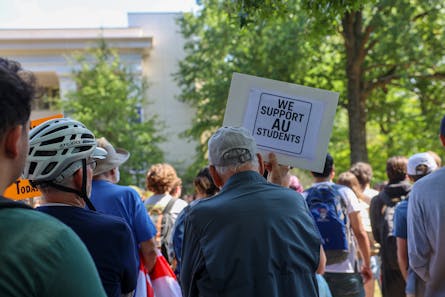
Kelsey Mackert, a senior in the College of Arts and Sciences and an organizing lead for Sunrise, saw the walkout as the start to a larger student campaign against Trump’s takeover, and said, “I feel like the walkout is a good starter to like, gauge how many people are into it, which I think will be a lot.”
Mackert said another goal of the walkout was to shift the student body away from what they see as apathy to the issue, since many students only live in D.C. for the academic year.
“I’m hoping that this walkout and this campaign agenda will get people to see that, like, ‘No — You are affected. This should matter to you,’” Mackert said.
Safia Malhotra, a sophomore in the School of Communication and SPA, and Audra Bassin, a sophomore in SOC, said they missed their classes to attend the walkout together. Both Malhotra and Bassin emphasized that family and friends back home were worried about them returning to D.C. for the school year.
“You usually expect people to be like, ‘good luck with your classes,’ … , ‘good luck with your semester,’” Bassin said, “A lot of stuff that I heard was just ‘stay safe,’ and that is not something that I should have to hear as a student going to school.”
As college students, “We’re the ones with the time and capability to do stuff,” Malhotra said. “I know that, like my family, they all really want to be out doing stuff, but they can’t… And when we do something on campus with a bunch of people, that’s really powerful.”
Chris Malloy, a resident of Cathedral Heights, attended the demonstration with a group of his neighbors and reiterated the power of student advocacy. During his time as a Georgetown University student, he protested the Vietnam War, and drew parallels between resistance then to student movements today.
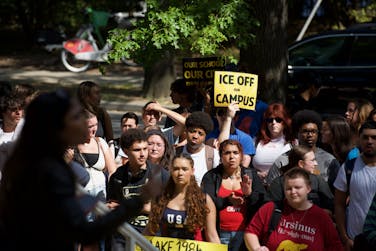
“I’m 75. I’m not going to be here much longer,” Malloy said. “You guys have a long life in front of you. And do you want to live in this kind of world? And I think about my kids, my grandkids. I don’t want them to have to live in this insanity.”
Malloy advised students to “keep working on getting people out on the streets, get them out of the classrooms, out of the dorms, out of the houses, get them out in the street. It’s the only thing that, in my mind, is going to work.”
Ouimet expressed excitement at the outcome of the walkout. He attended all four campus walkouts that day, and recognized AU’s as having the best turnout.
Alongside his satisfaction with the day, Ouimet reiterated Mackert’s hope that students will start caring more about the cause.
“I think that today we put up a strong student resistance,” Ouimet said. “And if we’ve achieved anything, hopefully we’ve moved the needle on campus, but we’ve also, super early in the year, shown how many students are activated and ready to be organized.”
This article was edited by Payton Anderson, Abigail Hatting and Walker Whalen. Copy editing done by Sabine Kanter-Huchting.
