

The following piece is an opinion and does not reflect the views of The Eagle and its staff. All opinions are edited for grammar, style and argument structure and fact-checked, but the opinions are the writer’s own.
After the 2024 presidential election, I witnessed a massive energy shift, especially in Democratic politics. People around me were having serious conversations about wanting to leave politics. Disappointed by former Vice President Harris’s failed bid for the presidency and Democrats losing their Senate majority, they spoke about ending their involvement in the democratic process.
The School of Public Affairs’ Leadership program enlisted me to create a social action project that focuses on how political motivation has changed after the 2024 presidential election. I wanted this to be a non-partisan test, focusing mainly on measuring American University students and including those currently working in politics, and non-students.
I conducted an eight-question survey, spoke with people working in politics or who previously worked in politics, and I realized my initial understanding was incorrect. My survey was conducted shortly after President Donald Trump’s inauguration and remained open for one month.
The survey received over 70 responses from AU students and public servants. The intention was to have only SPA students take the survey, but I quickly realized that being enrolled in a political science program is not a requirement to be interested in working or learning about politics.

I wanted to analyze the difference between those who want to work in politics and those who are interested in learning about politics.
In true AU fashion, the combined data results showed that students and those working in the political field were excited to learn about politics. I was intrigued to see that most people who answered the survey were extremely motivated to learn. Because my survey was mainly conducted in SPA, these results are extremely fitting. Many students who choose to study political science often have characteristics associated with lifelong learning.

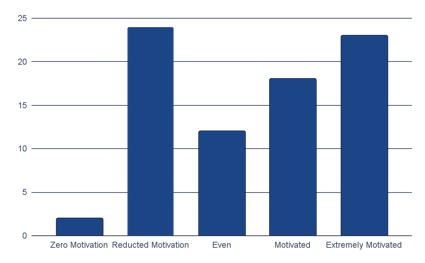
However, the results were quite different when it came to working in politics. This was similar to what I anticipated.
Two opposites, one had decreased motivation and was highly motivated, were within a few points of each other when it came to wanting to work in politics, which suggests that there was disappointment after the election. However, it also indicated that people are hopeful about the future and feel more motivated. Perhaps, with a second Trump presidency and Republican control of Congress, there is a boosted interest in watching the president’s next moves, but also not wanting to be involved in advocating for policy changes in the pipeline.
Even though Democrats faced significant losses in 2024, they have already achieved massive wins in 2025, which may continue to change people’s opinions on their involvement in politics. These wins can continue to motivate and even potentially re-engage those who used to work in politics.
In early April, the Wisconsin state Supreme Court race resulted in a victory, with Susan Crawford being elected, securing the liberal majority on the court. In Iowa, there was a massive win in the state Senate. Democrats flipped a Republican seat during the January 2025 special election, a seat that Republicans had won by 5 points in 2022.
Going into this project, I was convinced that this data would show that people are done with politics, especially because that was how I was feeling and matched the sentiment in the conversations I had. However, as this continued and I spoke to those who have worked in (and quit) politics, it made me realize that every election will have a group of people leave politics, but elections can also reinvigorate others to get involved.
The data above shows how we are interested in learning about politics. A critical aspect to remember after elections is that a loss is saddening, but it doesn’t have to be the end of the world, and every win is a big win.
Ritika Shroff is a sophomore in the School of Public Affairs and a columnist for The Eagle.
This article was edited by Quinn Volpe, Alana Parker and Walker Whalen. Copy editing done by Sabine Kanter-Huchting, Ariana Kavoossi and Emma Brown.
