
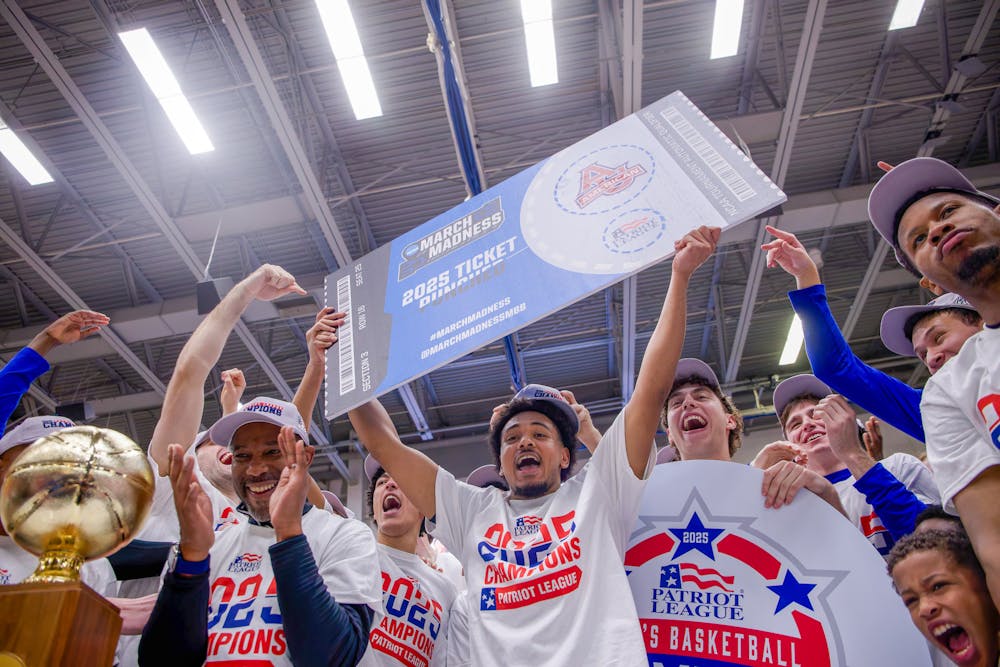
The American University men’s basketball team is poised for a significant financial boost after their 74-52 victory over Navy in the Patriot League Championship game which earned them a berth to the NCAA Tournament. However, University administration is tight-lipped about how much money is coming in and where the incoming funds will go.
American men’s basketball soared in that game, fueled by 3-pointers from Geoff Sprouse and Colin Smalls, 25 points from Matt Rogers and a tight defense. With the final buzzer echoing throughout an energized Bender Arena, the Eagles punched their ticket to March Madness for the first time since 2014, ending an 11-year dry spell.
March Madness isn’t just a chance to be on the national stage — it’s a billion-dollar business.
The NCAA distributes funds to leagues in units. It’s then up to those leagues to decide how they split up the money — most divide the money evenly among schools. This year, the units are worth an estimated $2 million, according to Sportico.
Units are awarded based on how many games a league’s teams play in. For the Patriot League, that’s one. After winning the Patriot League Tournament, AU is set to receive a portion of the estimated $360,000 the NCAA will give to the Patriot League. When and where this profit is distributed is a little more complicated than one would think.
The NCAA will distribute around $2 million — one unit for one game played — to the Patriot League, which has declined to discuss the timeline for releasing these funds. Additionally, there is the question for AU Athletics to answer about where this money is going.
One thing is certain: students are vocal and ready for change within the American men’s basketball team. After conducting a general student population survey, it was found that the majority of the fourteen respondents wanted AU’s recent success to guide NCAA funds toward recruitment.
Forty-three percent of students favored using the earnings for recruitment, while 36 percent prioritized training equipment and 14 percent chose social media and branding.


Despite this focus on recruitment, 83 percent of students said they were unsure how funding is currently allocated, highlighting the disconnect between student priorities and transparency from AU’s athletic department.
On the flip side, one American University basketball player desired to see more funding allocated toward the training room.
“I think the biggest thing, as far as funding, would probably be to help our athletic training room, so less people get hurt, like me,” senior guard Alex Daniels said.
For players like Daniels, who spent most of the season recovering, increased funding for recovery programs could diversify the lineup and give starters more time to heal.
Money breakdown
The NCAA is a lucrative business, generating nearly $1.2 billion during the 2023–24 fiscal year, according to its website. Of that, $263.2 million came from championship tournaments. But the NCAA’s biggest payday comes from its broadcasting rights deal with CBS and Warner Bros. Discovery Sports, valued at $8.8 billion and lasting through 2032.
While a portion of this revenue covers operational costs — travel, officiating and event operations — the majority is redistributed to member schools. For programs like American’s, a March Madness ticket is a financial win. But the payout process is layered.
The NCAA’s Basketball Performance Fund compensates conferences based on the number of games their teams play in the NCAA Tournament, excluding the title game. Each tournament appearance earns a “unit,” valued at about $342,000 in 2024, and these payouts are distributed over the course of six years.
Richard Stern, assistant athletic director for men’s basketball communications at San Diego State University, clarified that these units are paid to conferences, not individual schools.
Each conference determines how to divide the money among its members, typically choosing either to distribute money equally or to give the teams that performed better more money.
American’s share of the earnings depends not only on its tournament performance but also on the Patriot League’s internal distribution rules — details that the Patriot League has declined to share with The Eagle. AU Athletics also declined to respond to multiple requests for comment.
According to Wylie Chen, a sports business professor at AU, smaller schools like American often see a limited direct financial benefit from this system. While American earns a share of one unit through the Patriot League, the exact amount is determined by the Patriot League.
Chen said that the greater value of a March Madness appearance is often in its indirect return: national exposure, increased alumni engagement and recruitment opportunities. These advantages depend on how effectively a school builds on the moment.
“We got a lot of publicity, and that came with gear and NIL [name, image and likeness funding]. Not for certain people, just money for the team,” Daniels said. “Since it’s only 64 teams that make March Madness out of, like, 300, we’re on a different pedestal.”
Despite an 83-72 loss against Mount St. Mary’s in the First Four, the University’s time on the national stage is expected to create ripple effects across the athletic department for years to come.
Profit distribution estimates
Men’s basketball is one of the most spectated events at AU, drawing more than 26,000 fans throughout the 2024-25 season, peaking at 3,319 fans for the home opener.
Daniels reflected on the tournament’s perks, saying, “We got everything that you could think of that said March Madness; including shirts, a cream-colored Nike Tech Fleece and then we got a couple pairs of shoes.”
Despite its visibility, the team did not rank among the top fundraisers during AU’s 2025 Athletics Giving Day, bringing in $36,551 from 75 donors. The wrestling team raised $108,491, while swimming and diving collected $43,861, and lacrosse brought in $37,246 — each surpassing men’s basketball in donor support.
While most teams rely heavily on donations, the men’s basketball team secured a rare financial advantage. Their single victory in the Patriot League Tournament earned the conference an NCAA tournament unit, which will be paid out over six years, with a portion expected to benefit AU.
When AU qualified for March Madness in 2014, it received revenue in the same way: distributed incrementally over several years following a structured payout system. Due to this six-year breakdown, it wasn’t until 2018 that AU Athletics was able to invest in new technology like a global positioning system (GPS) and heart rate tracking, according to Sean Foster who was the assistant athletic director for athletic performance at the University from 2013-2020. GPS is used to detect fatigue in matches, compare intensity profiles according to player position and gauge competition skill levels.
Foster noted that the weight room received improvements in chunks of three years. While the funding for these projects is not traceable to NCAA funds directly, the renovations that AU administered mirror the funding delegation patterns used by the NCAA.
Foster left American in 2020, and noticed major growth in coaching and support staff sizes during his tenure at American. When he first started working with the University, there were two coaches, including himself. When Foster left, there were two full-time coaches, one part-time coach and 23 insurance workers on staff, who were responsible for managing medical athletic coverage for program participants.
Though funding allocations aren't precisely traceable, these developments replicate the slow release of NCAA tournament money.
Looking ahead
Ultimately, AU was able to grow and refurbish most aspects of its basketball program during the years it received NCAA Tournament award funds following 2014.
Chen explained that smaller programs often don’t have the resources, such as dedicated fundraising staff or alumni outreach, to turn tournament exposure into long-term financial support. He said American’s ability to benefit will likely depend on how well the school uses this opportunity moving forward.
Karen Angell, assistant athletics director for communications and digital media for men’s basketball, emphasized why the new funding is critical to the basketball program’s growth.
“Our department has to fundraise a lot of money just to operate,” Angell said. “Athletics accounted for nearly 74 percent of donations for AU's Giving Day this year at over $400,000. And all of that, from what I gather, just helps keep us within our operational budget.”
AU’s athletics department declined all requests to answer exactly how much money they will receive.
It is now up to AU Athletics to determine whether this windfall produces lasting success or a lost opportunity.
This article was edited by Jack Stashower, Penelope Jennings and Walker Whalen. Copy editing done by Sabine Kanter-Huchting and Emma Brown.
