
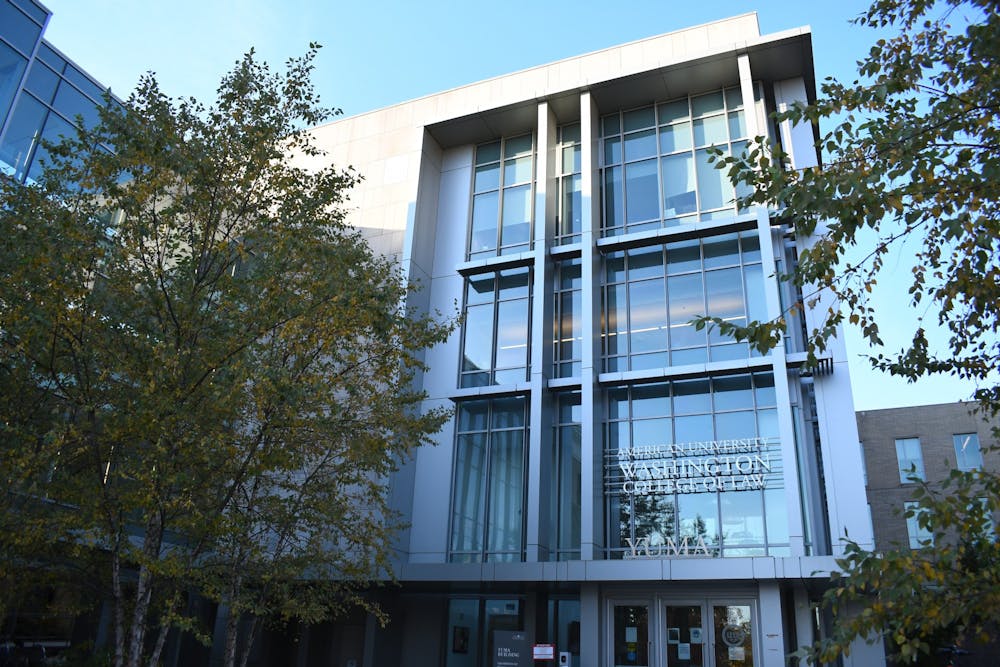
The Immigrant Justice Clinic and Defending the AU Dream Initiative at the American University Washington College of Law has continued to adapt to ongoing immigration policy shifts by the Trump administration.
Through hosting clinics and webinars, the IJC’s rapid response team hopes to advise and inform both students and the D.C. community at large.
The IJC has seen the impact of national policies across D.C., with noncitizens experiencing increased anxiety over their status in the country. Within the boundaries of AU’s campus, students and faculty have expressed concerns to the clinic over retribution from the federal government for their past political advocacy.
Many have expressed general feelings of vulnerability as well, apart from activism, according to Jayesh Rathod, a WCL professor and the director of the IJC.
“We just wanna make sure that everyone is aware of how to protect themselves, their friends, their community,” said Carly Truscott, a law student who has been working with the IJC’s rapid response team this semester.
Washington College of Law’s immigration services
The IJC is one of the WCL’s 11 clinics designed to give students hands-on legal experience serving under-represented clients and communities. It was founded in 2010, according to Rathod, who has been the director since it began.
The clinic is “designed in a way to be flexible and to respond to emerging needs in the community,” Rathod said. “We are now focusing on educating the community on their rights in the context of immigration enforcement.”


This flexibility was exhibited in 2021 when the U.S. withdrew troops from Afghanistan and the Taliban regained power, Rathod recalled. At the time the IJC adapted its services to prioritize Afghan refugees coming to the D.C. area.
Although the IJC has occasionally engaged in national advocacy, it tends to focus on communities in the D.C. area — which have been particularly in need over the past few months.
Truscott said that there has been an increased casework load that’s responding to “a lot of heightened fear and anxiety.”
This semester, eight law students worked with the IJC, four of whom form a “rapid response pod” which works on intake clinics that provide legal advice to immigrants in the D.C. area, as well as rights training. These trainings have included webinars targeted towards undergraduate and graduate students on the University’s main campus.
According to Truscott, the intake clinics are “quickly paced,” where they meet with clients for 15 minutes at a time to gather information and provide advice.
The law students in this pod have also worked with AU Dream, which is a part of the IJC that provides free immigration legal services to college students across D.C., Maryland and Virginia schools.
AU Dream was founded in “response to the harsh policies” of President Donald Trump’s first administration, said Saba Ahmed, a staff attorney with AU Dream.
According to Rathod, AU Dream provides services to any noncitizen student, but international students tend to seek more help from them than those who immigrated to the U.S. before college.
AU Dream was created to ensure that immigration status concerns would not impede on student’s ability to “complete their degree programs and their studies,” according to Rathod.
“Of course we can all understand that having a dark cloud of immigration uncertainty hanging over your head could be a huge problem if you’re trying to focus on studying and getting your coursework done and just graduating,” Rathod said.
The national climate
Ahmed recalled entering an immigration detention center the day after Trump was elected in 2016, with a “long face” and feeling discouraged.
“And one of the guys that I was talking to who was detained and in removal proceedings, he just looked at me and he was like, ‘I don't care if it's Obama or Trump, I'm here. This is happening to me, right? It doesn't matter which president it's under, this is the reality,’” Ahmed said.
Eight years later, Erick Lajara, a law student working alongside Truscott for IJC’s rapid response pod, was not surprised by Trump’s second triumphant election. He also knew that the new administration would conduct “rapid action” once Trump took office again, Lajara said.
Since January, Trump has launched a series of attacks on immigrant populations in the United States. The administration has attempted to end birthright citizenship, enacted a 200 year-old wartime law against immigrants, mistakenly deported a man to a maximum security prison and more.
International college students studying in the U.S. have not been spared — instead, many argue, they, particularly student activists, have been especially targeted.
Mahmoud Khalil, a vocal leader during Columbia University’s pro-Palestine encampment last spring, gained national attention when he was detained by Immigration and Customs Enforcement in the beginning of March.
Since then, over a 1,000 international students and recent graduates across over 30 states have had their visas revoked or legal statuses changed — many without being notified.
Many of these students have participated in protests or expressed pro-Palestine views in the past, either in public or on social media. Secretary of State Marco Rubio has expressed that the State Department is focusing on visa holders who may have views opposing American foreign policy.
Among those with their visas revoked by the State Department without notice are multiple AU students, according to the University.
On April 22, AU’s administration signed on to an American Association of Colleges and Universities statement with over 150 institutions in response to the administration’s ongoing policy changes. The statement expresses concern over the government encroaching on academic freedom, yet does not list specific developments such as revoked visas of international students.
A spokesperson for the University said that AU is working with the students whose visas have been revoked.
Students, staff and faculty have called for the University to do more. Student Government passed a referendum in March encouraging AU to become a “sanctuary campus” for noncitizens. At the end of March, faculty and staff demanded that the administration “commit to protecting faculty, staff, students who are government targets, regardless of citizenship status.”
The American Civil Liberties Union of D.C. also sent a letter to AU and seven other D.C. area universities on March 20 that urged them to protect students against two of Trump’s executive orders. One of the orders may allow the administration to revoke the visas of those they view as “Hamas sympathizers.”
Observations from students and staff with IJC and AU Dream
Students and faculty involved with IJC and AU Dream have been approached with concerns from international students, but are unable to provide information on specific cases.
Ahmed has spoken to students with pending green card applications worried about permanent residents being deported, and green card holders who are rushing to apply for citizenship because they feel like their status is insecure.
According to Truscott, concerns regarding retribution over activism are not limited to college students.
This semester, the IJC conducted intake clinics with the D.C. chapter of the National Domestic Workers Alliance. Truscott encountered “a lot of questions about, as small as, you know, ‘I signed my name to this petition, or I went to this march… am I safe?’”
“And even just to hear people who sought asylum here, fleeing governments that were oppressive and where freedom of speech was limited,” Truscott added. “It was scary to hear how unsafe people are now feeling here in this country.”
Other AU faculty and student organizations have approached Rathod with concerns over Trump’s actions against international student activists and have asked “what can be done to better protect immigrant students at AU,” Rathod said.
“There have been questions that have been posed to me around the policies of AU, whether they’re sufficient, whether more could be done, what the University should be doing,” Rathod added.
Ahmed recalled her time in college, feeling “completely lost in these big institutions.” She believes that clinics and initiatives like the IJC and AU Dream are what makes WCL’s services unique.
“I didn’t know how to navigate [these institutions]. I didn’t know what resources were available to me. I didn’t know how to ask for help,” Ahmed said. “ So it’s really rewarding to be able to work with students who are in that position and see their journey…it resonates with me.”
Regardless of action from the administration, Rathod believes in the “profound impact” of the IJC and AU Dream.
Truscott expressed a similar feeling. “It’s definitely been a crazy time so I’m glad that we’re able to do this work now,” she said.
This article was edited by Cara Halford, Maya Cederlund, Tyler Davis and Walker Whalen. Copy editing done by Luna Jinks and Sabine Kanter-Huchting.
