
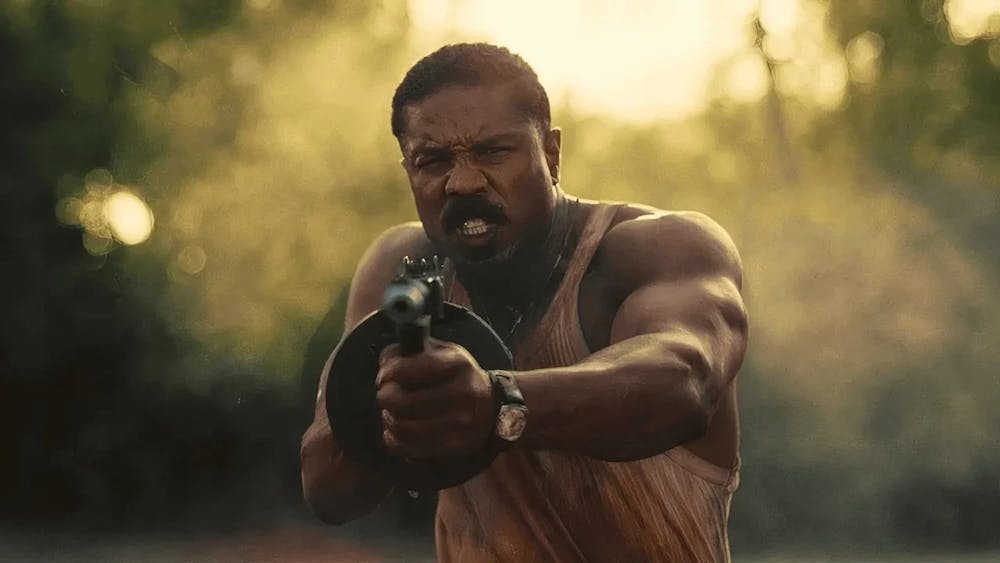
Critics and fans alike are praising writer and director Ryan Coogler for his newest film, “Sinners,” and its unique, expectation-subverting take on the monster-slaying genre. Coming off of “Black Panther: Wakanda Forever” two years prior, Coogler decided to fully commit to his long-awaited passion project, “Sinners.”
“Sinners,” while a daunting 2 hours and 17 minutes long, makes use of every second on IMAX screens in order to masterfully tell its complex narrative.
The cast is led by Michael B. Jordan, who plays twin brothers Stack and Smoke as they return to their small hometown in 1930s Mississippi to start up a juke joint for local musicians.
Over the first hour of the film, Smoke and Stack each seek out different members of their community to serve a different role for the grand opening of their speakeasy that night. Cornbread (Omar Benson Miller) is hired as the bouncer, Delta (Delroy Lindo) is hired as the pianist, Beatrice (Tanaj L. Jackson) is hired as the bartender and the twins’ cousin Sammie (Miles Caton) is hired as the blues guitarist.
While the first part of the film takes its time introducing each and every character, as the story progresses and the characters evolve, the extended introduction and added context becomes increasingly important for the audience.
Somewhere around the 38-minute mark is when the audience is introduced to the main vampire and antagonist of the film, Remmick (Jack O’Connell), who turns two members of the Ku Klux Klan into vampires.
The film’s setting, Mississippi circa 1932 during the era of Jim Crow laws, brings themes of racial divide and prejudice to the forefront. As an audience, we are confronted with racist language, especially used against our main characters, which immediately sets the tone for the verbal and physical violence to come.
As the film progresses, Remmick and the two newly-turned vampires arrive at the twins’ juke joint. At first they are refused, but when Smoke and Stack’s patrons start disappearing into the night, the main crew begins to question what happened to them and if the suspicious men are to blame. What follows is a nuanced and original take on the monster-slaying genre that depicts the horrors of racism in 1930s America.



Although Coogler’s direction and vision are clearly a winning formula at the domestic box office and are most polished in the creation of “Sinners,” Autumn Durald Arkapaw’s contribution to the film’s cinematography is most impressive. Arkapaw’s biggest credits to date are on the Disney+ series “Loki,” Coogler’s “Wakanda Forever” and Gia Coppola’s “The Last Showgirl,” the last of which is praised for its stunning cinematography.
In “Sinners,” Arkapaw uses a series of technically stunning long takes in the juke joint that are truly jawdropping. The smooth and fluid transitions paired with the abruptly unsettling horror scenes leave the audience on a roller coaster of intentional tone-shifts that grab the audience’s attention.
Another highlight is the soundtrack, courtesy of Ludwig Göransson, the Grammy and Oscar winner whose “Oppenheimer” score made it big last year. Göranasson strips down his usually grandiose and cinematic style in exchange for a raw bluesy southern twang that percolates throughout the film’s entire score.
Coogler and Jordan’s most recent film is excellent in regards to its direction, cinematography, score and performances. It has also made history as the most successful opening for an original project since Jordan Peele’s 2019 film “Us.”
“Sinners” will undoubtedly become a staple in 2020s cinema and a standout amongst the work of exceptional Black filmmakers in the past 25 years. For now, the silver screen will sit back and pleasantly watch the deserved dough roll in for this genre-breaking, career defining film.
This article was edited by Alia Messina, Marina Zaczkiewicz, Maya Cederlund and Walker Whalen. Copy editing done by Luna Jinks, Olivia Citarella and Emma Brown.
