
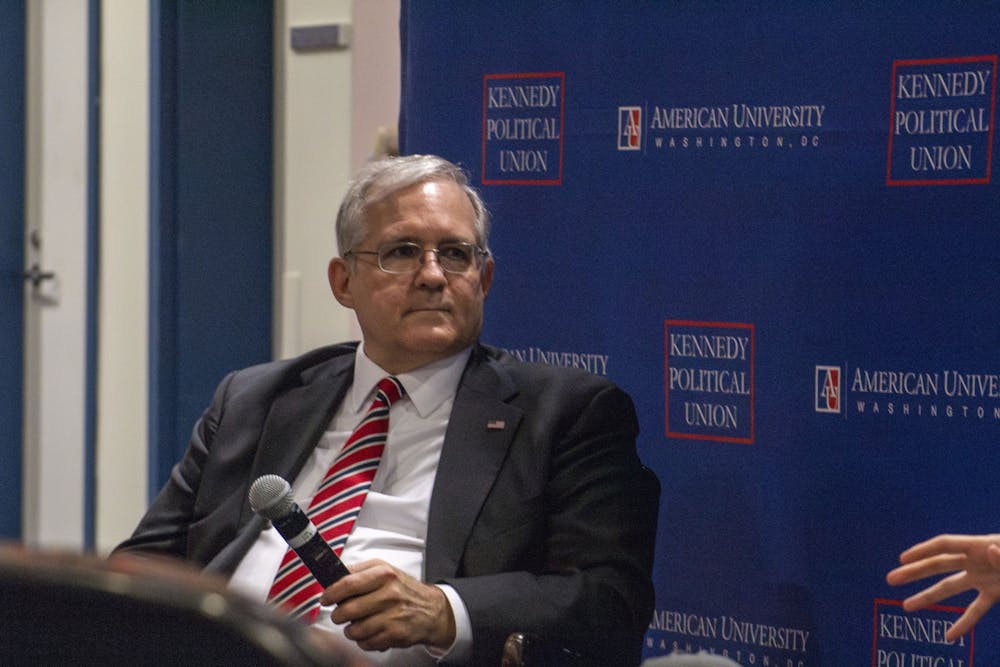
Former United States Marine Paul Whelan spoke at an American University Kennedy Political Union event on April 22 about his detention from 2018 to 2024 in Russia on espionage charges.
KPU Director Aidan Skidds moderated the event, which was co-sponsored by American University-based foreign affairs think-tank The Pericles Institute.
Whelan, a citizen of Canada, the United States, the United Kingdom and Ireland, enlisted in the U.S. Marine Corps Reserve at 24 years old. Whelan was returned to the U.S. in August as one of 16 Americans released by Russia in a historic prisoner swap executed under the administration of former President Joe Biden.
As a Marine, he visited countries such as Brazil, Russia and South Africa, taking basic precautions in his travel and never experiencing hostility from those countries' governments.
Whelan said his experience in the Marine Corps, and the fact that hostage diplomacy hadn’t been attempted since the Soviet era, made him feel safe while traveling to Russia.
“Russia was a place that we were never really worried about,” Whelan said. “You do, as in any country, have to worry about thieves, criminals of opportunity, people that want to victimize foreigners — and we always took precautions that we weren’t victims of those sorts of people.”
Whelan was arrested in his hotel by Russia’s Federal Security Service under the pretense that he was working as a spy. He was detained at Lefortovo Prison in Moscow while awaiting trial and said he passed the time by reading books, writing letters and meditating.
After receiving a 16-year sentence in 2020, Whelan was relocated to a maximum security labor camp in Mordovia, a republic of Russia, where he said he was subjected to inhumane conditions. The water, for example, was contaminated by lead pipes.


“The labor camp had been a prisoner of war camp during the ‘40s,” Whelan said. “German prisoners of war were kept there in the ‘30s, Russian prisoners were kept there [and] they haven’t really renovated the place since.”
Despite his circumstances, Whelan said he found it easy to make friends with the other prisoners. Communicating in the Tajik language, he would frequently share food, water and medications given to him by ambassadors and consuls.
“I had fresh food coming in once in a while,” Whelan said. “I was able to share that, with medications and whatnot, [and] help my friends stay healthy.”
When Russia launched a full-scale invasion on Ukraine in 2022, the Russian citizens in the camp were sent to combat duty and were replaced by prisoners from Central Asian countries to keep the prison labor system going. Whelan said many of them knew of him through news media coverage of his captivity, a fact that surprised him.
“Interacting with the young guys from the Central Asian countries was really interesting because they’d seen me on TV, they basically knew who I was,” Whelan said. “They thought it was kind of cool to have this Westerner there that had some notoriety.”
Whelan said he felt it was important to keep in contact with his culture through writing letters and collecting up to 125 books. He said he also retained a strong sense of patriotism and national pride. Every morning, he would sing the national anthems of the four countries in which he held citizenship while the Russian national anthem played over loudspeakers.
Whelan said he never lost confidence in the U.S. and continued to believe that a deal would be worked out to bring him home.
“I think it’s important, in situations like that, that you remain faithful to your country because you never know what they’re up to,” Whelan said. “And in my case, they were doing a lot.”
He has since been slowly readjusting to daily life, and said he has enjoyed every aspect of the process, from using a real telephone to relearning how to shovel snow. As for hostage diplomacy, he is optimistic that similar deals will be made in the future.
“President Trump has brought two hostages back from Russia already,” Whelan said in an interview with The Eagle. “He’s negotiating with other countries to get people back, so when we talk about hostage diplomacy, we’re in a good area.”
This article was edited by Payton Anderson, Tyler Davis and Walker Whalen. Copy editing done by Olivia Citarella, Sabine Kanter-Huchting and Hannah Langenfeld.
