
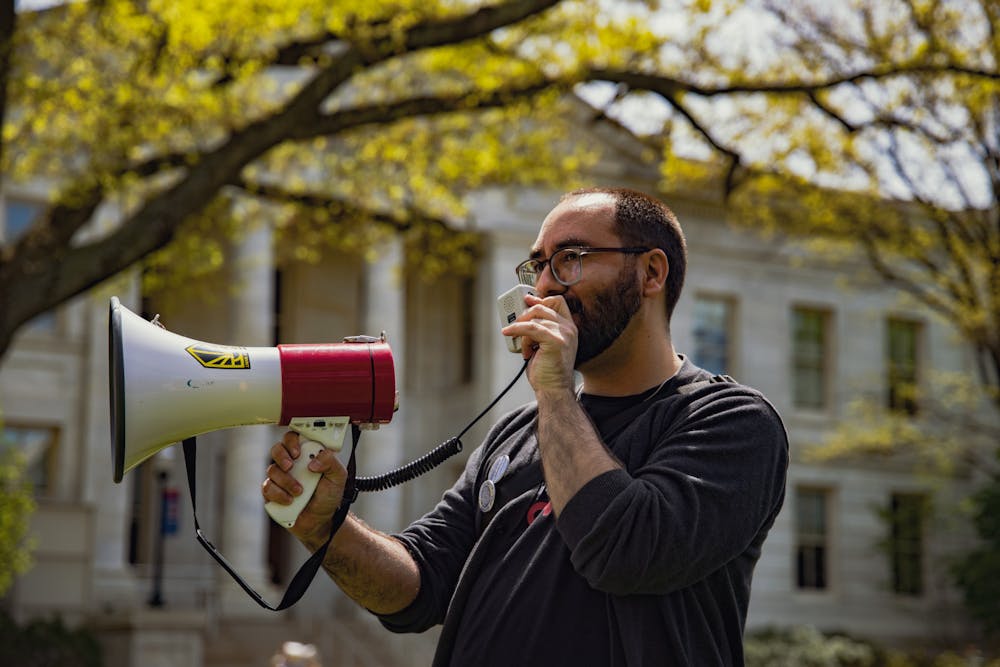
Faculty and students joined together in two days of “action for higher ed” on April 17 and 18, calling on American University’s administration to protect academic freedom and vulnerable community members amidst the Trump administration’s attacks on universities.
On April 17, the University’s chapters of the American Association of University Professors and the Sunrise Movement held a teach-in, followed by a rally, and on April 18 held another small rally on the quad.
The organizations called for University action on a range of issues, including the threat of deportation for international students, academic freedom, freedom of expression and divestment from the fossil fuel industry.
Day one: Teach-in and administrative demands
The first day of protests involved more than 30 faculty members and students marching from the Mary Graydon Center to the President’s Office to deliver their demands to the doorstep. The demands included protecting international students, LGBTQ+ students and those who have openly supported Palestine, as well as defending what faculty members called the “core mission” of the University, which includes research done by students and faculty.
“This is a moment when higher ed is under attack,” said John Bracht, AU’s AAUP chapter president. “It’s a moment when we need our administration to stand up.”
Tazreena Sajjad, a professor in the School of International Service who chaired an immigration-centered panel at the teach-in, said that AU must resist any potential U.S. Immigration and Customs Enforcement deportations or government requests for citizenship data. Sajjad said that this resistance could at least partially come in the form of protecting student protests on campus.
“A space for students to protest should be protected, if universities like American want to consider themselves a place of learning,” Sajjad said.
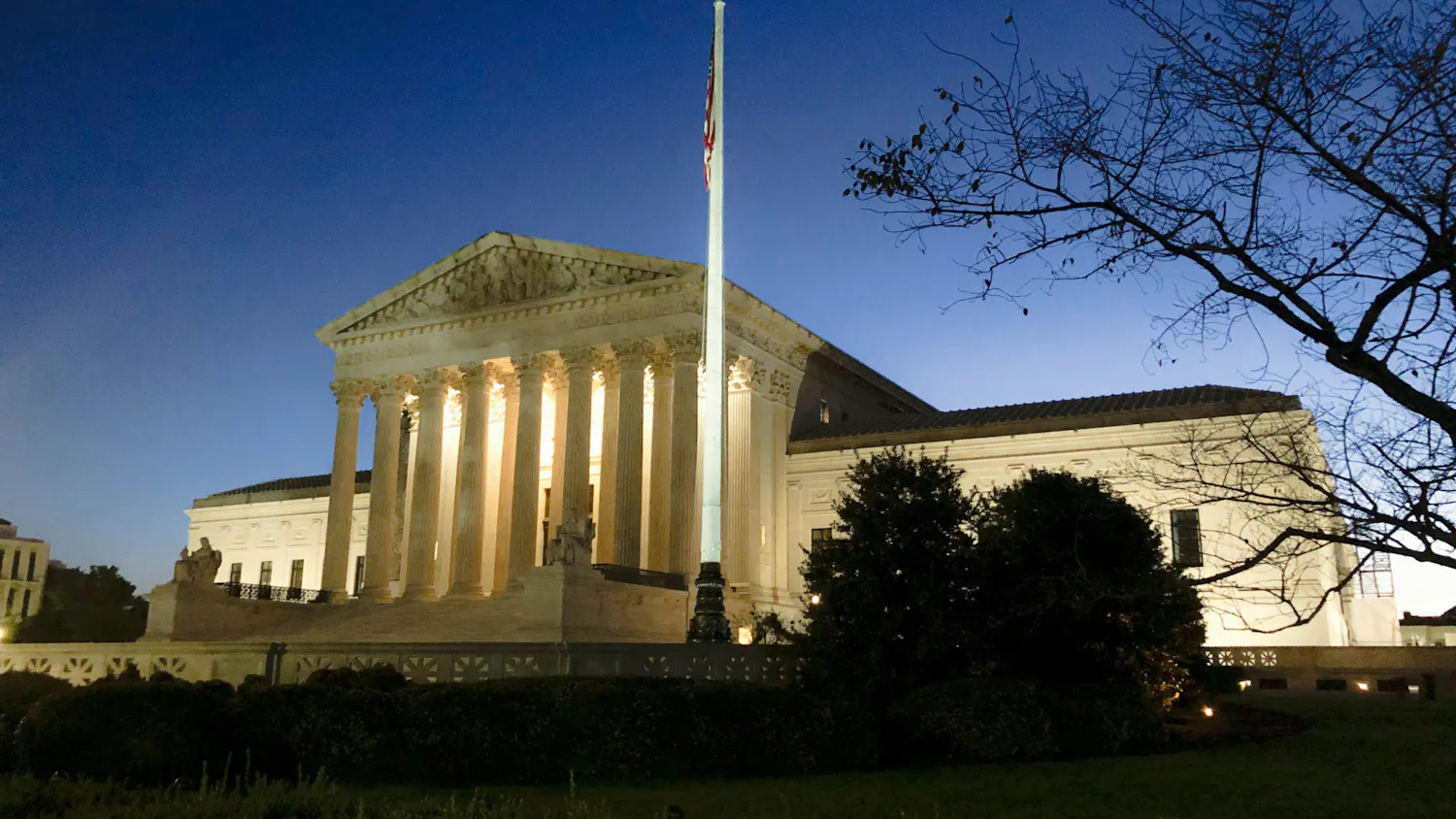
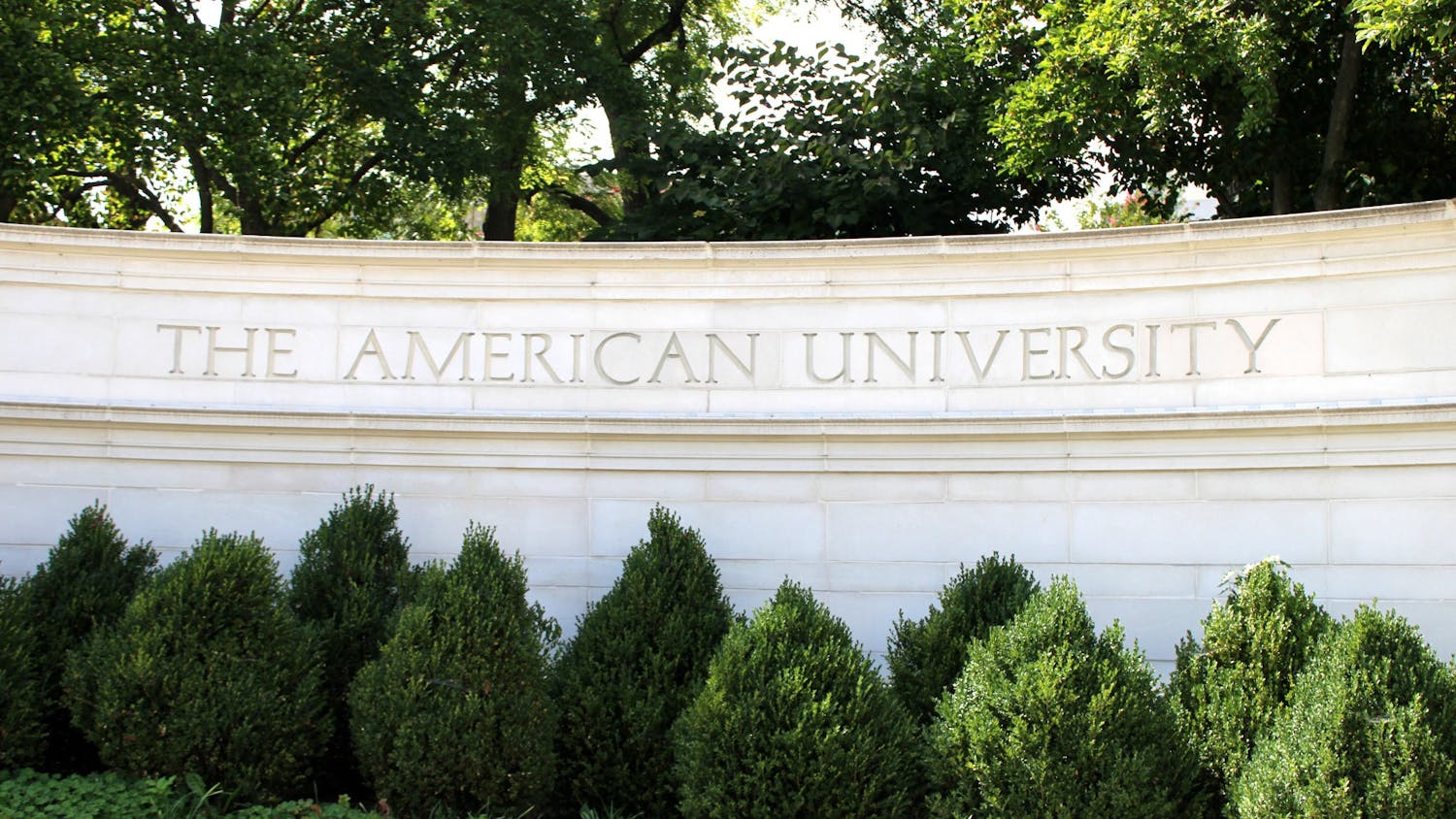

In early February, the University said it will not ask students to disclose immigration status in admissions or financial aid applications and that it will not participate in immigration enforcement efforts unless required by law.
AWOL reported on April 22 that an unknown number of AU students had their visas revoked.
Jordanna Matlon, a professor in SIS, emphasized that the University’s support is more important now than ever.
“These are scary times. It would be nice for the admin to be on our side,” Matlon said.
As protestors marched to the President’s Office, they chanted, “Protect the vulnerable, protect academic freedom, protect the core mission.”
Additionally, AU’s AAUP chapter criticized the University for arresting a graduate student who displayed a Palestinian flag during AU President Alger’s inauguration.
“By dragging Elaf K. Hasan out of the event, the university violated its own freedom of expression policy,” an open letter from AAUP said.
Some staff members, such as Matthew Stifter, AU Abroad’s assistant director of partner programs, say they are disappointed with the absence of a University response.
“I see the University following the law, I see management of risk. What I don’t see a lot of is communication,” Stifter, who was attending the rally during his break and not in his capacity as a staff member, said.
Communication is just one step that many of the faculty members and students asked for. Stella Del Carmen, the president-elect of the Graduate Leadership Council, said she wishes the University would take a more active role in challenging Trump’s actions.
“What’s taking AU so long to follow the paths of other universities?” Del Carmen asked.
A number of universities, including all 18 members of the Big 10 Conference, have passed resolutions to join pacts with other large Universities to defend academic freedom, The Guardian reported April 16. Harvard also suffered a $2.2 billion funding freeze after it announced it would continue to support protests on its campus.
On April 22, AU signed a statement from the American Association of Colleges and Universities that calls for a response to Trump’s attacks on higher education.
As AU Sunrise Vice President Annette Lee taped the faculty’s demands to the president’s door, she said she hoped that they would elicit some kind of change.
“Listen to your students, listen to your faculty,” Lee said. “This is a university that is supposed to serve their students, faculty and staff and we feel that is not happening right now.”
Day two: ‘This is an emergency — AU needs more urgency’
The April 18 rally reiterated calls on the University to preserve academic freedom, protect vulnerable students and cut ties with the fossil fuel industry.
Dante Arminio, the action lead for Sunrise AU and a junior in the School of Public Affairs and the College of Arts and Sciences, kicked off the rally by speaking about research grants that AU receives from fossil fuel companies and the relationships that some trustees have to those companies.
These ties, he said, are a conflict of interest for AU as a carbon neutral university.
“Quite frankly, I don’t want my environmental science degree tainted by fossil fuel money,” Arminio said.
Other speakers followed, including Stifter, who spoke on behalf of the AU Staff Union to express solidarity with Sunrise and AAUP.
“We must continue this fight and stand together,” Stifler said. “We can’t let this be the end of it. We need to go back to our schools, to our departments. We need to let the admin know we will not back down, that our voices will be loud and we will not be silenced.”
Organizers led chants such as, “Hey hey, ho ho, fossil fuels have got to go” and “This is an emergency — AU needs more urgency” between speakers.
Bracht also spoke on AAUP’s role as a “coalition supporting freedom on campus” that “defends, as a watchdog, academic freedom.” He said a graduate student’s arrest for unfurling a Palestinian flag at Alger’s inauguration was “against the rules of academic freedom that American has endorsed” and asked the administration to drop all charges and apologize.
The University did not respond to The Eagle’s request for comment.
“Where are our administrators as the firewall to protect academic freedom on this campus?” Bracht asked.
He also called on the University to designate safe private spaces on campus where ICE cannot enter and to “protect the core mission of the University.”
Nancy Snider, director of AU’s Department of Performing Arts’ Applied Music Program, said she joined the demonstration because she thought it was too important not to speak out about things happening on campus and in the United States. She said freedom was the key issue underpinning all of the concerns brought up at the rally.
“It’s freedom from this oppression and this irrational tyranny that’s at every place you turn,” Snider said. “And it’s an insidious thing that if we don’t take action now, it’s going to be too late, and history has taught us that.”
Ronan Tanona, a Sunrise member and a sophomore in SIS who spoke at the rally, said Sunrise recognizes that its fight for “climate justice” also means “fighting for a better world for everybody, across all levels of oppression.”
“Fighting for the climate is more important now than ever, and yet it is now more difficult to speak up and protest than ever,” Tanona said. “So we’re fighting for the climate, and we’re fighting for free speech, especially when it is being punished more and more, like ICE coming after graduate students and students on visas.”
It wasn’t the first time the AU community called on the administration to take a stand against President Donald Trump’s actions.
In March, AU’s chapter of Latinos En Acción called for better protections of immigrant students and, a few weeks later, a group of faculty members asked the University to speak on Trump’s actions to reshape higher education.
Over 80% of students who participated in the Student Government spring elections supported a referendum calling on AU to become a sanctuary campus.
The American Civil Liberties Union of D.C. sent a letter to AU and other D.C. universities urging them to protect student speech and avoid involvement with immigration enforcement.
Charlie Murphy, the communications director for Sunrise AU and a sophomore in SIS and CAS studying environmental science, said the through line of all the issues could be found in a chant that the group echoed throughout both days’ demonstrations: “Protect the vulnerable. Protect the mission. Protect academic freedom.”
This article was edited by Owen Auston-Babcock, Tyler Davis and Walker Whalen. Copy editing done by Luna Jinks and Olivia Citarella.
