
From the Newsstands: This story appeared in The Eagle's April 2025 print edition. You can find the digital version here.
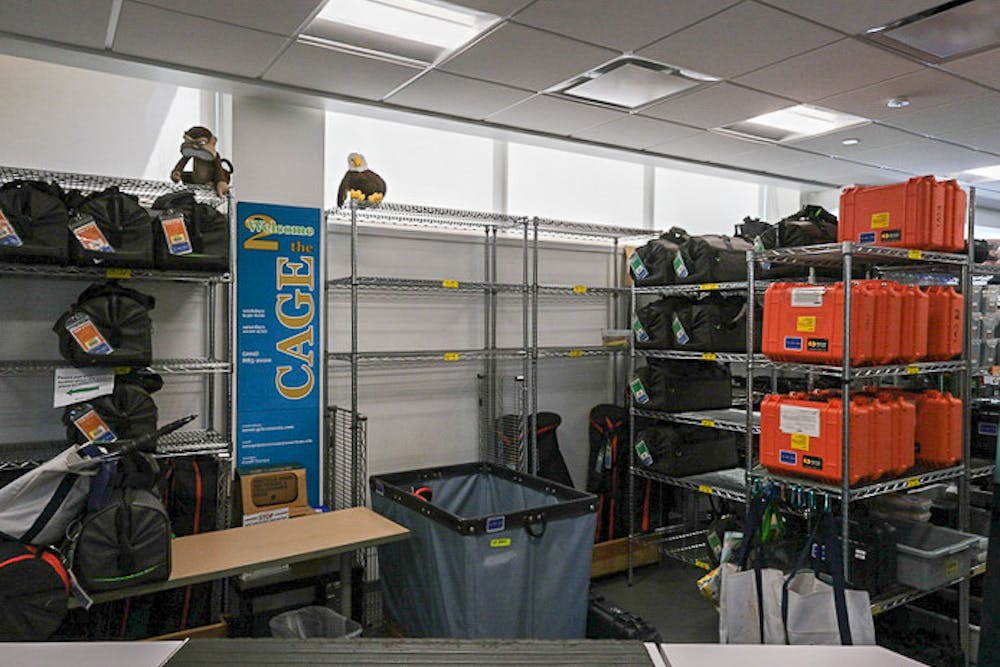
Tucked away in the basement of the Media Production Center behind the Letts-Anderson Quad is the School of Communication Equipment Room, lovingly referred to as “The Cage.”
Familiar to most SOC students, The Cage houses professional level production equipment for production classes and projects, while the Media Production Center upstairs offers 24/7 access to editing suites with professional software for students’ post-production needs.
American University Film and Media Arts professor Larry Engel teaches production classes using equipment from The Cage.
Engel said that equipment access, which is free to students for educational use, is allocated based on the course, with specific access to “camera, sound, lighting [and] grip” equipment based on class criteria.
“All basic SOC students qualify for the first basic package in the equipment room. There’s a Sony Z150 camera which comes with a tripod, and then that comes with some wireless lavaliers, microphones, really all you would need to get going,” Jacob Audouin, the University’s media services manager, said.
The hidden trove of technology is essential for student film majors, but movie-making equipment on campus isn’t limited to students in SOC.
Engel pointed to Bender Library’s catalog of editing and filming equipment that is open to non-majors.


Through “AV Equipment Borrowing” students can borrow smartphone gimbals, camcorders, omnidirectional microphones and the ability to reserve the “Simple Studio,” a professional grade space for filming. The library also offers a “Visual Guide” for amateur filmmakers who may not yet be knowledgeable about film terminology.
Another accessible, on-campus filmmaking resource for non-major students is the University’s SubHub, an open editing lab with monitors and software for all, for class and passion projects alike.
“The McKinley building has an open lab called the SubHub on the third floor, which has all of the Adobe software on it…anyone can come to that space and use the computers there. Those are great resources for editing,” Audouin said.
Through the SubHub and Bender Library’s resources alone, non-film majors can rent from a catalog film equipment, reserve a professional studio to shoot video and record sound in and edit their projects with access to high-quality software from the Adobe Creative Cloud.
Engel is optimistic about the future of filmmaking resources for students and hinted at The Cage receiving a “generous” donation from a graduate of AU’s Film and Media Arts MFA program. The donor is a color grader, and Engel said the donation will be used to convert an editing suite in the Media production center into a color correction lab.
Engel said the film and media arts staff, himself included, “want to train the next generation of image makers, filmmakers, who will have the next opportunity to save the planet” through the University’s filmmaking resources.
This article was edited by Jessica Ackerman, Marina Zaczkiewicz, Copy Editing by Emma Brown, Sabine Kanter-Huchting, Nicole Kariuki, and Ella Rousseau.
