
It was a “pigtail Monday” practice, 16 days before her team was leaving for the biggest competition of the season, and junior Meliann Niangne sat on the bleachers with a boot on her foot watching her team find out they’ll be re-working their routine around her absence.
The previous Thursday, Niangne had attempted an upgraded tumbling pass consisting of a whip back to a back handspring to a layout variation, something she had done at practice many times. This rep, however, was different. She landed shorter than anticipated and took an injury to her left Achilles tendon.
“ I was like, ‘Okay, listen, we have 16 days. 16 days. I promise you I've competed on injury before,’ because I was a gymnast,” Niangne said. “And I was like, ‘can’t you just tape it up and then just send me out and I’ll keep rehab-ing until it’s all over, and then I’ll completely not do anything on it?’”
Her pleas couldn’t change the outcome, which was having to wait for an MRI to confirm her injury before returning to any physical activity. So, she sat through practice hopeful that the team could soon adapt to any changes made that night.
Cheerleaders have historically been associated with sports teams, whether it be basketball or football, and seen as the support system for their respective teams. When thinking about the American University men’s or women’s basketball teams, you might find your mind wandering to the cheer team’s timeout trick show, or the crowd engaging in their sign-led “AU” chants. However, for the University’s cheer team, school spirit and representation doesn’t end the moment they leave the court.
Three times a week, the team finds themselves at three hour long practices in either Bender Arena or the Dream Allstars gym in Maryland. They spend this time working on anything from dances to tumbling and stunting skills, making sure to film everything.
Every rep that happens during a practice is recorded by either a member of the team or an assistant coach and put into a shared drive accessible to the entire team. Typically, if assistant coach Marlo Bloom is unable to attend practice, the team expects to see her comments left on their practice videos.
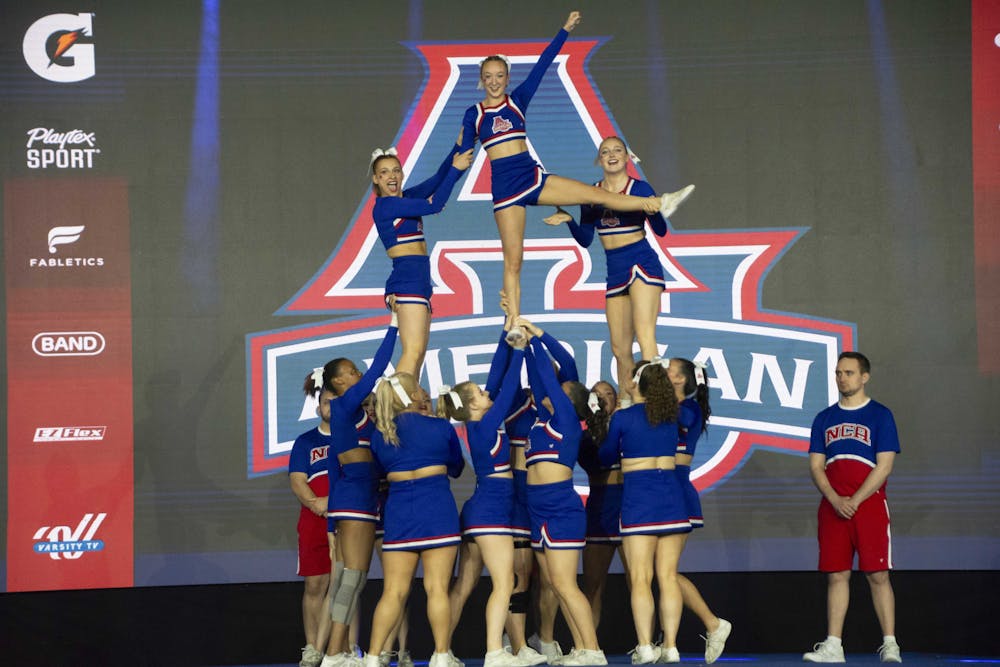
Once a year, the Eagles cheer team heads to Daytona, Florida to compete in the National Cheerleaders Association’s college nationals with the goal to “hit zero,” or in other words, perform a perfect routine with no point deductions. The routine can be divided into different sections: partner stunts, tumbling, jumps, pyramid and dance. All sections are scored on both difficulty and execution.



The team competes in Intermediate All Girl Division I, one of the fastest growing in the competition, with between 10 to 14 girls on the mat competing at a time. In 2021, there were eight. This year there were 13 girls competing. Hitching a ride on the bus to Daytona and finding a spot on the blue floor, Clawed Z. Eagle, American’s beloved mascot, weaves his way through formations with the occasional wave to the crowd or jump into a split.
Anyone who knows head coach CJ Murphy knows that she always has a plan, and whether it’s kept in the extremely detailed ‘thought dump’ note in her phone or the handwritten notebook she often references during practices, she is prepared to lead her team through anything thrown their way.
That is why she started off practice by sitting the team down and telling them exactly what they could expect following the potential loss of their teammate on the nationals floor. She warned the team that they would be working out of, “two different parts of their brain,” meaning that they would prepare a new routine while also keeping the previously practiced one in the back of their minds.
“In the past, we’ve had to redo this routine multiple times,” Murphy said. “This year, the crunch time has never been as close to nationals as it is right now, but it’s not like this is a muscle we haven’t exercised, so it’s just another day for us.”
Throughout their practice, Murphy was trying out new pyramids and partner stunt groups — swapping girls in and out to determine what would be the most successful. When the girls weren’t playing stunt group roulette, they would make a pit stop to say “hi” or “we miss you” to Niangne on the bench.
All AU cheerleaders go through a tryout process before becoming official members of the team, and typically returning members will tryout in the spring session following their trip to Daytona and incoming freshmen and new members audition the following fall.
With absolutely no time to spare after the team is finalized in August, the new team gets right to work on preparing for their first event of the season, National Cheer Association Cheer Camp. This year, having only been practicing together for about a week, the team traveled to an away camp where they worked with both their coaches and NCA instructors to perfect new and old dances, rally chants, and stunts. Their hard work ultimately earned them a Silver Paid Bid to compete in Daytona.
The Silver Paid Bid allows for teams to “receive 2 free hotel rooms, reduced registration fee per person and the 1st priority on hotel assignment,” according to an NCA Camp document. Must have a minimum of 10 registered attendees,” the document continues.
In previous years the team participated in what is called a home camp, where a representative from NCA travels to the team, allowing them to qualify for the April competition in the comfort of Bender Arena. However, this camp only allows teams to receive a bronze paid bid, which only allows for a $160 discount per team member and hotel priority over video qualifications.
When the team returns from camp, they completely switch from their focus on nationals skills and Daytona prep to game day responsibilities, which need to be ready for the basketball teams’ first exhibitions. Since the coaches don’t discriminate when it comes to experience levels during tryouts, the first few post-camp practices are spent on the basics: what is offense and defense? Who are the starting players for both men’s and women’s basketball?
Knowing these details matters since the team needs to know which cheers to call on the sidelines, which dances to do during timeouts and which stunts to put up during player introductions. Murphy explains that during these practices, coaches would mock a tip off to teach the team when to call various game accurate chants.
Along with their cheers from the sidelines, the team performs the fight song and various dance routines during games that all need to be learned and cleaned prior to basketball season beginning. This year, the team was motivated by the possibility of attending the Flo Milli concert held on campus in October — if they could perfect all of their dances and fight song before the concert, they could go. If not, they would be practicing instead.
Freshmen Constanza Prato Bravo and Annika Holder recall having a great time at the concert.
After weeks of attending games and having their attention on all things basketball, the team begins their shift back to more nationals oriented practices. It’s at this mid-point in the year that the overlap of games, practices, fundraising and various other appearances start to get a bit hectic. But with a routine to perfect, their number one priority is always staying focused.
“This team is my heart,” Bravo said. “When things get hard, I try to center myself in gratitude. I love it.”
Around early November the team welcomes their choreographer, who for the past three years has worked with the team to build a seamless two minute routine that maxes out on majority, difficulty and execution points — or what coach Murphy calls “the axis.” For example, if there are 14 girls competing on the mat, eight of them would need to be throwing the same tumbling pass to max out on majority points.
The goal of getting choreography is not to have it perfect on the first or even the second try. Rather, having a routine set in place early in their season allows the team to work towards obtaining new or more difficult skills.
“You are going to get choreographed a routine that you can’t do,” senior and three-year captain Dana Kriebel said.
This means that the team will begin with less difficult progressions, and work their way up to the finished product they show off later in the season at their first showcases in April. By that time, they have begun practicing their nationals ready routine full-out, with a posterboard spreadsheet to keep track of their goals.
The spreadsheet contains each component of the routine and a space to add a sticker if that section was successful during every run of the routine.
In past years, the team would have boarded a bus for their trip to Florida, but this year the Eagles were able to fly the D.C. nest straight to the floor in Daytona. After arriving on Wednesday, with a printed itinerary from coach Murphy in hand, the team had one official practice before taking the floor for the preliminary round the next day.
The competition day begins with the team doing their hair and makeup together at the hotel before heading to the Ocean Center Arena for the first time that weekend. Dressed in their American University uniforms and feeling bonded as a team, the girls await for their designated time to enter the warm-up area.
Here, they get eight minutes that are split between three different mat sections to warm up their routine jumps, tumbling, pyramid and basket tosses prior to their performance — but they are already used to this. About two weeks leading up to the competition, they begin practicing how they will warm up on the big day.
“ I think there’s also confidence that comes with that too, because you're not like, ‘wait, what are we supposed to be doing?’” Murphy said. “You're like, ‘no, we know exactly what we’re doing. We're gonna approach that mat and be confident with it.’”
As the prelims are not a qualifying round of the competition, the team automatically advances to the finals on Friday. Their score from the previous round carries over to finals, counting for 25 percent of their overall score.
In 2024, the team placed eighth out of 23 teams competing in their division. This year, the team finished 17th. Kriebel emphasized the team’s lack of attention to placements throughout the competition, as they can’t control what other teams do, and they only set out to accomplish their own team goals.
Niangne wasn’t able to compete with her team this year, but she said next year will be that much more special.
“Daytona is where all your hard work and everything you’ve done and everything you’ve worked towards is put on the floor in that moment,” Niangne said. “It’s just to just show what you've done together, like practices, all these tears, you cried, all that blood, sweat, and pain. It’s all there.”
This article was edited by Jack Stashower, Penelope Jennings and Walker Whalen. Copy editing done by Luna Jinks, Olivia Citarella, Sabine Kanter-Huchting and Nicole Kariuki.
