
Editor’s note: This story contains descriptions of gun violence and may be upsetting to some readers.
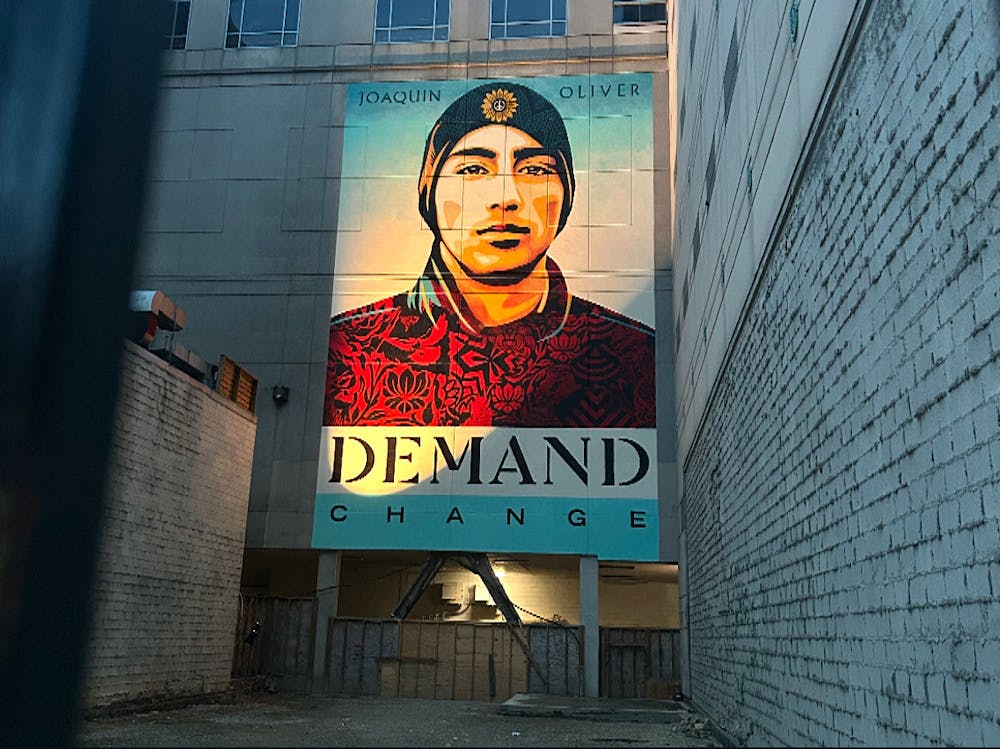
Located right outside the Gallery Place - Chinatown metro station, an artfully crafted tribute to Joaquin Oliver overlooks the street. Oliver was a 17-year-old who was murdered on Feb. 14, 2018, in a school shooting at Marjory Stoneman Douglas High School in Parkland, Florida.
In 2025 alone, there have been at least 48 shooting incidents on school campuses across the U.S., resulting in 13 deaths and 41 injuries.
The mural, called “Demand Change,” brings attention not only to Oliver but to all the lives lost in the U.S. due to mass shootings and the push for gun reform.
Painted in vivid reds and blues, the mural depicts Oliver with a deep contrast against the brighter background as he looks straight ahead at onlookers.
Oliver’s face is painted with a straight expression, and he appears neither shocked nor confused. Instead, he looks steady and knowing.
When viewers look up at his face, the expression is haunting.
The image itself is even more moving when one analyzes its placement, as well. The wall behind the painting is a dark, lifeless gray and attached to a tall building right in downtown D.C. It is surrounded by restaurants and stores, giving it a claustrophobic feel.


Artist Shepard Fairey, who painted the mural this year, is most famous for his work on the Obama “Hope” posters.
Fairey sought help from Oliver’s father and mother when painting this mural. Both of Oliver’s parents aimed to develop a piece that would spark conversation around gun reform. Oliver’s parents have both been dedicated to raising awareness about gun violence since Oliver’s death.
Fairey’s goal with this artwork was to inspire conversation around gun violence and the need for stricter gun laws. He wanted the focus to be on a young person whose life was taken to showcase how kids are the ones greatly affected by the government’s lack of action.
Art has played a pivotal role in activism and inspiring social change. Through vivid imagery, large murals, and emotional storytelling, protest art, including “Demand Change,” can inspire communities to take action and spread awareness.
“Demand Change” can act as more than a memorial to Phoenix as a victim of gun violence, by also being a catalyst for collective action and hope.
This article was edited by Jessica Ackerman, Maya Cederlund, Marina Zaczkiewicz and Walker Whalen. Copy editing done by Olivia Citarella, Luna Jinks, Emma Brown and Ella Rousseau.
