
From the Newsstands: This story appeared in The Eagle's April 2025 print edition. You can find the digital version here.
Fashion is used as a form of personal expression, a revolution against oppression and a reflection on traditions. However, the industry has encountered a problem: cultural appropriation.
The recently popularized “clean girl aesthetic” trend on TikTok encompasses dieting, exercise and glowy makeup, but also slicked-back hairstyles, signature lip combos and gold jewelry.
On the surface, this trend seems harmless and serves as motivation for women to adopt personal health habits. However, it often appropriates culturally and historically significant elements of Black and Latino cultures, according to many social media influencers, journalists and activists.
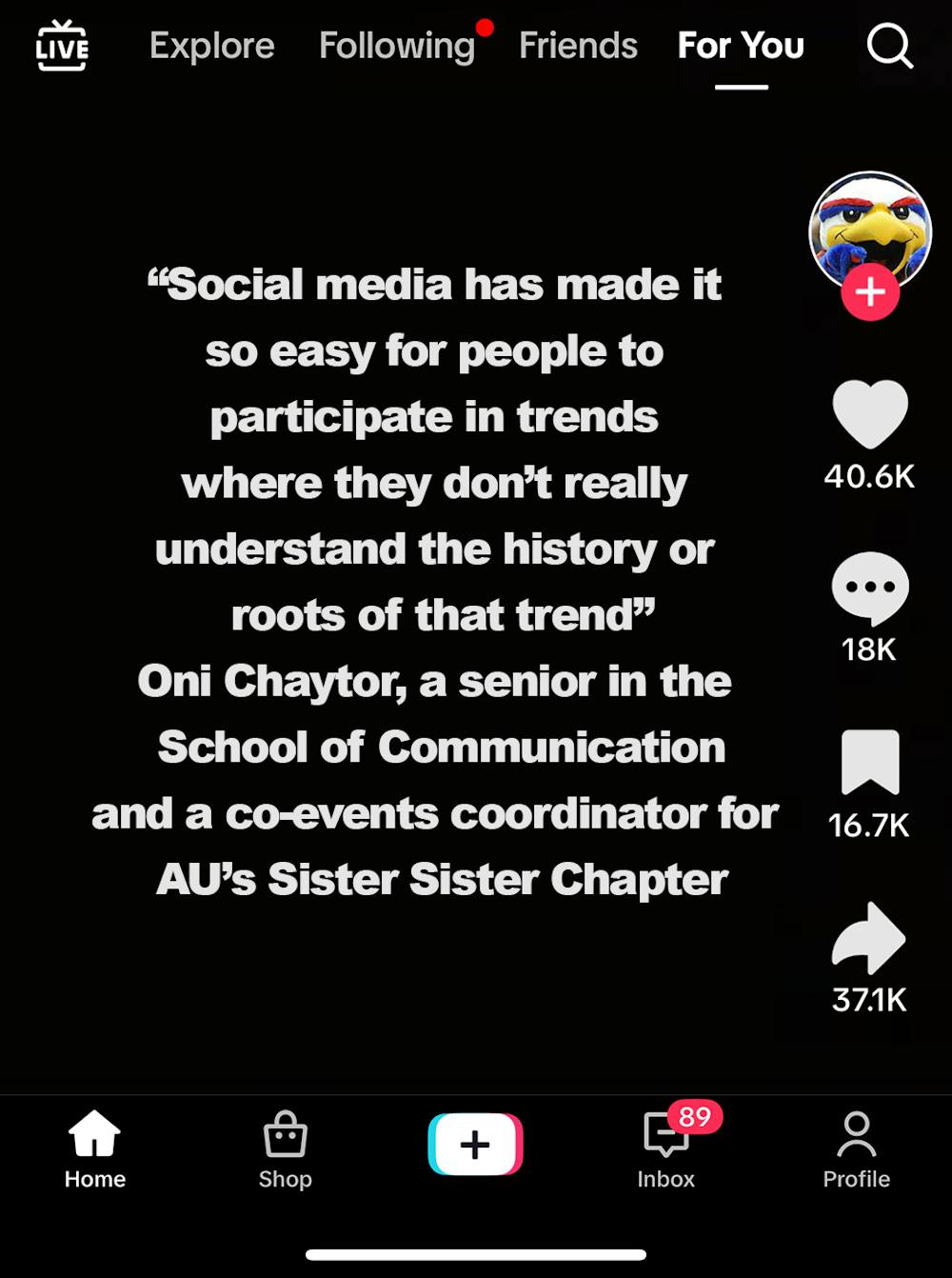
“Social media has made it so easy for people to participate in trends where they don’t really understand the history or roots of that trend,” said Oni Chaytor, a senior in the School of Communication and a co-events coordinator for American University’s Sister Sister group, a “safe space” for Black women on the University’s campus. “It has given everyone a platform to spread misinformation, especially when it comes to culture.”
While interpretations of trends are subjective and can be seen as disrespectful, understanding the difference between creative inspiration and blatant disrespect is important, Chaytor said. Although factors like businesses and individuals can play a role in appropriation, giving due respect and recognition to cultures of inspiration can establish and promote proper appreciation.
The slick-back hairstyle dates back to the 1900s. It was originally a manner of oppression that forced the Black community to conform to European beauty standards at a time when curly and coily hair textures were perceived as “ghetto,” according to Zimbabwean actress Thandie Newton, who plays a Nigerian activist in the film “Half of a Yellow Sun.” Even in recent years, members of Black and Latino communities continue to face discrimination for their hair, which others often perceive as being messy and unkempt.
As a form of liberation, the Black community has taken this slick-back technique back and introduced a new avenue for Afro-textured hair to be worn naturally. The Black community has made “laying down edges” — which is a hairstyle technique of arranging the fine “baby hairs” at the edge of the hairline into flat, decorative designs — into a form of expression, transforming it into a symbol of pride.


With social media trends, this symbol of resistance has been distilled into being just a “clean look,” pushing the years of history aside while falsely crediting it to white celebrities like Hailey Bieber, who popularized it on social media within non-Black communities.
Cultural appropriation in fashion predates TikTok. In her 2013 American Music Awards Performance, Katy Perry dressed up like a geisha, a Japanese female entertainer who performs traditional ceremonies in art, dance and music, and in her music video for “This is How We Do It,” she wore cornrows.
On TikTok, the dupatta, an important piece of South Asian attire, was labeled as European and called a “Scandinavian shawl.” Even TikTok’s “Blokecore” trend was taken from Black and Hispanic cultures, showing the impact that social media has on appropriation.
Chaytor said she has noticed cultural appropriation extensively inside and outside of the fashion world and on and off campus, especially when it comes to aspects of the Black culture. She said that this disrespect can spread negative stereotypes within the Black community.
“When it’s on a Black girl, it’s ‘ghetto.’ But when it’s on a white girl, it’s deemed ‘revolutionary,’” Chaytor said. “We don’t get credit for it because our contributions are not seen as worthy enough.”
Ean Williams, the creator of DC Fashion Week, said that appropriation is subjective.
“If there is a designer who decides they want the influence of a certain country because that is what they are inspired by, they’ll just do it,” Williams said. “And some people may be offended by it and think it’s appropriation. Others will think it spreads a message of diversity.”
Williams started his career in fashion as a model and actor, taking off as a designer later in his career. After seeing there wasn’t a platform in the District to introduce local designers’ creations to the world, he envisioned what is now DC Fashion Week — a platform for both local and international designers to showcase their work to the fashion community.
How can one tell the difference between appropriation and appreciation? And more importantly, what can be done? Chaytor said it is hard to draw a line between the two because of how commercialized fashion and culture have become.
Isabella Diaz, the vice president of Latinos en Acción, an on-campus organization that has discussed cultural appropriation, is pessimistic about fashion brands learning to understand the difference and changing their work.
“A brand is a business,” Diaz, a junior in the College of Arts and Sciences, said. “The fashion industry is very capitalist and consumer-focused. If that’s what consumers like, that’s what they’re gonna do. If they don’t even address their effects on climate change, why would they address appropriation?”
Individuals researching whether a trend is appropriation is an important action, Chaytor said.
“It’s important for people to do their own fact-checking and make sure the things they are participating in are good and not harmful to a certain minority group or culture,” Chaytor said.
Domonique Graham, backstage and glam squad manager of DC Fashion Week, offered a positive perspective on how the fashion industry is finally turning the page. Graham pointed to Fenty Beauty because it highlights a variety of models of different cultural and ethnic backgrounds.
“If one person could do it, I know the message is starting to resonate with people,” Graham said. “Nothing great comes overnight, but we don’t ever want to be stagnant.”
Editor’s note: Oni Chaytor is a former staff writer for The Eagle. She was not involved in the pitching, editing or writing of this story.
This article was edited by Maria Tedesco, Marina Zaczkiewicz and Abby Turner. Copy editing done by Emma Brown, Sabine Kanter-Huchting, Nicole Kariuki, Ella Rousseau, Ariana Kavoossi, Hannah Langenfeld, Charlie Mennuti and Jaden Anderson.
