
From the Newsstands: This story appeared in The Eagle's April 2025 print edition. You can find the digital version here.
The following piece is an opinion and does not reflect the views of The Eagle and its staff. All opinions are edited for grammar, style and argument structure and fact-checked, but the opinions are the writer’s own.
To be liberated is to be set free. Liberation is a powerful term representing long-denied freedoms granted to people who have often faced marginalization and oppression for centuries. For many Americans, the election cycle allows us to debate what we want to be liberated from.
I’m sure that when President Donald Trump called his second inauguration “Liberation Day,” many resonated with his words and looked with pride at the man they voted for. Trump’s use of the word “liberation,” a term I’ve often associated with true justice from oppressive systems such as prisons, police and the military-industrial complex, made me question who, if anyone, is truly being liberated with him in power.
With his first term under his belt and the clear implementation of the ideas of the Heritage Foundation’s Project 2025, I believe Trump is set to make changes that will do the opposite of liberating marginalized communities. The existential question of who deserves to be liberated and to whom Trump owes this treatment matters little to him.
More important is the idea that those already being hurt by Trump’s ideas are humans first, no matter what anyone argues is owed in terms of equality and justice. In trying to determine who deserves liberation, Trump has intensified the suffering of so many people in a land that supposedly represents opportunity and hope. In making this decision, he is liberating no one and hurting many.
Over one million children born in the U.S. have two parents who are not here legally. Because of the 14th Amendment, these children are constitutionally guaranteed citizenship and all of its benefits, which has been affirmed for over 150 years. Trump has already increased the military presence at the U.S.-Mexico border by 60 percent and reinstated the “Remain in Mexico” policy, forcing asylum seekers to stay in what could be unsafe conditions while they wait for the already-difficult process to conclude. On top of this, he suspended the entry of all undocumented migrants and shut down the app that allowed people to schedule asylum appointments more efficiently, leaving thousands of migrants stranded in Mexico.
Even if you don’t believe Trump owes anything to people who are not citizens, he is going directly against people who are considered citizens by the Constitution by challenging the 14th Amendment. Additionally, it is a deeply rooted American value to take in the people who need our support most, as is engraved on the Statue of Liberty: “Give me your tired, your poor, / Your huddled masses yearning to breathe free, / The wretched refuse of your teeming shore.”


Though some conservatives once argued that they support legal immigration, it is clear that Trump is doing everything in his power to limit what this entails, all while promising to deport over 11 million people.
In his inauguration speech, Trump echoed a popular conservative talking point akin to the “All Lives Matter” mantra often used to rebut the liberation movements that exist today. “We will forge a society that is colorblind and merit-based,” he said.
How does one liberate those who truly need it without acknowledging the very reason for their oppression? Angela Davis, a prominent Marxist activist and philosopher who visited American University in 2023, once said, “Racism is embedded in the fabric of this country.”
Color blindness as an ideology claims to treat all people equally by ignoring race. In reality, it erases the historical and structural forces that create racial inequality in the first place. Color blindness logic is fueling policies that ignore systemic inequities in areas of life like housing, education, employment and criminal justice. It allows the benefits white people reap from a system of white supremacy to persist.
This idea, which seems to be at the root of Trump’s anti-diversity, equity and inclusion policy, is not a passive failure to see race, but an active avoidance of the realities of being a racial minority in this country. By insisting that race should not be considered, his policies attempt to hide how race very much so does matter, especially for those who suffer from the consequences of a racist system.
The entirety of the colorblind argument rests on the false assumption that all individuals have equal access to opportunities, which is objectively untrue considering the centuries of racial discrimination that have created an uneven playing field. Color blindness does not solve the problem of racial injustice; it merely ignores it altogether.
To liberate communities, one must first acknowledge the structures that oppress them, which colorblindness actively denies. By framing race-conscious policies as unnecessary or even discriminatory, Trump and others who embrace this ideology dismiss the need for systemic change while maintaining a false narrative of present fairness.
True liberation requires actively dismantling oppressive systems, not passively refusing to acknowledge that they exist. By promoting colorblindness, Trump is not seeking to liberate communities, but is rather ensuring that the structures benefiting those in power remain untouched. Ultimately, we must not pretend oppression doesn’t exist, especially under a presidency that is furthering this oppression. Actively acknowledging these issues and working to solve them is the first step in reaching liberation.
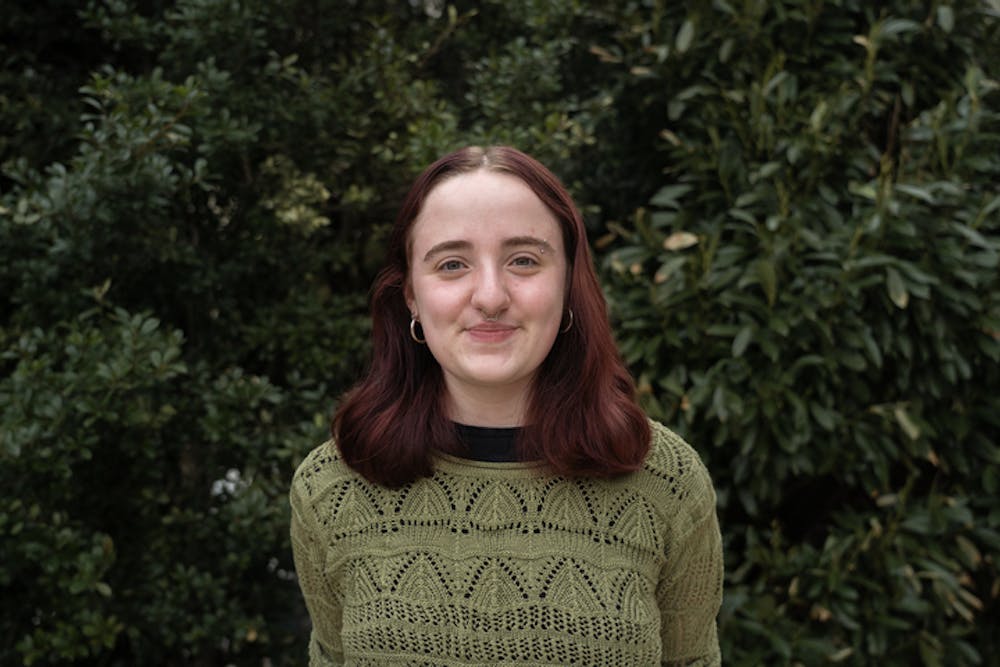
Quinn Volpe is a junior in the School of Communication and Kogod School of Business and the assistant opinion editor for The Eagle.
This article was edited by Alana Parker and Abigail Turner. Copy editing done by Luna Jinks, Olivia Citarella, Emma Brown, Nicole Kariuki, and Jaden Anderson. Fact checking done by Luna Jinks, Olivia Citarella and Diana Melgar.
