
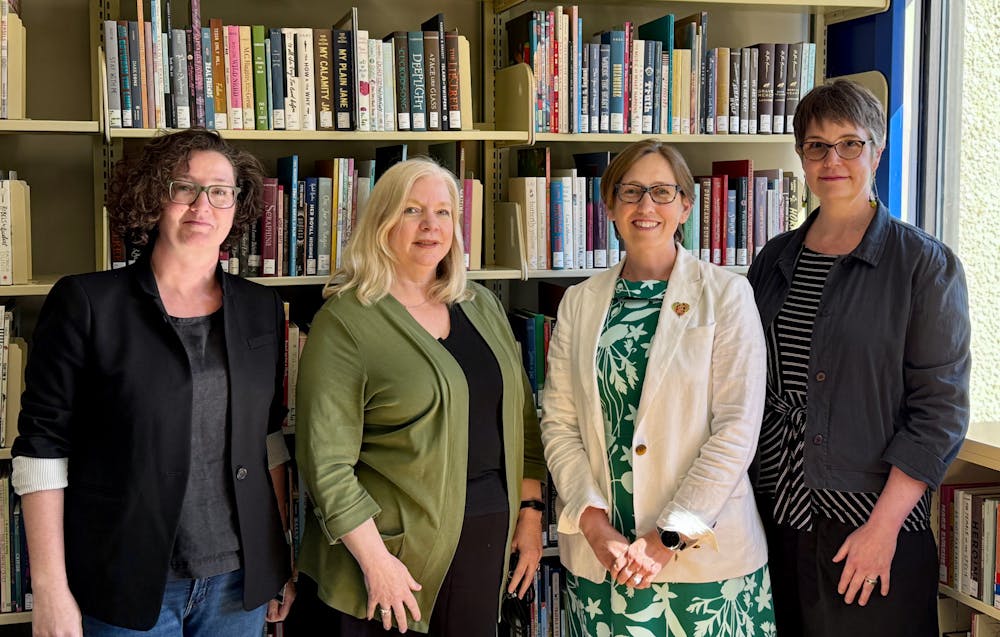
A team of four librarians at American University is joining a nationwide effort to preserve removed or redacted data in a Government Information Data Rescue guide. Editors Jessica Breen, Gwendolyn Reece, Olivia Ivey and Sarah Gilchrist each bring their own expertise to the table.
The effort follows multiple executive orders starting Jan. 31, including executive orders 14168 and 14151, that ordered the removal of information that promotes “gender ideology” and information related to diversity, equity and inclusion efforts, respectively.
Backsliding in terms of data accessibility
Jessica Breen, a geographer and one of the guide editors, worked on rescuing environmental data with the Environmental Data and Governance Initiative during Donald Trump’s first term. In Trump’s second term, she has become a leader in supporting the team at the University.
“Data is the way that governments speak, and if people can’t access that data, they can’t speak to the government in a way that the government can understand them and they can’t get things done,” Breen said.
There had been significant advancements in people being able to access and use information on the internet without being experts, Breen explained, in part because of various accessibility functions like data being available in computer-readable formats. Now, those accessibility functions will no longer be available.
It has become common practice among “open data folks” including librarians, researchers and others to prepare to archive information whenever there is a presidential change. Library hallway conversations began at the end of last semester about this guide, Breen said.
After the AU library started receiving emails from faculty about data they were pulling to try and archive it as well as pleas from others, the librarians decided they should take on a piece of this massive data rescue project.

“It had come up in the open data groups I hang out with asking people, ‘Are there data sets that would be a problem for you if they went away?’” Breen said.
Gwendolyn Reece, director of Research, Teaching, and Learning at the AU library, said there were many concerns from faculty about the removal and alteration of data as it “begins to change the validity of some of the foundation of their research.”
“There was redaction that happened, and not all the redaction has been particularly clear, right?” Breen said. “The folks who did it don’t necessarily want the information that’s missing to be noticed that it’s missing.”
Reece added that the United States government has historically been the largest collector of data in the world, so researchers and scientists globally use this data to advance the “development of knowledge.”
Reece said much of the tampering with data is being done in spite of the strong objection of health experts, who are aware of the detrimental impact.
AU joining the work of many others
This situation is a “fast moving target,” Reece said, and the University does not have the infrastructure of some other repositories, like the Data Curation Network. Currently, the Government Information Data Rescue team is temporarily saving data to then transfer it to a more permanent location for access.
Other groups, such as Census Reporter, are pulling frequently accessed data, but AU’s team has been focused on saving more “niche” data for the University, Reece said.
“A lot of it we’re trying to direct people to where there are good trusted repositories where the data has already been kind of preserved,” Reece said.
Olivia Ivey, one of the guide editors who is the liaison to the School of Public Affairs, said government information is a chief function of faculty and students’ work, which becomes complicated without “reliable access” to data.
“At the foundation, accessibility and transparency is a major pillar of trust in a democratic society to have citizens that can see and understand the work that their government does is essential,” Ivey said of the need for the government to collect data and make it accessible.
Breen said people started grabbing data in 2016 and putting it anywhere they could, but this time around, librarians have gotten involved so data is placed in institutional archives where others can access it.
“The first letter in ‘F.A.I.R.’ for F.A.I.R. data is that it has to be ‘findable,’” Breen said.
The acronym stands for “findable,” “accessible,” “interoperable” and “reusable,” and represents the rules researchers follow when handling data.
While working to save data, Breen said, there has also been a push toward creating a list where all this information can now be found so individuals can track where data has been moved to.
“So putting [data] in an institutional archive is great,” Breen said, “Those folks are well organized and you can actually search their stuff, but knowing which one [repository] to look for is the bigger problem.”
The “first line of defense,” Reece said, is to always make sure data is no longer there first before it’s assumed that it has been taken down.
Because of this, groups such as the Inter-university Consortium for Political and Social Research are tasked with ensuring that the government doesn’t make any changes within the data itself.
The issue with this process is that data has been taken down and placed back onto sites by the government without any notice, even after the fact, so it’s difficult to identify which data might have been edited, Breen said.
Data is a right and “everyone can help” make sure it’s protected
Aram Sinnreich, an AU professor and graduate director of Communication Studies, posted on Bluesky highlighting the AU library’s government data rescue program’s stepping up and undertaking of being a repository for data.
“We are living in an era where our own federal government is failing to live up to our promises to us,” Sinnreich said. “And one of those promises is collecting and making public data that are of vital interest to the American people.”
Leslie Nellis, AU’s head archivist for Special Collections/Digital Initiatives, spoke of their work preserving data that will be of interest in the future in an interview with The Eagle. Nellis’ work includes her recent initiative to web archive capture AU policy pages made in response to changes at the federal level.
Nellis is involved with the government rescue operations through their role in the special collections department which collects distinctive materials of lasting value. This includes work with the U.S. Agency for International Development Alumni Association to “catch government document ephemera that were not suitable for transfer to the National Archives,” according to Nellis.
There are 15 collections so far within the project, but Nellis said she expects submissions to pick up once people are out of “survival mode.” Nellis has been working with people at the Association to download public domain images from Flickr connected to USAID accounts.
“We’re raising visibility of what we’re doing so we can be ready to go when we are called on,” Nellis said.
Librarians carry a professional responsibility to protect the right to non-censored open information, Nellis said. The work being done at the University is a part of a larger effort across the country by those who understand data’s value.
Nellis added that awareness is the first step in preserving data and that everyone can get involved in saving information because the data ecosystem is vast.
“It doesn’t take that much effort to have a high impact and everyone can help,” Nellis said.
Nellis warned that the federal government is cutting citizens out of the processes of democracy by making decisions behind closed doors and by limiting the amount of information people can access.
“We have the right to this information, and to see it being taken down, to see it being lost, should be a moral outrage for every citizen and person living in this country,” Nellis said.
This article was edited by Cara Halford, Tyler Davis and Walker Whalen. Copy editing done by Luna Jinks, Olivia Citarella, Sabine Kanter-Huchting and Hannah Langenfeld.
