
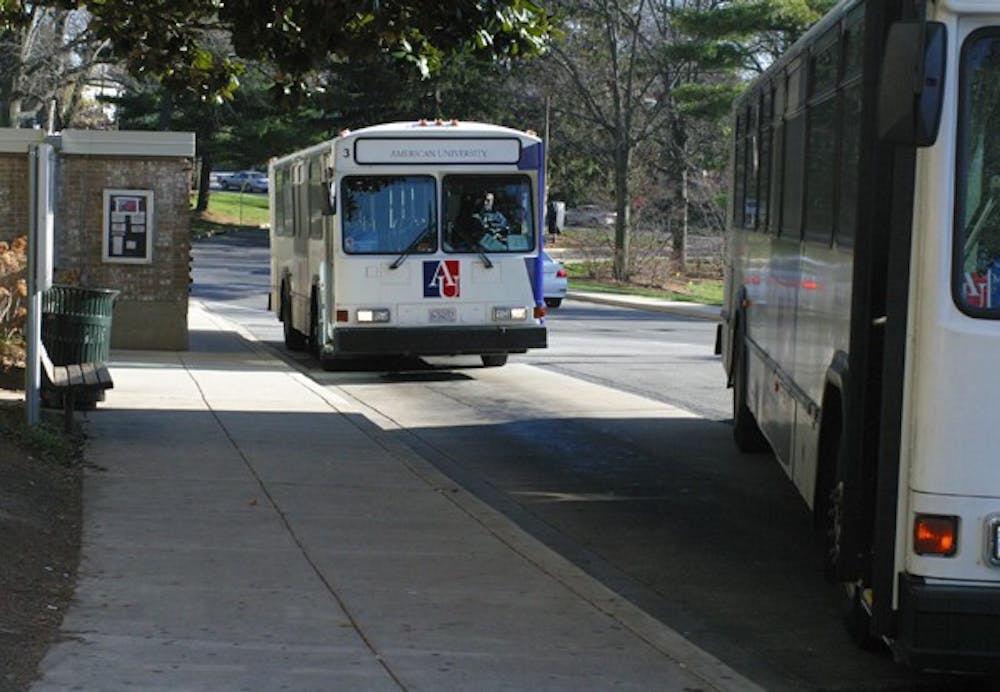
Students will soon be able to access information about the location of the AU shuttle buses online and from their cell phones.
The nine shuttles received tracking devices over the summer, and Facilities Management is now testing the system and finalizing ways for students to access the data remotely. Administrators are not sure when the system will be ready for use.
“We want confidence that our customers will be well served by the system,” said Alef Worku, the manager of Transportation Operations and Maintenance for Facilities Management. “We are working hard to get it [available] as quickly as possible.”
The devices use GPS technology to display the real-time locations of each shuttle in operation. Initial plans include a website to display these locations on a map and text messaging for estimates of the wait time before the next shuttle.
Worku estimated that the technology cost $60,000 initially, with a recurring fee of approximately $1,000 a month.
For finding the next shuttle using a text message, each shuttle stop will be numbered, and a telephone number would be posted. Riders will be able to send a text message with the shuttle stop number and receive an estimate of when the next shuttle would arrive.
Worku also hopes that tracking information can be displayed on television screens around campus.
Facilities Management has been working on the tracking project since May of 2009, when it hired Solstice Transportation Group to advise the University on reorganization of the shuttle system. Three months ago, the University selected the tracking services of InSight USA’s StreetEagle GPS for the AU shuttles.



Former Student Government President Andy MacCracken worked on improving the AU shuttle system last year and said a key advantage of the tracking tool for students is they will know how long they will have to wait for a bus.
“The perception of how long the shuttle takes is just as important as the actual timeliness,” he said. “Especially in winter, when it's cold, five minutes could seem like 10 minutes; 10 minutes could seem like 20 minutes.”
In addition to the GPS technology, Facilities Management installed an automatic passenger count system, Worku said. It enables him to track high-ridership and low-ridership periods in order to improve the bus schedule.
A long-term result of the GPS system will be the production of a schedule for bus arrival times at shuttle stops. The Facilities Management website gives estimated frequencies for each route, but exact times are not available.
“The ultimate goal is to create a schedule,” Worku said.
news@theeagleonline.com
