
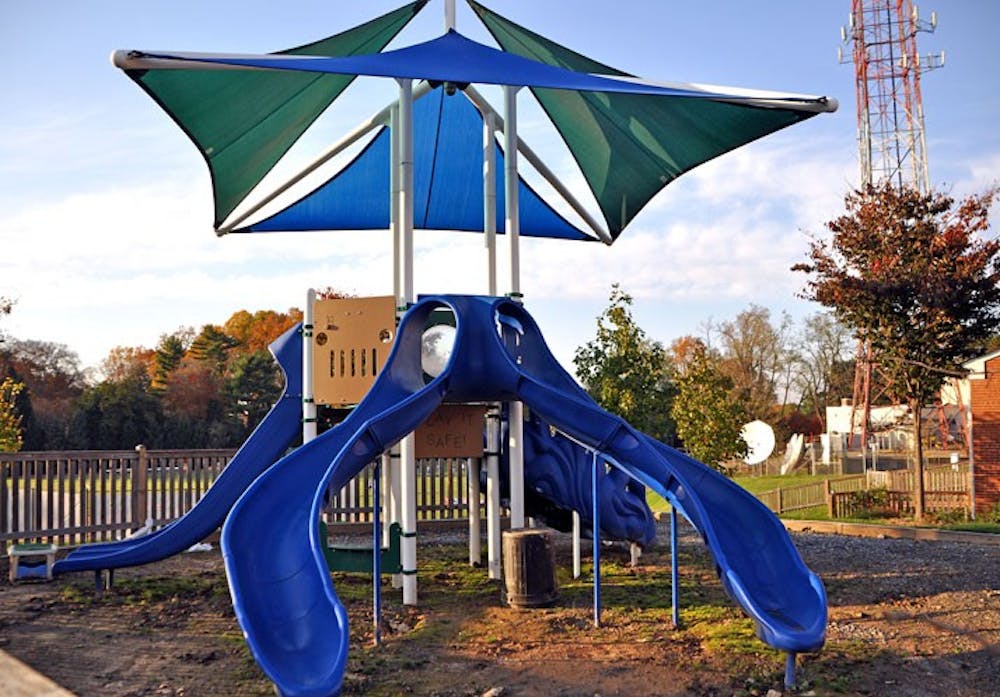
Finishing touches are being made this week to the Child Development Center’s playground, preparing it for when AU’s six-and-under crowd finally moves back in after eight years in Leonard Hall, President Kerwin’s Chief of Staff David Taylor said Monday.
The development center has been closed to the young children of AU faculty since 2001, when the Army Corps of Engineers detected elevated levels of arsenic in the soil underneath and around the building and on the adjacent intramural fields, The Eagle previously reported.
Once the playground’s current crushed tire surface is replaced with a spongier, softer surface designed to more effectively absorb impacts, a D.C. licensing agency can then evaluate if the overall facility is ready to be used once again as a day care center.
While a tentative move-in date is dependent on the swiftness of the D.C. bureaucracy, Taylor said it is possible that the children could be back on South side by winter break.
The development center has been “fundamentally ready” for some time but there has been too much Army Corps activity nearby, which had deterred administrators from moving the children back to their original location, Taylor said.
“We didn’t want to be in a situation of moving the kids back, only having to move them back [into Leonard Hall] again,” Taylor said. “We wanted to make sure everything was free and clear.”
Any move would likely take place between semesters, he said.
“It’s just a matter of finishing touches, getting the licensing done and figuring out when is the best time,” he said.


A high-priority investigation is underway at the 4825 Glenbrook Rd. property behind the Watkins building, but the development center does not lie within the Corps’ established 96-foot safety boundary.
In 2001, Corps investigations revealed that 35 percent of tested soil contained arsenic levels higher than the Environmental Protection Agency’s removal guideline level of 43 parts per million.
In some areas, these levels were as high as 498 ppm, according to minutes of a Feb. 13, 2001 meeting of the Spring Valley/Corps Community Group.
After the discovery, the development center was relocated to Leonard Hall and the Agency for Toxic Substances and Disease Registry conducted exposure investigations on development center’s children and staff.
While test results revealed “detectable levels” of arsenic in hair samples from eight of the 32 participants, the ATSDR report concluded that hair arsenic concentrations were “not elevated” in the 28 children and four adults who participated in the exposure investigation.
“All of the hair arsenic levels detected in the [Exposure Investigation] participants were within the ranges reported for unexposed populations,” the report stated, adding that background hair arsenic levels in the general population have not been well characterized.
The Corps removed contaminated soil from around the development center building, but failed to remove potentially contaminated soil from underneath the building, according to Kent Slowinski, a former Restoration Advisory Board member and Spring Valley resident.
“If there is elevated arsenic soil beneath the [Child Development Center], there could be a problem with vapor intrusion,” he said.
Vapor intrusion is when chemicals in the soil give off gas and toxic fumes. Such fumes could potentially enter a structure through cracks in the foundation, according to the Corps’ military response program manager Dan Noble.
After speaking with the university’s scientific adviser, Dr. Paul Chrostowski, Taylor said vapor intrusion does not represent a significant threat.
“Given the substantial work done on and around the site, there is no reason to suggest that ‘toxic gas’ is an issue,” he said. “In addition to the soil having been removed and replaced, not only around that building but in the adjacent areas, air monitoring and dust control [were] done throughout the operation.”
You can reach this staff writer at ccottrell@theeagleonline.com.
