
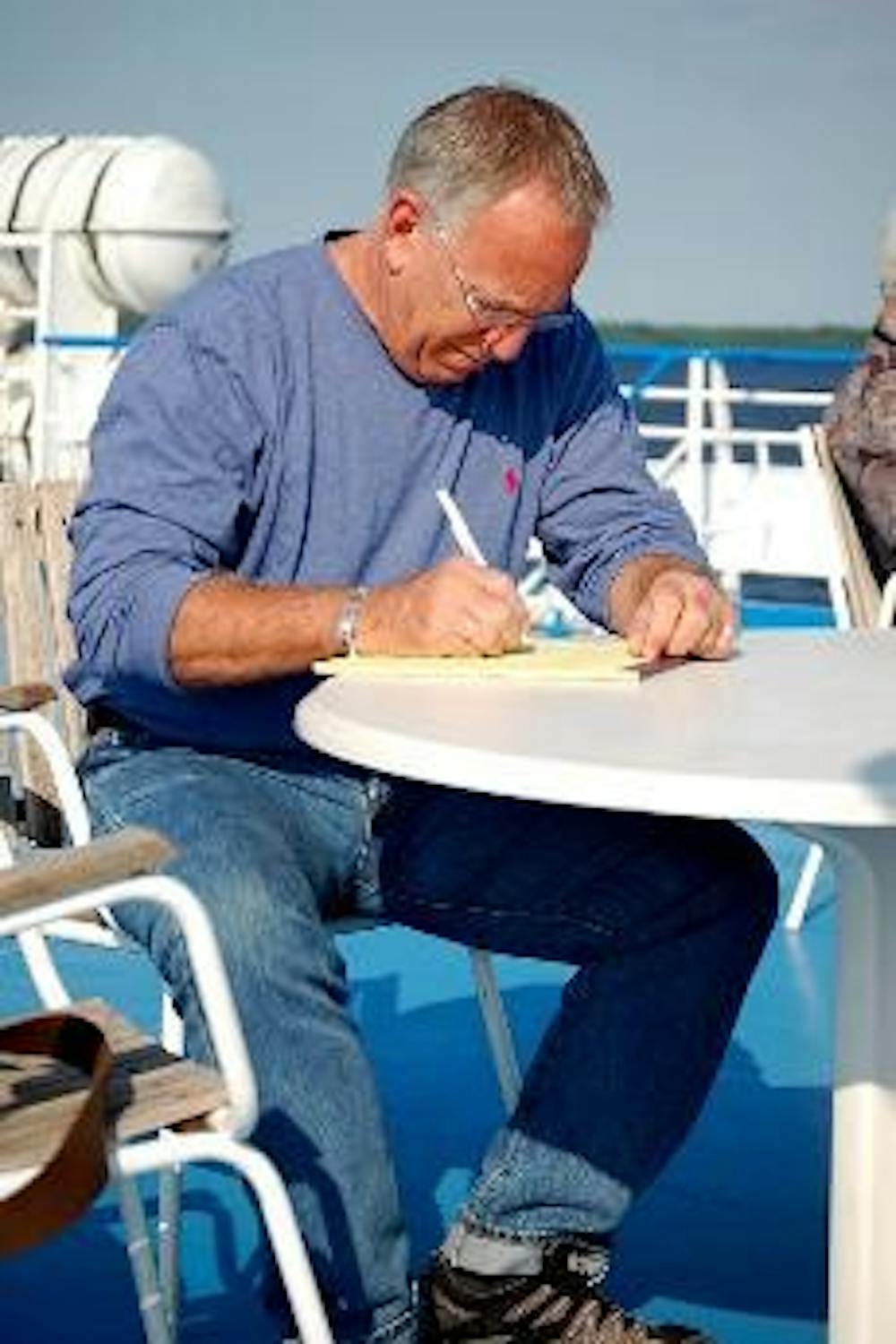
AW: Where did you grow up/where are you from? WL: I grew up in Tallahassee, Fla. - the panhandle, north Florida.Well, we moved there from Tennessee when I was 3 years old, lived there until I went to graduate school.
AW: What is your favorite way to relax after class? WL: After a long, strenuous day at the university, I either go to the gym or I go home and I sit on my deck or in my garden, and I watch the flowers. Or if it's wintertime, I sit at the window and stare out and look at my garden and imagine what it's going to look like come springtime.
AW: Would you consider gardening a hobby of yours? WL: My partner and I have 60-odd rosebushes. We have a lot of flowers. We do a lot of gardening. We do a lot of landscaping work outside, a lot of construction work outside, so working outdoors is one of the things we do both to improve the quality of the house and also because it makes the yard look nice.
AW: What area in D.C. do you live in now? WL: AU Park.
AW: Where did you attend college? WL: Florida State [University].
AW: What classes do you teach besides being the department head? WL: I teach courses in language and culture; sex, gender and culture. I teach the lesbian, gay studies, queer study courses in anthropology and sometimes, courses in public anthropology.
AW: What is your favorite aspect of AU? WL: One, I should say is the students because that's what a responsible faculty member says. The truth is my favorite thing about American U is the academic environment of the campus. Because we have an environment here that for all its shortcomings allows, I think, incredible amount of freedom of opportunity and inquiry. We have conservative groups, we have progressive groups who table next to each other on the quad, and there's not friction. We have very active young Republicans. We have very active young Democrats and maybe there is friction, but I don't hear about it. What I hear about is various points of view, and they're out there and people seem to be working very hard to create and maintain a campus where we can talk from different points of view. And not all university campuses do that. So it's not perfect, but it's an environment where people seem not to be afraid to work together in difference, and I really, really like that.
AW: If you could change one thing about the world, what would it be and why? WL: Well, I'd sure like to see a lot less homophobia, a lot less sexism. Peace in the Mid East would be a very helpful thing all the way around.


AW: What is one thing your students or colleagues don't know about you? WL: Don't know about me, when I was an undergraduate at Florida State, I managed a coffee house for two years and I was the featured singer one night a month.
AW: What kind of music did you sing? WL: Well this was the '60s, so all of us were singing folk and various kinds of protest, kind of capturing in song the work we were doing elsewhere in the community at that particular time.
AW: What is your favorite word and why; it doesn't have to be in English. WL: One of the words I use often for various points of reference is Cape Town because I had five years of field work in Cape Town, South Africa, in the '90s, and it was a very important experience for me both in terms of academic development but also in terms of understanding how the world works. So that city has kind of mystical significance, and I think about that place often, so that's an important one.
AW: If you had $1 million, what would you do first? WL: My first impulse is to say retire, though I doubt that because then I would be bored. I would certainly take care of some personal debt. I think I would make some strategic gifts to a couple of organizations that really need some financial support. Make some strategic investments so that retirement would be a little easier. There's some activities at American U that I think could use a little bit of money. I can think of a lot of ways.
