
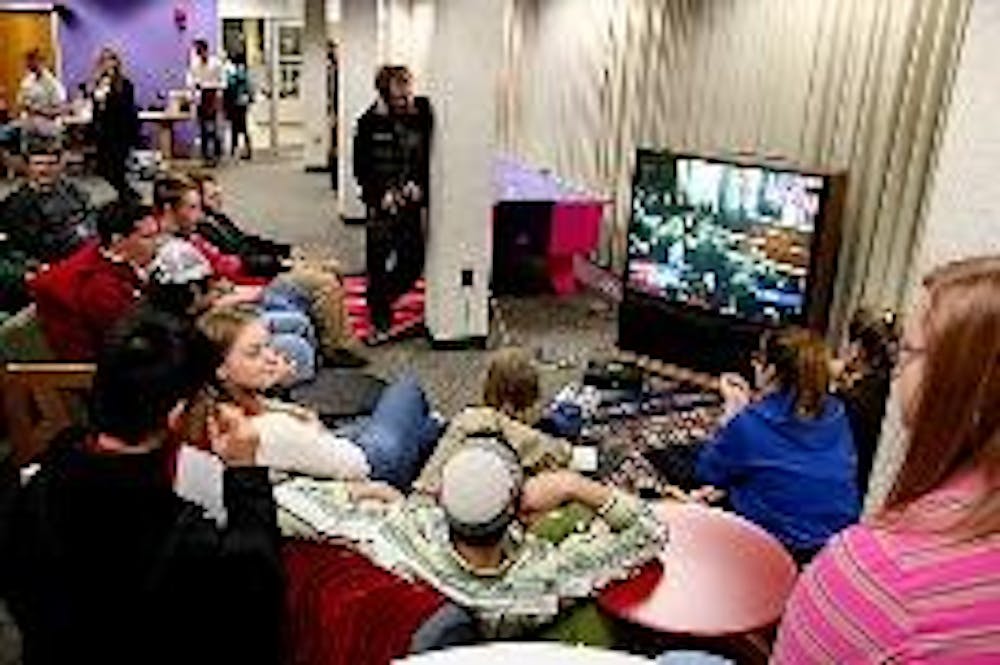
For the first time at AU, the College Democrats and College Republicans gathered together for the annual State of the Union address, as President Bush spoke before a Democratic-controlled Congress for the first time.
John Zevitas, president of College Republicans and a junior in the School of Public Affairs, said the groups were viewing the address together "in the spirit of bipartisanship."
Similarly, John Cipriani, outreach director of College Democrats and a sophomore in SPA and the College of Arts and Sciences, said he thought Bush's address was "unusually refined" and appreciated his comments about the reduction of foreign oil dependence.
Bush reiterated the idea of bipartisanship while congratulating the Democratic Party on its success in the midterm elections. He added that citizens "don't really care which side of the aisle we sit on, as long as we are willing to cross that aisle when there is work to be done."
Bush spoke to Americans about the 7.2 million jobs that have been created and the low rates of unemployment and inflation.
"The economy is on the move and our job is to keep it that way, not with more government, but with more enterprise," Bush said.
Bush addressed major economic reforms, including plans to balance the federal budget without raising taxes.
He proposed a standard tax deduction that would "level the playing field" for people who do not receive health insurance and proposed the expansion of health savings accounts.


Bush also proposed a plan to support the American "melting pot" while keeping it safe from terrorists. He said he plans to double the size of U.S. border patrol and establish a legal path to employment for immigrants.
The greatest applause from AU students came when Bush spoke about the $1.2 billion plan to combat malaria in African countries, and efforts to reduce AIDS worldwide and end violence in places like Cuba, Burma and Darfur.
"I don't think many people realize that he has given more money to AIDS relief than any other president," Zevitas said.
Bush urged diversification of America's energy sources, and said his goal is to combat global climate change by reducing gasoline usage by 20 percent in the next 10 years.
In reference to democratizing Iraq, Bush said, "To win the war on terror, we must take the fight to the enemy." He proposed an increase in active army and Marine Corps by 92,000 in the next five years.
"This is not the fight we entered in Iraq," Bush said, "but it is the fight we are in."
Cipriani said he was displeased to hear about Bush sending more troops to Iraq, and said he thinks many Democrats share his concern.
Seth Johnson, secretary of the College Republicans, a senior in SPA and former editor of The Eagle's editorial page, said he thought Bush's address was open and honest and better than his address in 2006.
"He didn't propose too many brand new ideas, but did go into more explanation about key issues," Johnson said. "He wants to work in a bipartisan manner, and I thought he was very respectful."
However, Cipriani said Bush "talked about things he has talked about before" and these past issues have never actually been fully addressed.
Zevitas said he thought Bush's address was one of his best and that it "took a lot of tension out of the air" and addressed "the whole picture" very well.
"We understand that Iraq is in shambles and that there is still much that needs to be done," Zevitas said.
